


During World War II, the United States Navy fielded more than 100 aircraft carriers and built 24 Essex-class flat-tops in just three years between 1942 and 1945. Today, the Navy is required to maintain only 11 operational carriers—and Operation Epic Fury just exposed the brutal truth that even that small number isn’t enough to handle multiple theaters at once.
The U.S. Navy Needs More Aircraft Carriers

(Aug. 8, 2017) The Nimitz-class aircraft carrier USS George H. W. Bush (CVN 77) at sea during exercise Saxon Warrior 2017, Aug. 8. Saxon Warrior is a United States and United Kingdom co-hosted carrier strike group exercise that demonstrates allied interoperability and capability to respond to crises and deter potential threats. (U.S. Navy photo by Mass Communication Specialist 1st Class Theron J. Godbold /Released)
Operation Epic Fury has highlighted the advantages of aircraft carriers in modern naval operations, but it has also exposed a major issue with the United States Navy.
Despite possessing the most expensive and technologically advanced aircraft carriers in the world, the Navy cannot currently field enough to handle multiple theatres of operation.
When assembling forces in the Middle East, the U.S. could only muster two carrier strike groups and keep them in the region for a prolonged period of time.
This lack of carriers is especially worrying for the South China Sea, where China now fields three operational carriers with a fourth on the way.
The Strengths and Weaknesses of the Aircraft Carrier
In the Middle East, aircraft carriers have proven to be valuable assets.
Unlike fixed bases, carriers operate at sea and can perform evasive maneuvers when targeted. Carriers are also escorted by multiple escort vessels, which serve as a layered air defense and electronic warfare screen.
The result is that carriers are incredibly hard to target and hit reliably. Throughout Operation Epic Fury, Iran tried multiple times to hit the U.S. carriers in the region and seemingly failed to do so. This can be attributed to the carriers’ defenses and also Iran’s limited intelligence and targeting capabilities. Regardless, American carriers have been a vital asset against Iran thus far.
At the same time, the conflict with Iran has exposed some of the aircraft carrier’s inherent limitations. Despite the largest naval buildup since the invasion of Iraq, the U.S. was unable to deter Iran and cripple its offensive capabilities effectively.
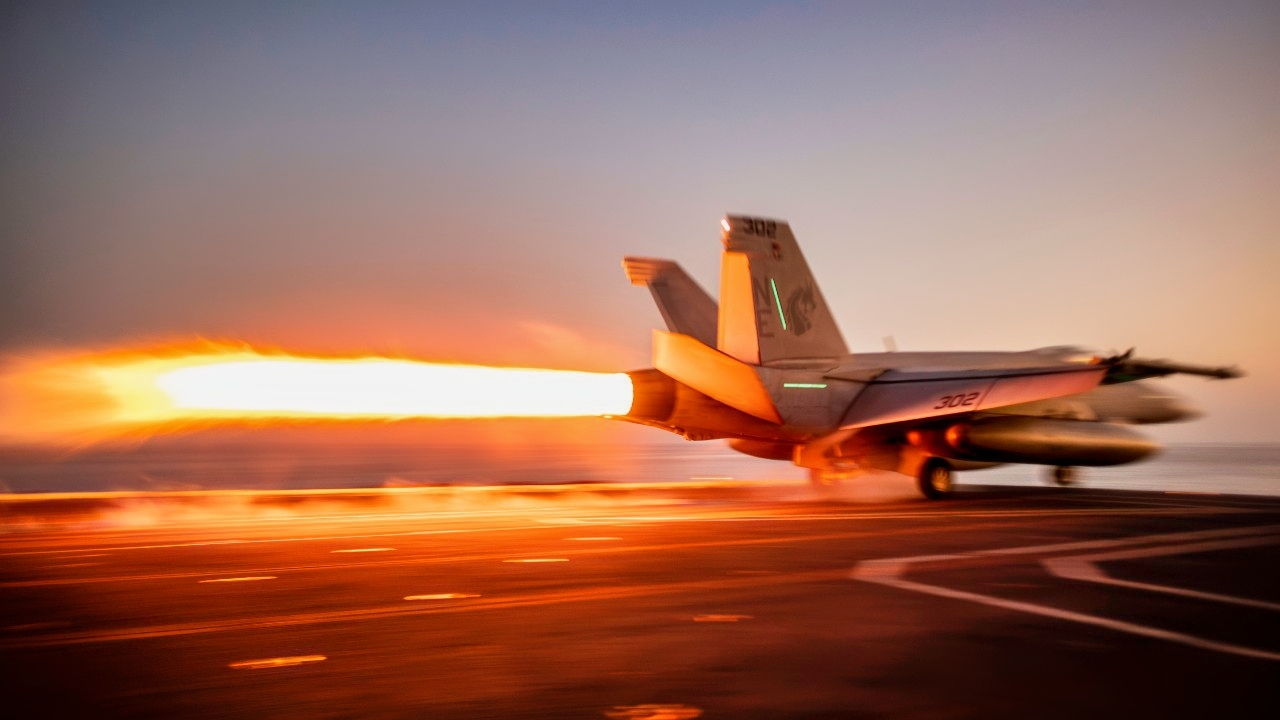
250429-N-FS097-1154 U.S. CENTRAL COMMAND AREA OF RESPONSIBILITY (April 28, 2025) An F/A-18E Super Hornet, attached to Strike Fighter Squadron (VFA) 192, launches from the flight deck of the Nimitz-class aircraft carrier USS Carl Vinson (CVN 70) in the U.S. Central Command area of responsibility. (Official U.S. Navy photo)
These issues were further compounded by the myriad problems aboard the USS Gerald R. Ford (CVN-78), which suffered from clogged sewage pipes and a lint fire that burned down a sizable percentage of the crew’s living quarters.
Despite her fatigued position, the Navy was unable to replace Ford because there were really no other options at the time. It was not until USS George H. W. Bush (CVN-77) arrived that Ford was finally allowed to return home.
Does the U.S. Need More Aircraft Carriers?
At the height of America’s naval might in World War II, the U.S. had more than 100 aircraft carriers in its service. After the war, most of these were decommissioned, with around 40 remaining in service until the 1950s.
U.S. domestic shipbuilding was also at its apex, with around 24 Essex-class carriers built between 1942 and 1945. Granted, these carriers were smaller than the supercarriers the U.S. Navy operates today and significantly less advanced, but it was still an impressive feat, especially for the time. During the Cold War, the fleet was significantly reduced, with only 15 deployable carriers in the 1990s and early 2000s.
Today, the Navy is required to maintain at least 11 operational carriers. In theory, half of these carriers can be deployed while the rest are in maintenance or used for training exercises.
In practice, however, the Navy has experienced numerous delays in its carrier maintenance programs, limiting the number of carriers in operational condition. Both the USS George Washington and the USS John C. Stennis experienced delays in their refueling and complex overhauls (RCOHs), keeping them at dock for more than a year. With Stennis wrapping up her RCOH, Harry S. Truman is slated to enter her RCOH soon, and Ford will soon undergo maintenance at her home port, which is all but certain to counter any delays.
Why the U.S. Cannot Mass-Produce Carriers Today
Unlike during World War II, the U.S. cannot simply build more carriers for several reasons. First, domestic shipbuilding is a shadow of its former self. After the end of the Cold War, the U.S. Navy reduced its fleet size considerably, leading to fewer shipbuilding orders and, naturally, a shrinking industrial base.
These issues were further compounded by the COVID-19 pandemic, which disrupted global supply chains and led to shortages of manpower and materials.
Since then, the Navy has invested significant resources in rebuilding domestic shipbuilding, but these issues will likely take years to fix. On the bright side, these measures do indicate a genuine effort by the Navy to address what is likely its biggest issue.

The aircraft carrier USS Nimitz (CVN 68) steams in the Pacific Ocean, Oct. 5, 2024. Nimitz is underway in 3rd Fleet conducting routine training operations. (U.S. Navy photo by Mass Communication Specialist Second Class Carson Croom)
The second reason the U.S. cannot churn out carriers as it once did is the age-old law of diminishing returns.
As hinted at earlier, today’s carriers are more advanced than their WWII counterparts by orders of magnitude. This, however, had the downside of making them exponentially more expensive and complex.
The Ford-class is a fine example of the best and worst aspects of the modern Navy. Pristine and sophisticated, the Ford-class carriers are the largest and most advanced carriers in the world. However, carriers have been the subject of central controversies. In development, they suffered from multiple reliability issues, which delayed the project and ballooned the program’s budget.
What Options Does the U.S. Have?
Originally estimated at around $5.1 billion, the USS Gerald R. Ford ultimately cost about $13.3 billion, more than double its original price. The next ships in the class will likely cost less once the issues in the class are resolved, but the program has already gone over budget. This does not factor in the costs of use and maintenance these carriers will incur over their lifetimes, which are likely in the multiple millions per carrier. Is this cost worth it? That depends on one’s strategic priorities.
As things stand, there are no short-term solutions to the U.S.’ carrier problems. One solution that some have proposed is to prolong carrier deployments, but that comes with its own set of problems, as Ford has so kindly demonstrated.
There is, however, a bright side. The early return of the USS Dwight D. Eisenhower (CVN-69) indicates that some areas of American shipbuilding remain functional. If the U.S. wants to build more carriers, it will need to play the long game and rebuild its domestic industry first. This will take time, but in the long run, it will yield much better results than straining the carrier fleet further.
About the Author: Isaac Seitz
Isaac Seitz, a Defense Columnist, graduated from Patrick Henry College’s Strategic Intelligence and National Security program. He has also studied Russian at Middlebury Language Schools and has worked as an intelligence Analyst in the private sector.


