

According to recent news reports, the USS Gerald R. Ford is finally making its way back to the U.S. after a staggering 316-day-long deployment. The aircraft carrier is scheduled to return to its home port in Norfolk, Virginia, where it will undergo a lengthy, much-needed period of maintenance after its long, grueling time at sea.
Ford made a lot of headlines over the past several months for its many mishaps during its prolonged patrol.

The aircraft carrier USS Gerald R. Ford (CVN 78) completes the first scheduled explosive event of Full Ship Shock Trials while underway in the Atlantic Ocean, June 18, 2021. The U.S. Navy conducts shock trials of new ship designs using live explosives to confirm that our warships can continue to meet demanding mission requirements under harsh conditions they might encounter in battle. (U.S. Navy photo by Mass Communication Specialist 3rd Class Riley B. McDowell)
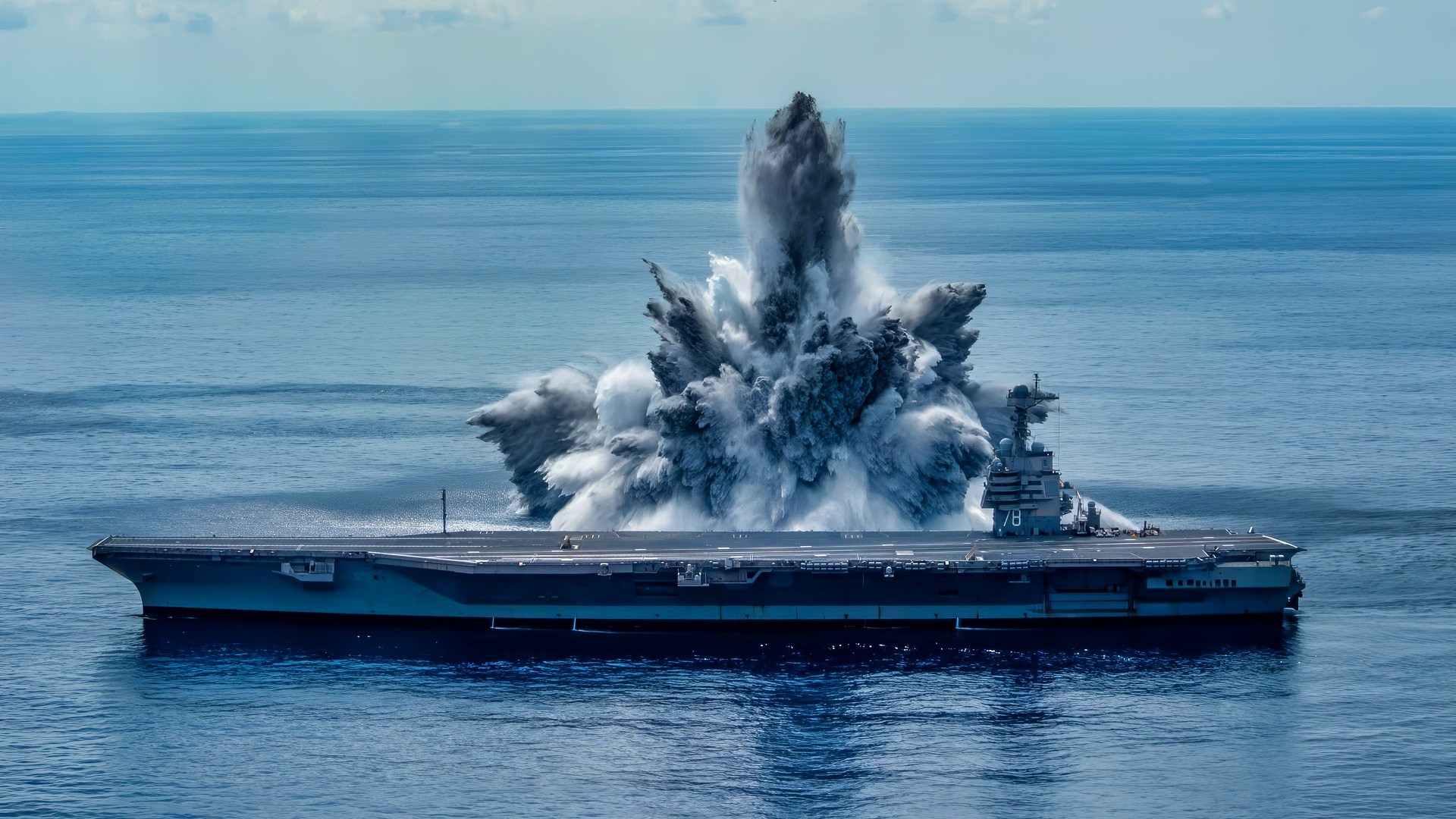
The aircraft carrier USS Gerald R. Ford (CVN 78) successfully completes the third and final scheduled explosive event of Full Ship Shock Trials while underway in the Atlantic Ocean, Aug. 8, 2021. The U.S. Navy conducts shock trials of new ship designs using live explosives to confirm that our warships can continue to meet demanding mission requirements under harsh conditions they might encounter in battle. (U.S. Navy photo by Mass Communication Specialist 3rd Class Novalee Manzella)
Suffering from plumbing issues, the onboard fire, and plummeting morale, the carrier and her crew have been pushed to their limits and are now finally getting the opportunity to rest.
Aircraft Carrier USS Gerald R. Ford Finally Returning Home
Just a week ago, the aircraft carrier was spotted transiting the Suez Canal as it made its way to the Mediterranean Sea. Officials from the U.S. Navy officially confirmed that the carrier and her weary crew were making their way back to Naval Station Norfolk, VA, after their record-breaking deployment.
She is expected to return home and receive long-overdue maintenance after her many combat operations in both Venezuela and the Middle East.
The aircraft carrier took part in combat operations alongside the USS Abraham Lincoln (CVN-72) in the Middle East region and is expected to be replaced by the USS George H.W. Bush (CVN-77), which left for its own deployment on March 31.
With the departure of Ford, two carrier strike groups (CSGs) remain in the Middle East: Abraham Lincoln and George H. W. Bush. The two nuclear carriers are expected to remain in the region as tensions with Iran remain at an all-time high despite the ongoing ceasefire.
While the carrier was on its way out, the Navy confirmed seven small Iranian boats were sunk in the region, with further reports indicating that Iran had launched its first missile/drone attacks since the ceasefire.
In addition to the two CSGs, the U.S. could also deploy the amphibious assault ships USS Tripoli (LHA-7) and USS Boxer (LHD-4) to the region to support combat operations.
Ford’s Long Deployment: A U.S. Navy Record
Ford’s long deployment began on June 24, 2025, when she first pulled out from Norfolk, Virginia. She was first expected to reinforce the naval buildup in the Middle East, joining the CSGs of USS Carl Vinson (CVN-70) and USS Nimitz (CVN-68). She was instead redirected north to the port in Oslo, Norway.
Her first deployment extension came in October of 2025, when she was sent to reinforce the naval buildup in the Caribbean Sea near Venezuela.
The CSG remained there until early February, after it had participated in the operation to abduct Maduro. The carrier had reportedly launched aircraft to support the operation, targeting defense infrastructure.

Ford-Class Aircraft Carrier. Image Credit: Creative Commons.

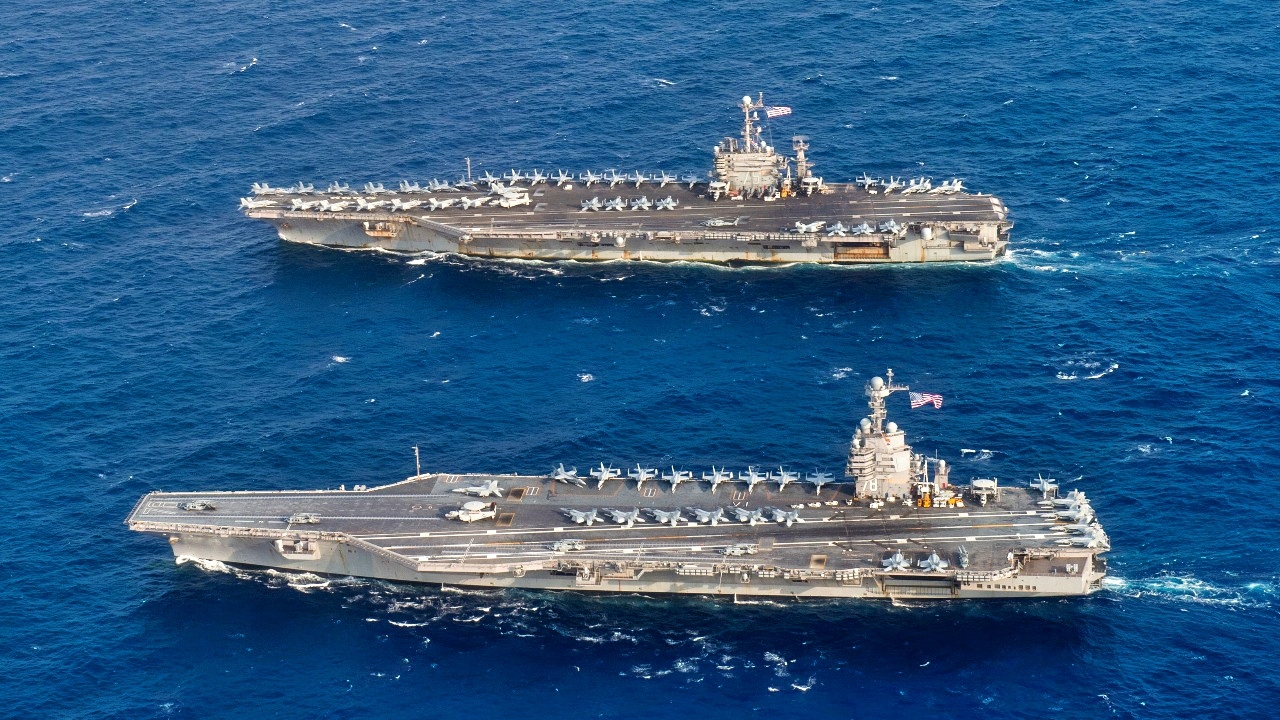
The world’s largest aircraft carrier, USS Gerald R. Ford (CVN 78) (front) and the Arleigh Burke-class guided-missile destroyer USS Bainbridge (DDG 96) participate in an integrated phase training event, March 23, 2025. The Gerald R. Ford Carrier Strike Group is underway in the Atlantic Ocean completing integrated naval warfighting training. Composite Training Unit Exercise (COMPTUEX) is the Joint Force’s most complex integrated training event and prepares naval task forces for sustained high-end Joint and combined combat. Integrated naval training provides America’s civilian leaders and commanders highly-capable forces that deter adversaries, underpin American security and economic prosperity, and reassure Allies and partners.(U.S. Navy photo by Mass Communication Specialist 2nd Class Maxwell Orlosky)
By February 2026, the carrier had been deployed for 9 months and was showing early signs of fatigue.
The crew then received word that their deployment was extended yet again and that they would be sent to the Middle East. Not long after, reports surfaced that the carrier had experienced plumbing issues, leading to sewage flooding.
These reports circulated before the carrier had even reached the Middle East. To be fair, clogged sewage pipes have historically been a problem with many surface ships, but as the U.S.’ most advanced carrier, Ford’s issues drew more eyes. The carrier then reached the Middle East, where it partook in combat operations against Iranian military installations as part of Operation Epic Fury.
Things went from bad to worse for Ford when a lint fire injured around three crew members. The fire had raged long enough for more than 600 crew members to have their bunks and personal belongings destroyed.
Throughout the entire incident, the carrier continued to launch combat missions. The ship briefly left for emergency repairs at Creete Naval Base in Greece, where she received mattresses from Ford’s sister ship, John F. Kennedy, which is still under construction. Rather than being sent home, the ship was returned to the Middle East to resume combat operations.
Why the Navy Couldn’t Replace Ford
At this point, the crew aboard Ford was reaching their breaking point. After around ten months at sea, the crew was exhausted and could only communicate with their loved ones for short periods.
The plumbing issues aboard the carrier, along with the fire, had severely degraded the crew’s quality of life, leaving them exhausted. These issues persisted while the carrier was in active combat operations and taking fire from Iranian missiles and drones. In late March, Ford was sent to Croatia for further repairs, but by then, it was clear that the carrier needed more comprehensive maintenance to address its major issues. She was then sent back to the Middle East for further combat operations before the Navy finally ordered her to return home in May.
As a Ford-class carrier, Gerald R. Ford represents the most advanced ship in the U.S. fleet, boasting better navigation systems, advanced launch and recovery systems, and larger hangar space.
This, however, makes Ford’s multiple hiccups on her last deployment even more surprising. The poor treatment of the carrier and her crew reflects poorly on the U.S. Navy and the leaders who continually extended her deployment despite signs of fatigue.
While Operation Epic Fury was supposed to be a show of force, Ford’s floundering instead projected a sense of desperation on the Navy’s part, which struggled to mass enough forces in the region for the operation.
With John C. Stennis (CVN-74) still in her RCOH, and Harry S. Truman (CVN-75) preparing to enter her RCOH, the Navy was short on carriers to send to Iran, and thus it had no choice but to extend Ford’s deployment at the expense of the ship and the crew.
About the Author: Isaac Seitz
Isaac Seitz, a Defense Columnist, graduated from Patrick Henry College’s Strategic Intelligence and National Security program. He has also studied Russian at Middlebury Language Schools and has worked as an intelligence Analyst in the private sector.


