

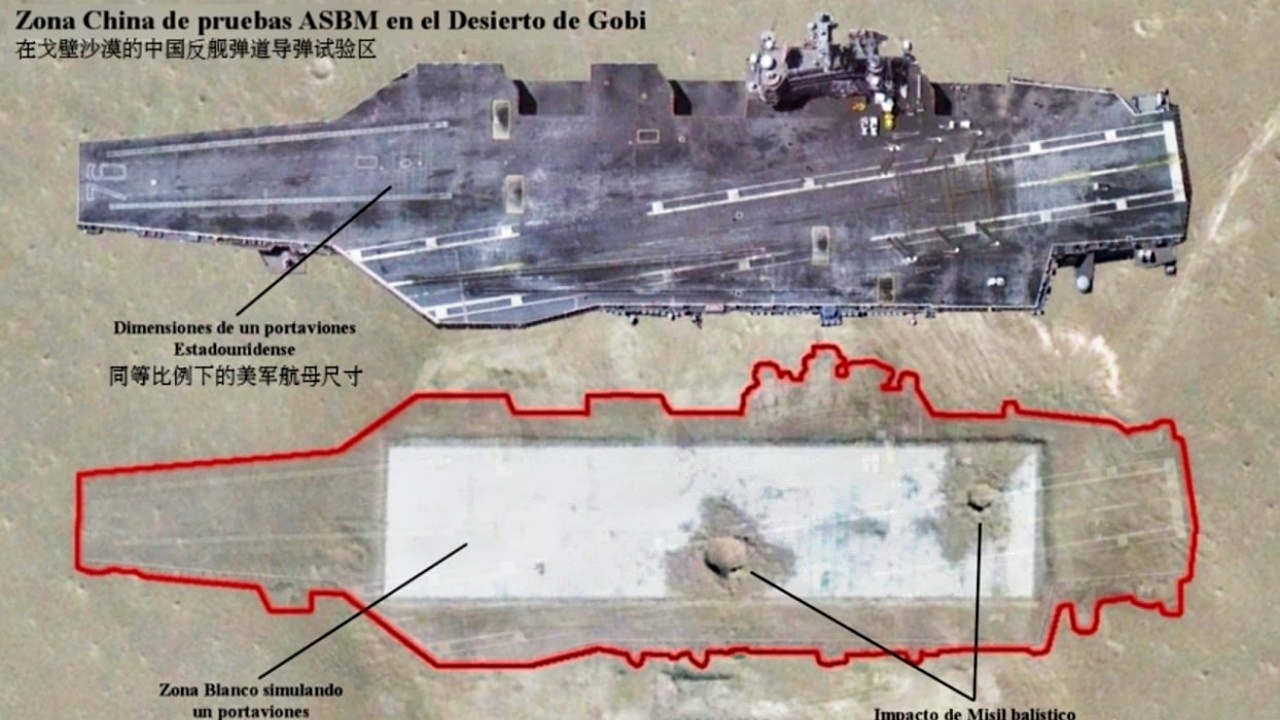
China’s missile arsenal now reaches every U.S. base in the Pacific. The DF-26, dubbed the Guam-Killer by U.S. analysts, is a conventionally armed intermediate-range ballistic missile that can sink an aircraft carrier or strike Andersen Air Force Base on Guam. The DF-17 carries a hypersonic glide vehicle, has performed extreme evasive maneuvers in testing, and ranges 1,800 to 2,500 kilometers. The DF-27, which the Pentagon has been tracking since 2021, ranges 5,000 to 8,000 kilometers — far enough to hit Hawaii, Alaska, and the U.S. West Coast. All three can carry either conventional or nuclear warheads.
China’s Missiles Mean Chaos for the U.S. Military

USS Carl Vinson Aircraft Carrier. Image Credit: Creative Commons.
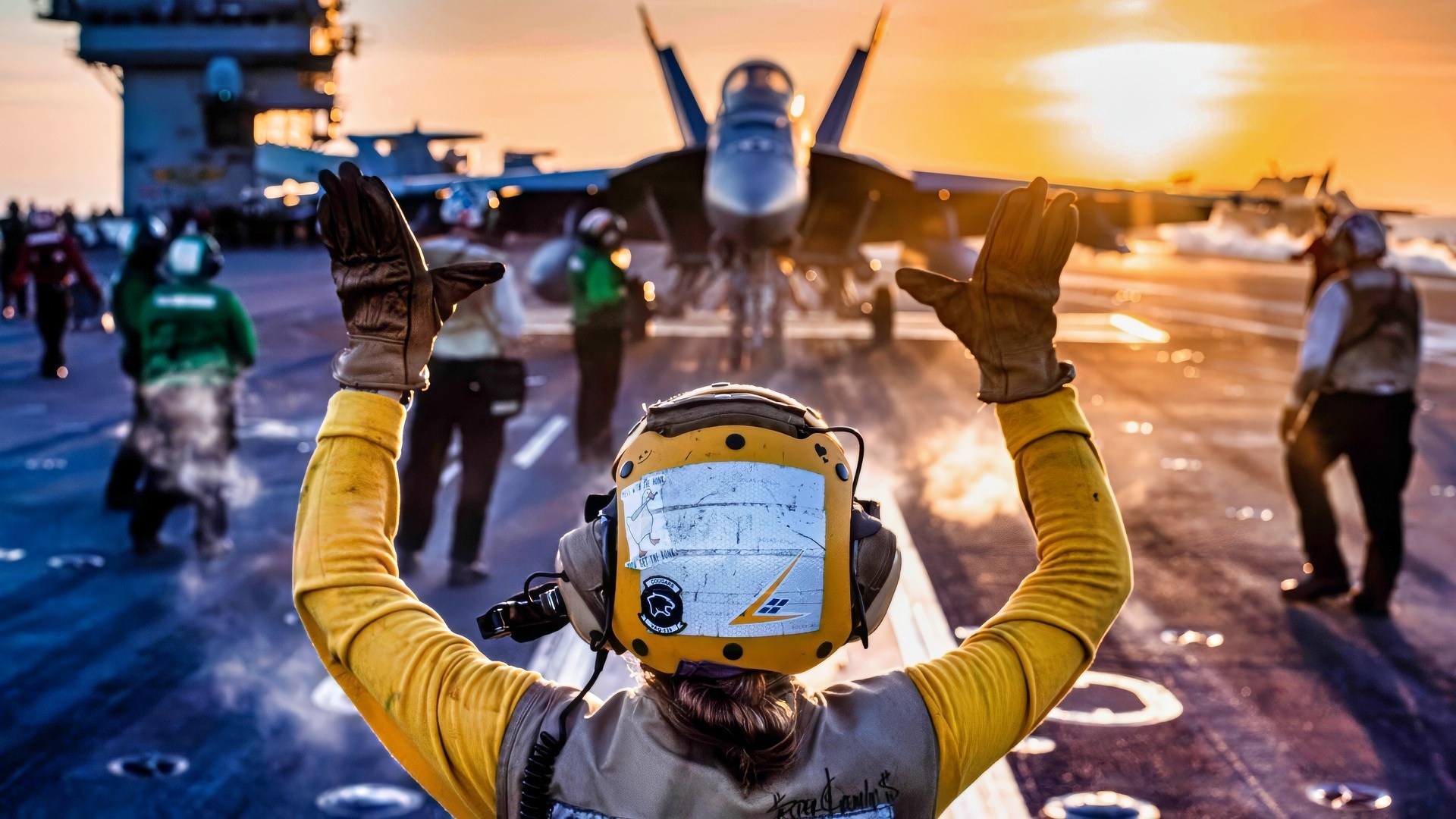
U.S. Navy Aircraft Carrier Training. Image Credit: Creative Commons.
The DF-26 is the first conventionally-armed IRBM capable of reaching the U.S. territory of Guam, including Anderson AFB. American analysts have dubbed the missile the “Guam-Killer.”
The DF-26 anti-ship ballistic missile variant can rapidly be swapped with conventional and nuclear land-attack warheads. It is capable of nuclear precision strikes, potentially with low-yield optionality.
Dubbed the “Guam Killer”, it is “enough to send all the American aircraft carriers within and beyond the Second Island Chain to the bottom of the sea”, said Yangtse Post military commenter Chen Gwangwen.
This capability could prove critical in a regional conflict because China could effectively strike the U.S. base with conventional warheads, without escalating to the use of nuclear weapons.
And the DF-17, China’s most dangerous missile, which deploys a hypersonic glide vehicle (HGV).
The Dongfeng-17 (DF-17) is a solid-fueled, road-mobile medium-range ballistic missile (MRBM) equipped with a hypersonic glide vehicle (HGV), designed for high-speed, maneuvering flight to evade defense systems. It has a range of 1,800–2,500 km and is capable of carrying conventional or nuclear warheads.
China’s numerous DF-17s carry hypersonic glide vehicles to evade U.S. and allied radar and ballistic missile defenses. “The DF-17 has demonstrated a high degree of accuracy in testing, with one U.S. government official saying a test warhead “within meters” of its intended, stationary target. U.S. defense officials have also said the DF-ZF HGV performed “extreme maneuvers” and “evasive actions” in previous test flights,” a CSIS Missile Threat essay says.
China’s DF-27 Can Possibly Reach The West Coast Of the US
In late December, the Pentagon, in its annual publication on Chinese military power, claimed that Chinese missile forces are operating a new type of anti-ship ballistic missile capable of reaching the West Coast of the United States.
While China has not revealed the system’s existence, the Pentagon has been monitoring the DF-27’s development since 2021.
“Official PRC writings indicate this range-class spans 5,000-8,000km,” the Pentagon 2022 report stated, and again in 2023.
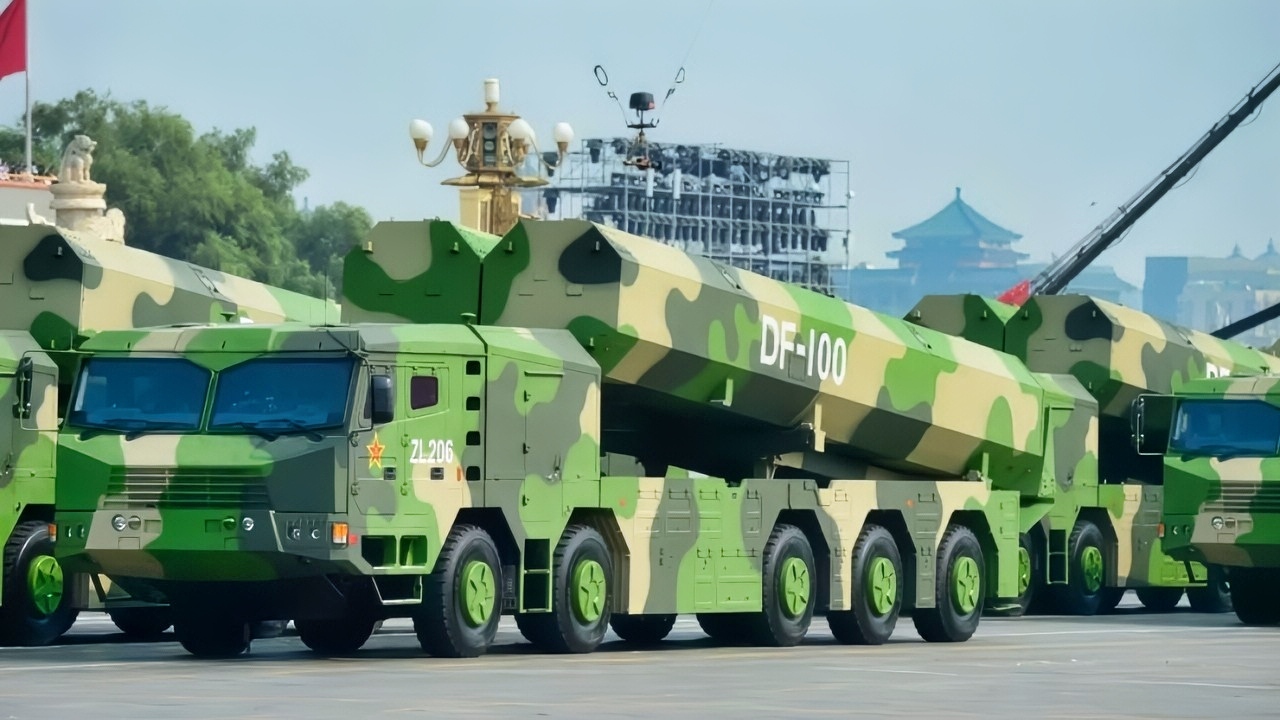
DF-100 Missiles: X Screengrab.
On page 89 of the 2024 report, the Pentagon warned, “The DF-27 may have an HGV [hypersonic glide vehicle] payload option in addition to conventional land-attack, conventional antiship, and nuclear payloads.
The PRC probably is developing additional advanced nuclear delivery systems, such as a strategic HGV and a FOB [fractional orbital bombardment] system.”
The DF-27 (Dongfeng-27) is a conventionally armed, long-range hypersonic glide vehicle (HGV) and ballistic missile operated by the People’s Liberation Army (PLA) of China.
With an estimated range of 5,000 to 8,000 km, it acts as a conventional ICBM/anti-ship ballistic missile (ASBM) capable of targeting U.S. bases in Hawaii and Alaska, as well as aircraft carriers and other ships.
Andrew Erickson wrote, “China today has the world’s most active and diverse ballistic missile development program, rapidly producing and fielding purpose-built systems at staggering scope and scale.
“With the world’s largest organizational system for acquiring and applying technology by all means possible, as well as the world’s largest defense industrial base by key measures, Beijing is able to translate doctrine into deployment with remarkable speed.”

DF-31 Map Chinese ICBM Missiles. Image Credit: Creative Commons.
Carriers and Airfields Are Prime Targets
The Chinese ballistic missiles will also be targeted against U.S. military runways and taxiways in Japan, Guam, and other Pacific islands in the event of a Taiwan invasion to impede American airpower.
In a new Stimson Center report, “Cratering Effects: Chinese Missile Threats to US Air Bases in the Indo-Pacific,” the Chinese will attack US airbases and crater the runways and taxiways, basically ceasing air operations for days if not weeks.
The essay’s main point is that to restore its ability to project air power early in a war, the United States will need to outthink—not outspend—the PLA. The sobering message is that American air bases “can no longer be considered a sanctuary.”
The U.S. is exploring ways to counter the A2/AD strategy by using submarines and unmanned systems, and by dispersing forces across a broader area to complicate Chinese targeting.
Defending A Taiwan Invasion Would Be Daunting For The US
The Chinese strategy of denying US carriers access to the First Island Chain has been ongoing and developing since the Taiwan Strait Crisis, over 30 years ago. That strategy, along with its military capabilities, has been modernized to make war in the Indo-Pacific a difficult proposition for US war planners.
Beijing’s plan is to force the US to operate its carriers from much farther away, thereby weakening its response and reducing its sustained presence.

DF-41 ICBM from China. Image Credit: Creative Commons.
However, the US Navy and Air Force would target Chinese carriers and landing ships needed for an invasion. That in itself would be a problematic scenario for the Chinese to overcome.
Xi Warns Trump On Taiwan
However, last Thursday, despite a ton of pageantry and symbolism, Chinese President Xi warned President Trump that the two countries could clash over Taiwan if the issue is not handled properly.
Xi expressed his hope that the U.S. and China could avoid conflict and asked: “whether the two countries can transcend the ominous ‘Thucydides Trap’ and forge a new model for relations between major powers.”
The DF-27 represents the Chinese PLAN’s continued development of increasingly complex and capable area-denial systems, an area Beijing has invested in to deter and defeat the blue-water naval forces of its adversaries before they can be brought to bear against Chinese forces.
Erickson said the DF-27 has “dramatically changed the naval balance” between Washington and Beijing.
“Although the United States and its allies possess manifold countermeasures in what would be a complex systems-of-systems contest, there is no denying that, by becoming the first major ASBM power and steadily expanding its ASBM families, China has dramatically changed the naval balance and the prospective ways of war in the Western Pacific and beyond,” Erickson added.
About the Author: Steve Balestrieri
Steve Balestrieri is a National Security Columnist. He served as a US Army Special Forces NCO and Warrant Officer. In addition to writing on defense, he covers the NFL for PatsFans.com and is a member of the Pro Football Writers of America (PFWA). His work was regularly featured in many military publications.


