


The M551 Sheridan was one of the strangest armored vehicles ever fielded by the US Army. Entering service in 1967, the M551 was a lightweight airborne assault/reconnaissance vehicle that combined parachute deployability, anti-tank firepower, and amphibious capability. Perhaps like no other Army vehicle, the M551 embodied the ambitions of Cold War engineering—but proved impractical in the field.
Why the M551 Existed
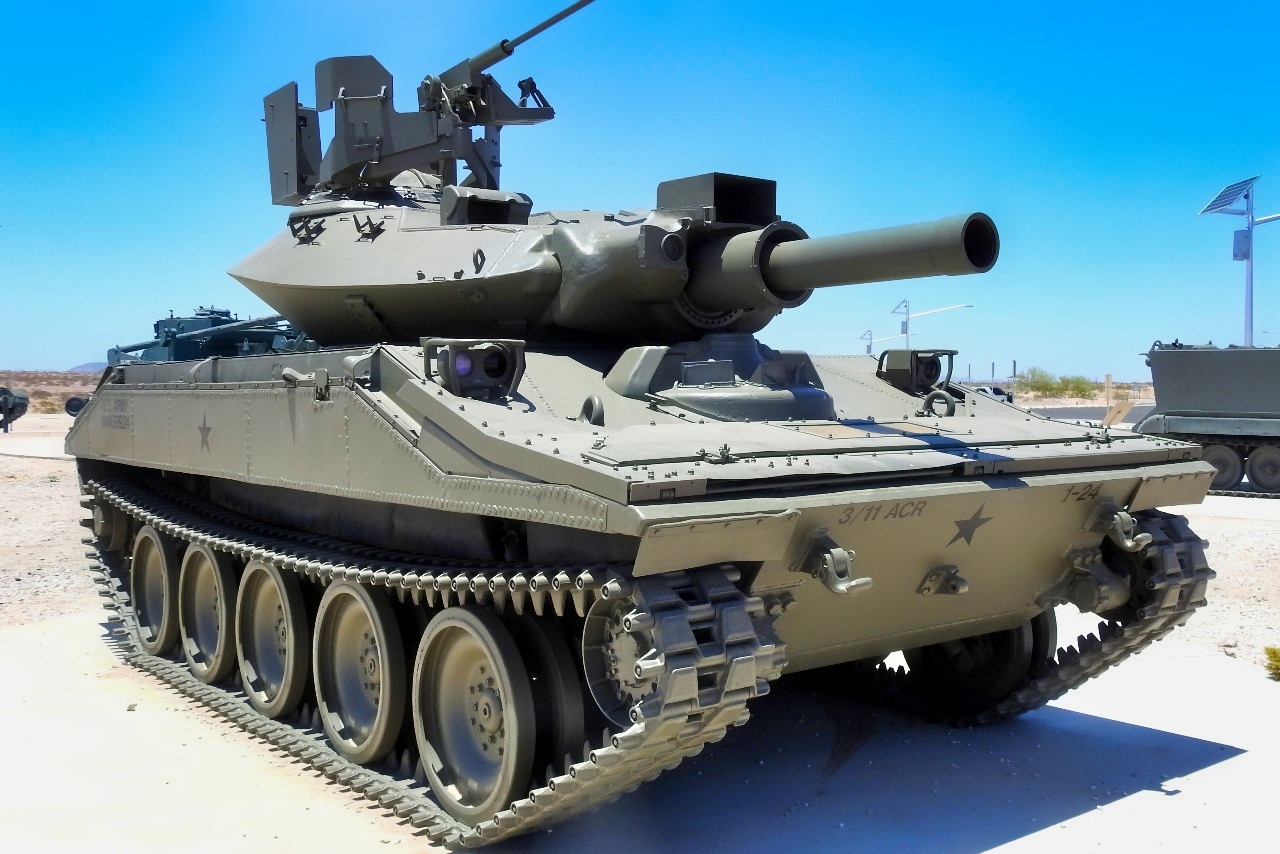
M551 Sheridan Light Tank. Image Credit: Creative Commons.

M551 Sheridan U.S. Army. Image Credit: Creative Commons.
During the Cold War, the US was concerned with the threat that Soviet armor posed in Europe.
Airborne forces, after landing, lacked the heavy firepower needed to counter Soviet armor; the Army wanted a vehicle light enough to be parachuted from cargo aircraft but powerful enough to destroy tanks and bunkers.
The target weight for the vehicle was 15 tons, which is dramatically lighter than that of main battle tanks, to be deployed rapidly in support of airborne infantry and cavalry reconnaissance units. Essentially, the M551 was designed to give airborne troops their own “mini tank.”
The 152mm Gun
The M551’s main weapon was an M81 152mm smoothbore gun/launcher that fired either standard shells or MGM-51 Shillelagh guided missiles.
This versatility paired a more traditional anti-tank gun with guided missiles, which offered long-range anti-tank kill capabilities from a lightweight platform using a SACLOS guidance system. The system sounded great on paper, but in practice, there were complications.
The electronics, for example, were delicate and unreliable. And the recoil was so intense that it frequently damaged components.
Attempting to merge artillery, missile launchers, and tank capabilities into a single platform was highly ambitious, but the effort was made decades before the necessary technology was mature enough to support it.
Problems in Practice
The recoil, in particular, was notable. The 152mm gun generated enormous recoil force, but the vehicle’s chassis was only 15 tons.
The result was that the front tracks were sometimes lifted clear off the ground while internal systems were violently shaken. Even the crew reportedly sustained injuries on occasion. Missile guidance hardware and vacuum-tube components were not strong enough to withstand the recoil effects.
The M551 also had a problem with its ammunition. The Army eliminated traditional brass shell casings, opting instead for combustible nitrocellulose cases.
This was to save weight and space. However, the nitrocellulose cases absorbed jungle moisture, swelling, cracking, and leaking powder inside the vehicle.
Hot residue would remain inside the breech after firing, and the next round could ignite prematurely, creating a backfire danger.
To fix the problem, the Closed Breech Scavenging System (CBSS) was implemented, using compressed air to purge burning debris from the barrel. It worked, only it also slowed the fire rate to roughly two rounds per minute.
The aluminum hull was another problem.
Constructed from 7039 aluminum alloy to minimize weight for parachute deployment, the M551 could be air-dropped from C-130s. Yet the weight-saving aluminum armor was far too thin to withstand RPGs or mines.
Mine blasts during Vietnam ruptured hull floors; sparks and exposed propellant triggered catastrophic fires. And aluminum, which burns intensely at high temperatures, compounded the problem.
So the weight savings that made the Sheridan deployable from the air also made it dangerously fragile in combat.
End of the M551
The M551 was widely used in Vietnam for cavalry and fire support and remained in service during the Panama and Gulf Wars.
The M551 wouldn’t be retired until 1996; despite the platform’s flaws, crews valued the Sheridan’s mobility and firepower, especially for airborne operations.
And though the Army had intended to replace the M551 with the M8 Armored Gun System (AGS), the end of the Cold War led to Clinton-era defense cuts that killed the program in 1996.
The Army’s doctrine shifted, too, toward wheeled vehicles and the Stryker concept.
More recently, the Army has been experimenting with the M10 Booker, which features a mobile fire support concept.

A live fire demonstration of the Army’s newest and most modernized combat vehicle, the M10 Booker, marks the conclusion of the M10 Booker Dedication Ceremony at Aberdeen Proving Ground, in Aberdeen, Md., April 18, 2024. (U.S. Army photo by Cpl. Jonathon Downs)
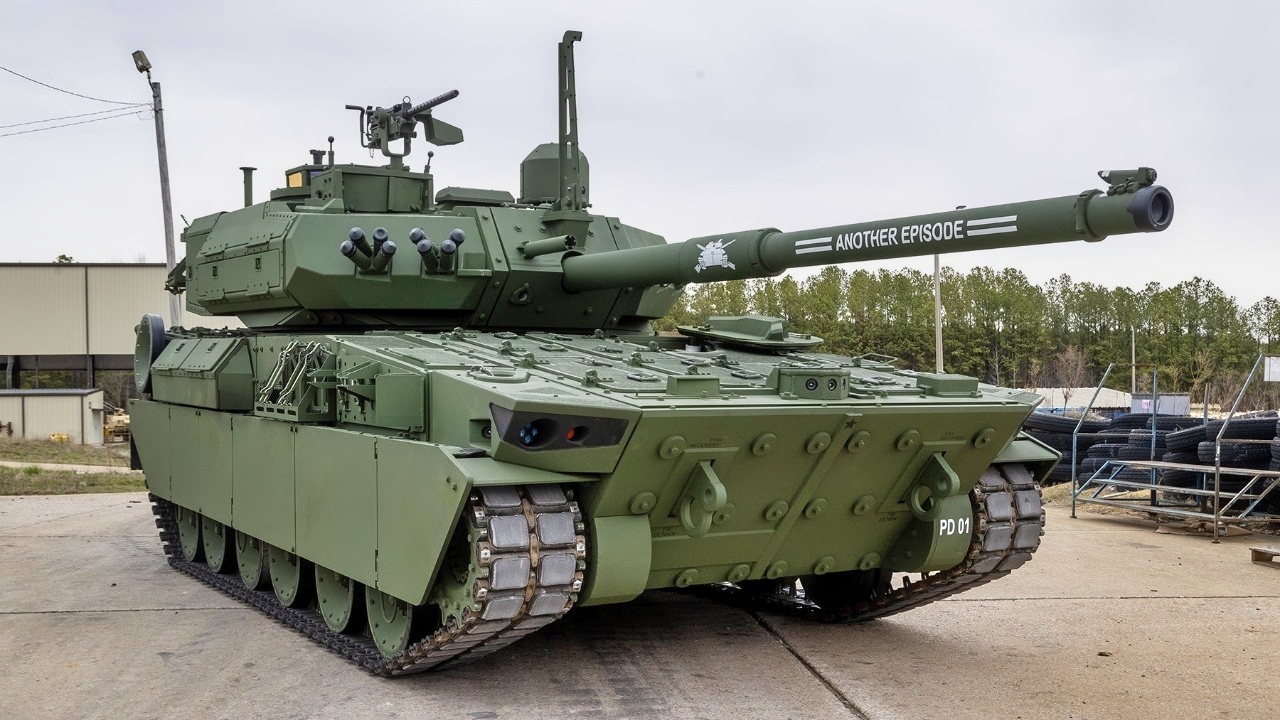
PD1 – Delivery of First Production Vehicle M10 Booker Combat Vehicle. Image Credit: U.S. Army.

The M10 Booker Combat Vehicle proudly displays its namesake on the gun tube during the Army Birthday Festival at the National Museum of the U.S. Army, June 10, 2023. The M10 Booker Combat Vehicle is named after two American service members: Pvt. Robert D. Booker, who posthumously received the Medal of Honor for actions in World War II, and Staff Sgt. Stevon A. Booker, who posthumously received the Distinguished Service Cross for actions during Operation Iraqi Freedom. Their stories and actions articulate the Army’s need for the M10 Booker Combat Vehicle, an infantry assault vehicle that will provide protection and lethality to destroy threats like the ones that took the lives of these two Soldiers. (U.S. Army photo by Bernardo Fuller)
The difference was that the M10 is too heavy for parachute operations.
So the airborne’s armored firepower problem is still not fully solved, decades after attempts to solve it with the M551. Regardless, the M10 has been canceled, again leaving the Army without an M551 successor.
For all its flaws, the Sheridan represented a problem the Army still struggles to solve: giving airborne troops real armored firepower without sacrificing mobility.
About the Author: Harrison Kass
Harrison Kass is a writer and attorney focused on national security, technology, and political culture. His work has appeared in City Journal, The Hill, Quillette, The Spectator, and The Cipher Brief. He holds a JD from the University of Oregon and a master’s in Global & Joint Program Studies from NYU. More at harrisonkass.com.


