

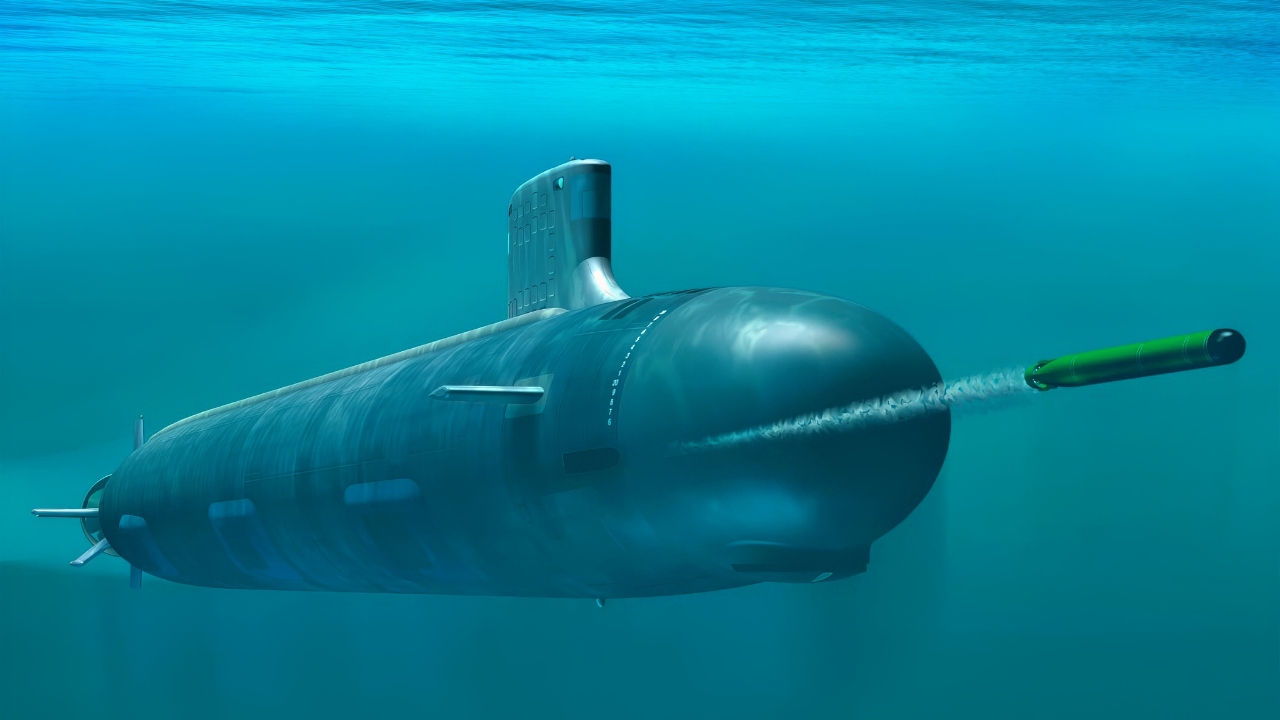
Rear Admiral Mike Brookes testified to the U.S.-China Economic and Security Review Commission in March that Beijing is building an undersea Great Wall of sensors — integrating air, surface, seabed, and undersea systems into a networked architecture designed to track American submarines and push them out of contested waters. China’s Blue Ocean Information Network combines a seabed sensor grid with satellite imagery from the Ocean Star Cluster, smart buoys, wave gliders, autonomous underwater vehicles, and the Deep Blue Brain data integration system. Non-acoustic detection technology can spot U.S. submarines through the magnetic field disturbance caused by their steel hulls. The U.S. Navy plans to use manned subs as quarterbacks for Unmanned Underwater Vehicles to survive.
No More Stealth U.S. Navy Submarines?

Type 093B Submarine from China. Image Credit: Screengrab.
Is the era of U.S. Navy stealth submarines dominating the seas over?
The “Silent Service” has enjoyed a huge advantage for decades.
These subs run quietly and run deep and can attack anywhere in the world at any time.
However, China has a vote in the underwater fight. The Chinese now have a “Great Wall” of sensors that can sniff out an American sub’s location and track it wherever it goes. This capability is often overlooked when assessing the U.S. Navy’s ability to deploy its submarines in the Indo-Pacific.
But now China could have a greater advantage in anti-submarine warfare.
Someday, the American subs will have no place to hide in the East and South China Seas.
They could even be stopped from patrolling the Taiwan Strait at will, which would give the Chinese a great advantage should they mount an amphibious attack against Taiwan.

China SSN Submarine. Image Credit: Creative Commons.
The Power of Manned and Unmanned Sumbarines
The U.S. Navy still believes it has a tactical advantage with its submarines and even hopes its force of nuclear-powered boats could run unmanned-manned teaming arrangements with Unmanned Underwater Vehicles (UUVs).
The crewed subs can serve as UUV quarterbacks, aiming to improve survivability for hunter-killer attack submarines and ballistic-missile SSBN boomer submarines.
China’s Great Wall of Sensors
Meanwhile, China is developing a multi-layered defense known as the undersea “Great Wall” to keep American submarines and future UUVs from operating with impunity.
As Asia Times has reported, American naval officers are concerned that China’s ability to detect and track U.S. submarines could erode their stealth advantage.
What Is ‘Systems Confrontation?’
Rear Admiral Mike Brookes appeared in front of the US-China Economic and Security Review Commission in March. Brookes believes China has a new strategy of underwater defenses he calls “systems confrontation.”
Asia Times described systems confrontation as the integration of “air, surface, seabed, and undersea sensors into a networked architecture to control key maritime areas and compel adversary submarines to withdraw.”

Virginia-Class Submarine Firing. Image Credit: Creative Commons.
Sharpening the Assassin’s Mace Weaponry
Undersea sensors can also be described as “Assassin’s Mace” technologies that counteract a stronger naval undersea force with asymmetric capabilities. The Chinese can thus keep the Americans from sending their subs into areas of the ocean the People’s Liberation Army Navy (PLAN) considers its own.
The Blue Ocean Information Network
Brookes also discussed the “Blue Ocean Information Network.” This is a “seabed sensor grid [used] to erode U.S. stealth advantages, complicate US undersea operations, and enable persistent surveillance across the South China Sea and beyond,” as the Rear Admiral explained in his testimony.
Non-Acoustic Detection Technologies
My colleague Kris Osborn reviewed an article from the Navy Submarine League called the “Non-Acoustic Means of Submarine Detection.” China could be basing its Great Wall of sensors on what this essay uncovered.
There are non-acoustic detection technologies that could give the Chinese an advantage in discovering American submarines. These devices can measure disturbances in the Earth’s magnetic field.
“As a large piece of ferrous metal, the steel-hulled submarine causes a local disturbance,” the authors explained.
This means American submarines could still be detected because their acoustic signature is not entirely eliminated.
“Submarines contain a large amount of metal that becomes magnetized in the course of normal operations. The permanent magnetic field associated with the submarine remains until active measures are used to demagnetize it,” the Naval Submarine League essay declared.
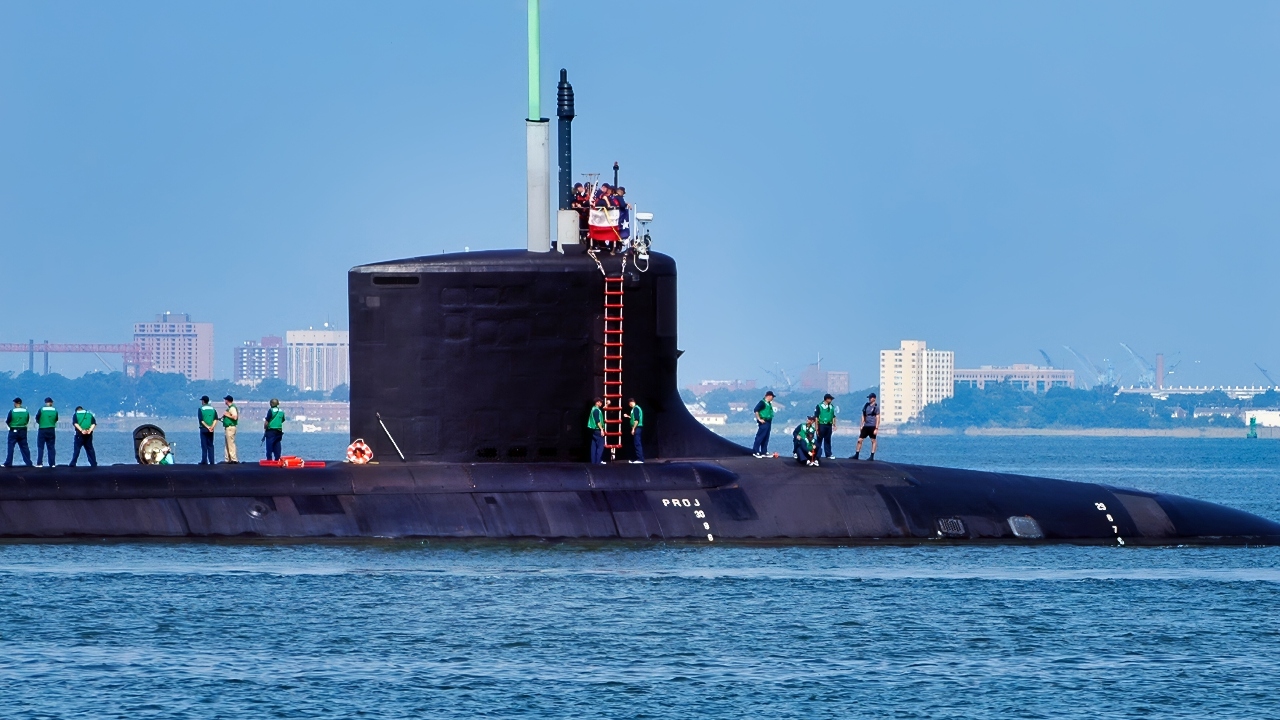
Norfolk, Va. (Aug. 22, 2006) – Sailors stationed aboard the Pre Commissioning Unit (PCU) Texas (SSN 775) stand topside as she gets underway from Naval Station Norfolk.
Looking at Subs With the Ocean Star Cluster
Asia Times also pointed out that analysts Tye Graham and Peter Singer, writing in Defense One, have identified a Chinese anti-submarine warfare practice that uses a layer of satellite imagery on top, called the “Ocean Star Cluster.”
“Below the Ocean Star Cluster, Graham and Singer claimed that the ‘Air-Sea Interface’ layer employs smart buoys, wave gliders, and unmanned surface vessels as relays. Beneath that, they observe that ‘Starry Deep Sea’ deploys floats, gliders, and autonomous underwater vehicles, while ‘Undersea Perspective’ incorporates seabed observatories and cabled hubs.” Graham and Singer added that the “Deep Blue Brain integrates and manages data across domains.”
Is China Really That Good?
Now that is one complicated system that could be overstated and may be vaporware. China may not have that concept fully deployed, but it would be a formidable deterrent against U.S. submarines if fully developed.
The Americans Can Still Be Superior in Undersea Combat
I’m skeptical about Chinese anti-submarine warfare, though.
There are certainly many people in China studying the subject. They have expertise in STEM fields that produce some of the world’s top thinkers.
But U.S. sailors on submarines are highly trained and expert at their jobs. They know how to run a boat that can counteract Chinese sensors, no matter how advanced they are.
So, my money is still on the U.S. Navy’s submarine force, which can be stealthier than anything the Chinese try to develop to counter it. Yes, the PLAN is catching up in anti-submarine warfare with new systems.
But they are untested in combat, and the U.S. Navy is aware of innovative tactics and operational art that could put its boats at risk.
We’ll keep an eye on this Great Wall of underwater sensors. This field is growing and should be monitored closely by the U.S. Navy, oversight bodies, think tanks, and Congress.
But Chinese anti-submarine efforts have a long way to go before they stop U.S. submarines from sailing anywhere they need to for American undersea dominance.
About the Author: Brent M. Eastwood, PhD
Author of now over 3,500 articles on defense issues, Brent M. Eastwood, PhD, is the author of Don’t Turn Your Back On the World: A Conservative Foreign Policy and Humans, Machines, and Data: Future Trends in Warfare, plus two other books. Brent was the founder and CEO of a tech firm that predicted world events using artificial intelligence. He served as a legislative fellow for US Senator Tim Scott and advised the senator on defense and foreign policy issues. He has taught at American University, George Washington University, and George Mason University. Brent is a former US Army Infantry officer. He can be followed on X @BMEastwood.


