


Summary and Key Points: The F-111 Aardvark was the world’s first production variable-sweep-wing aircraft — a Cold War bomber built to fly fast and low after Soviet surface-to-air missiles made high-altitude bombing a death trap.
-Its swing wings let it sprint through contested airspace and land on shorter runways. Below are our own photos from a visit to the F-111 last July at the National Museum of the U.S. Air Force.
-The Aardvark carried about four times the payload of the F-4 Phantom, saw heavy use in Vietnam and the Gulf War, and was retired in the late 1990s.
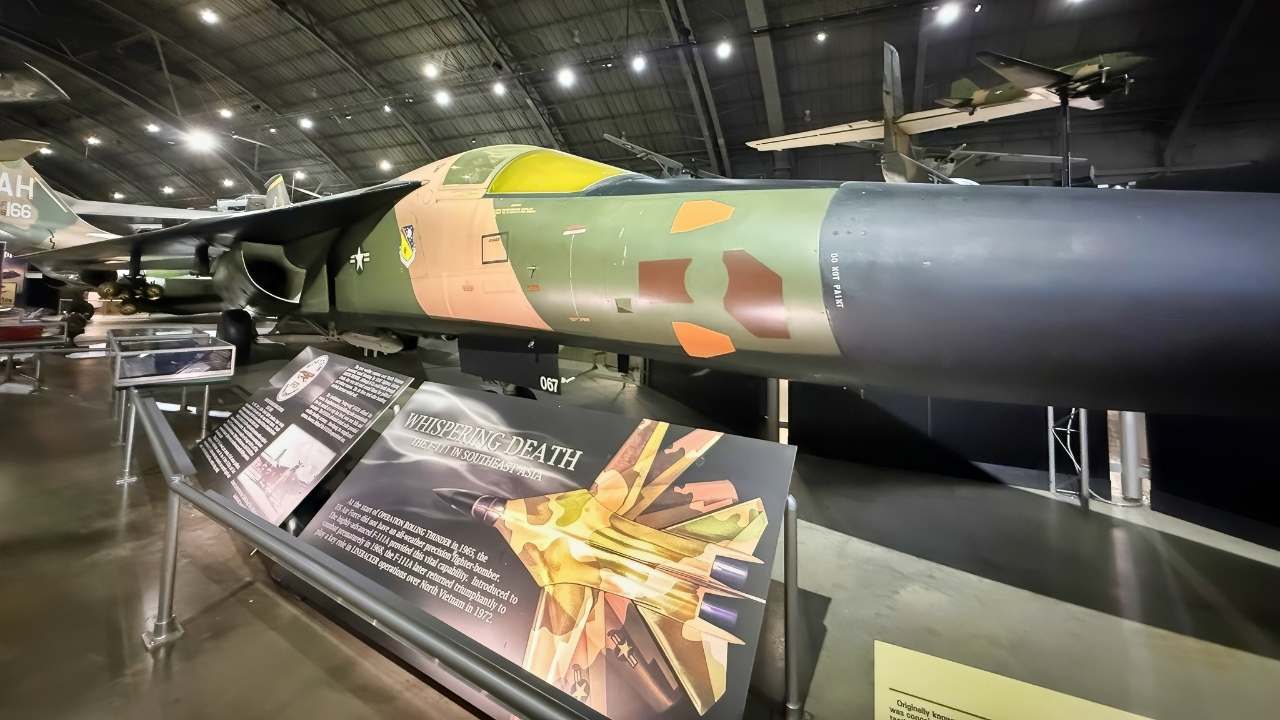
USAF Museum F-111 National Security Journal New Photo.
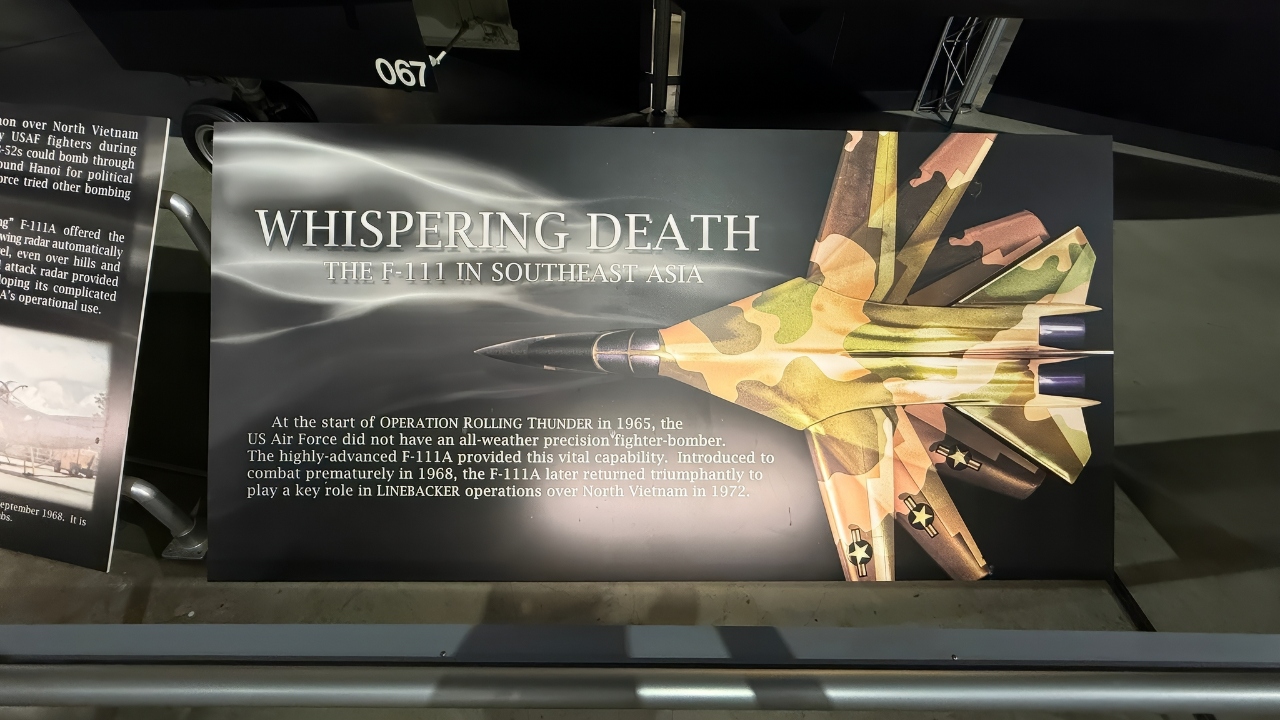
F-111 Photo from USAF Museum in Dayton. Image Credit: National Security Journal.
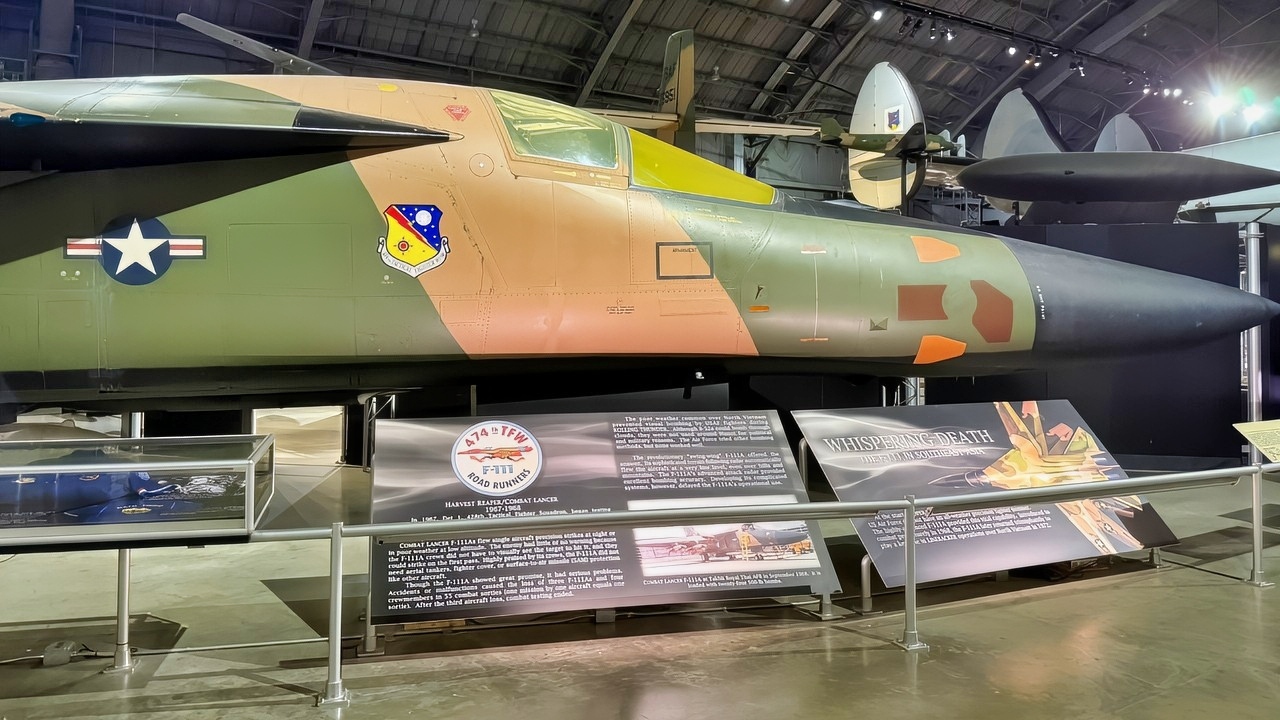
F-111 In USAF Museum July 2025 NSJ Image Taken by Harry J. Kazianis.
The F-111 Was Aviation History
During the Vietnam War, the Aardvark saw heavy use with American forces, where it was prized for its high payload capacity and ability to fly fast and low in support of troops on the ground.
Less than 10 were lost in Vietnam, and compared to one of the storied fighters of that war, the F-4, the F-111 could carry roughly four times the Phantom’s payload.
It’s unofficial motto: fly fast and fly low.
Following the Vietnam War, F-111s also served in the Gulf War as part of Operation Desert Storm in support of coalition forces.
After the end of the Cold War and the subsequent collapse of the Soviet Union, the F-111 faced stiff headwinds amid stiff budget cuts and was eventually retired from service.
Replacing its supersonic bomber mission was the B-1 Lancer bomber, which, like the F-111, operated from terrain-hugging fast and low mission profiles. For medium-range precision strike missions, the F-15 took over in place of the Aardvark.
Ultimately, the United States retired the F-111 in the late 1990s after more than three decades of service.
F-111 Aardvark and Cold War Realities
The U-2 spy plane incident in 1962, in which Soviet air defenses successfully shot down Gary Powers’ high-altitude reconnaissance plane, rocked American and Allied strategic thinking about their bomber fleets.
NATO could no longer take for granted that their bomber fleets would fly high above air defenses and safely out of reach — instead, they were hugely vulnerable to Soviet Surface-to-Air Missiles, or SAMs.
SAM sites of the period struggled to engage targets flying low, hugging terrain, a weakness the United States was keen to exploit.
However, some of the era’s most capable high-speed American interceptor aircraft were not designed to fly very fast at very low altitudes.
The need for a fast, low-altitude penetrating aircraft that could deliver nuclear weapons was born, and into the void stepped the F-111 Aardvark.
F-111 Aardvark, Explained
One of the extremely obvious aspects of the platform is its variable-sweep wings. Similarly to the U.S. Navy’s Cold War-era F-14 Tomcat, the warplane could adjust the angle or sweep of its wings for optimum flight performance at a variety of altitudes and airspeeds.
Though the F-14 is a much more “known” aircraft, the F-111 holds the distinction as the world’s first production variable sweep aircraft.
For low-speed landing, take-off, and for more efficient loitering time on station, the jet would sweep its wings outward.
Conversely, during high-speed bombing runs or sprints through contested airspace, the F-111 would swing its wings inward for an aggressively swept, more aerodynamic shape.
Though the United States did have one potential candidate, the F-105 Thunderchief, that aircraft’s take-off and landing speeds were rather high, and the bomber needed long, prepared runways to take off and land.
Thanks to the F-111’s variable-sweep wings, this problem was avoided.
Why the F-111 was Retired
Like other mainstays of the Cold War, the warplane fell victim to the cold calculus of cost-cutting following the collapse of the Soviet Union — without a concerted threat from the world’s only other superpower, the rationale for maintaining an expensive aircraft evaporated in the face of cost savings and budget drawdowns.
About the Author: Caleb Larson
Caleb Larson is an American multiformat journalist based in Berlin, Germany. His work covers the intersection of conflict and society, focusing on American foreign policy and European security. He has reported from Germany, Russia, and the United States. Most recently, he covered the war in Ukraine, reporting extensively on the war’s shifting battle lines from Donbas and writing on the war’s civilian and humanitarian toll. Previously, he worked as a Defense Reporter for POLITICO Europe. You can follow his latest work on X.


