

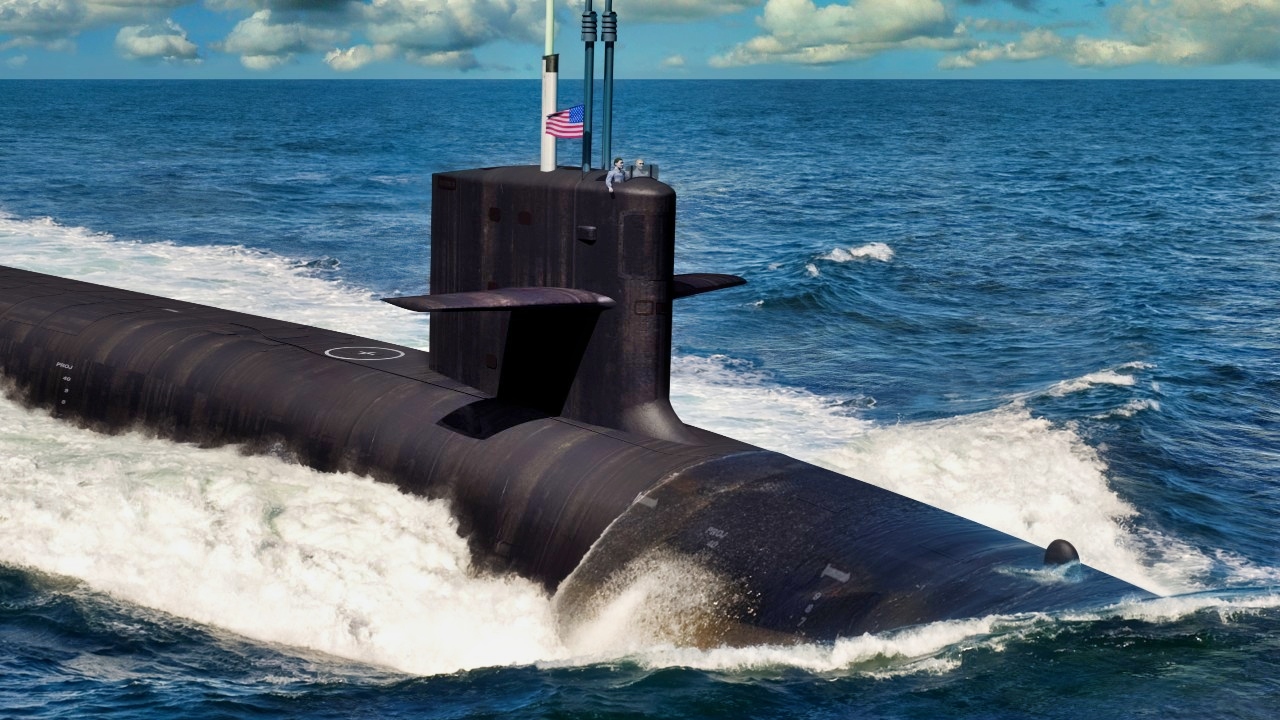
Summary and Key Points: It is being built to do something no weapon ever wants to be used for: survive the unthinkable and strike back. The U.S. Navy’s first Columbia-class submarine is expected to arrive in 2028, and its developers are already calling it the quietest and most lethal submarine ever built. Powered by a new electric-drive system that all but erases the acoustic signature that gives a submarine away, and reshaped with an unusual X-shaped stern, the Columbia is designed for a single, grim purpose: to vanish into the dark corners of the ocean carrying a fleet’s worth of nuclear missiles, ready to deliver a catastrophic second strike if America is ever attacked.
The Columbia-Class Is Getting Ready for a Nuclear War

The Ohio-class ballistic-missile submarine USS Maine (SSBN 741) begins a dive into the Strait of Juan de Fuca off the Washington Coast, March 18, 2025, during routine operations. Special units within the Coast Guard are tasked with the protection of U.S. Naval submarines while surfaced and transiting U.S. territorial waters to and from their patrol stations. (U.S. Coast Guard photo by Petty Officer 1st Class Steve Strohmaier)
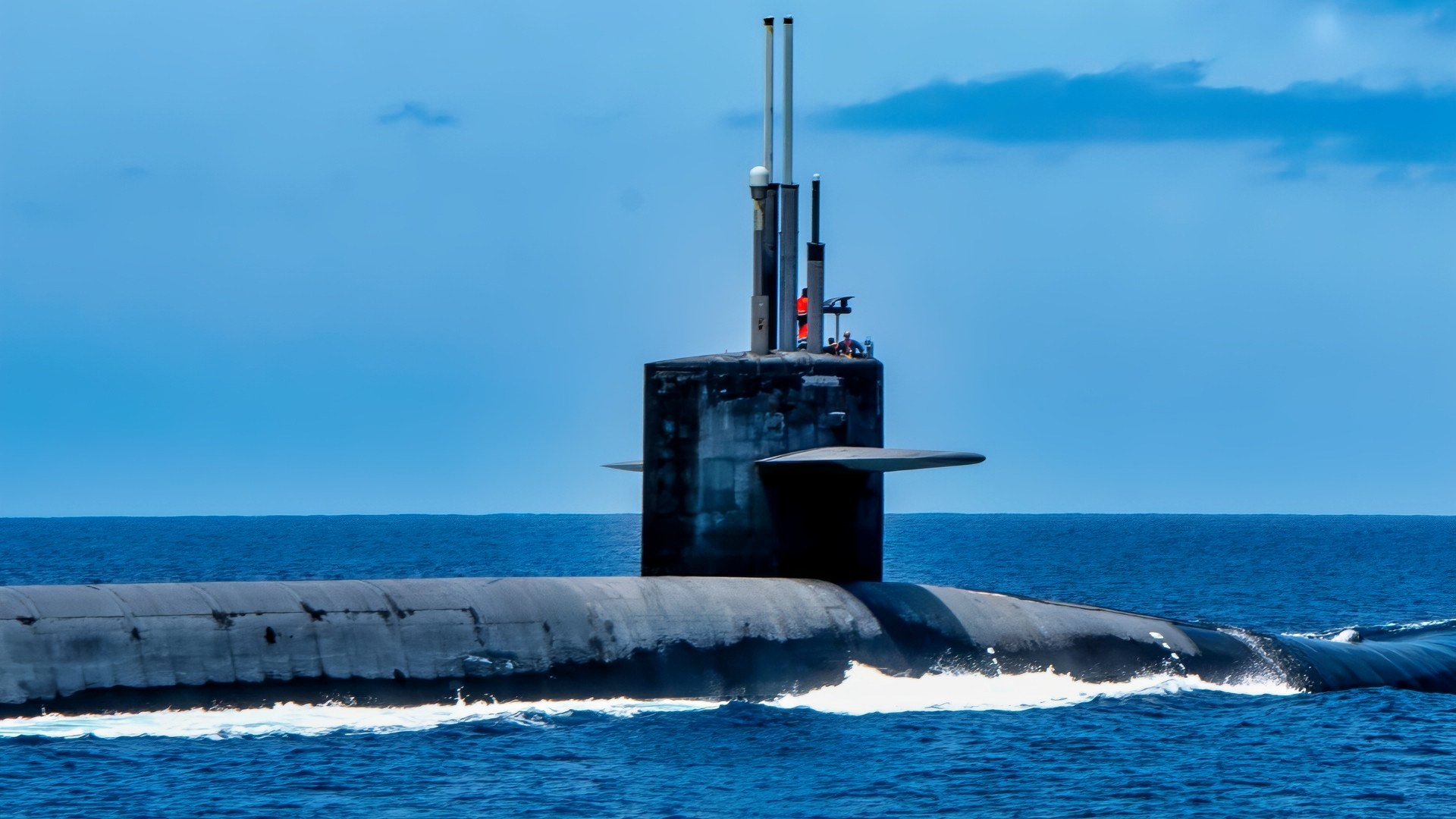
(July 29, 2025) – A U.S. Air Force A10C Thunderbolt II flies over the Ohio-class ballistic missile submarine USS Kentucky (SSBN 737) in the Pacific Ocean, July 29, 2025. The armed airborne escort exercise is designed to increase and demonstrate the Joint Force’s capability to protect strategic assets like Kentucky. Submarine Group (SUBGRU) 9, exercises administrative and operational control authority for assigned submarine commands and units in the Pacific Northwest providing oversight for shipboard training, personnel, supply and material readiness of submarines and their crews. SUBGRU-9 is also responsible for nuclear submarines undergoing conversion or overhaul at Puget Sound Naval Shipyard in Bremerton, Washington. (U.S. Navy Photo by Lt. Zachary Anderson)
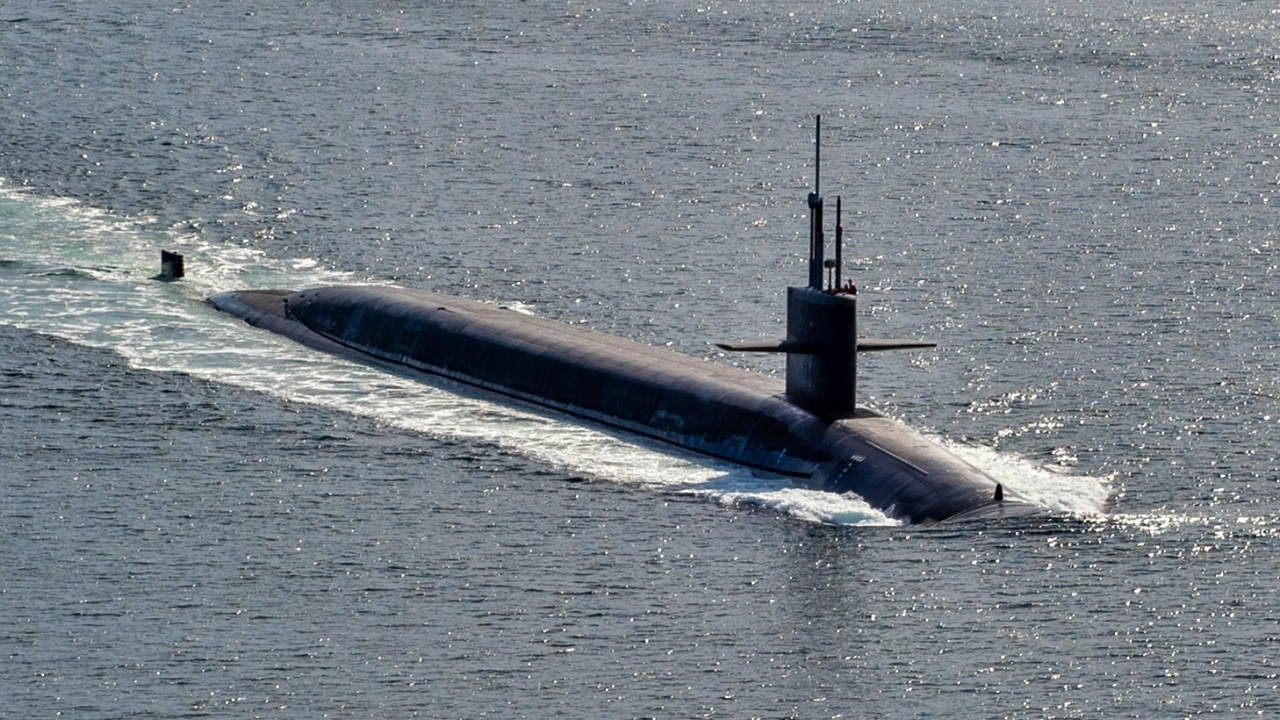
The Ohio-class ballistic-missile submarine USS Maine (SSBN 741) transits the Puget Sound during routine operations, March 18, 2025. Commander, Submarine Group (SUBGRU) 9, exercises administrative control authority for assigned submarine commands and units in the Pacific Northwest providing oversight for shipboard training, personnel, supply and material readiness of SSBNs and their crews. SUBGRU-9 is also responsible for nuclear submarines undergoing conversion or overhaul at Puget Sound Naval Shipyard in Bremerton. (U.S. Navy photo by Mass Communication Specialist 1st Class Ryan Riley)
The Navy’s first next-generation high-tech new Columbia-class submarine will arrive in 2028 as the service works intensely to build its first two nuclear-armed boats.
Intended to quietly and secretly lurk in dark corners of the ocean in a position to launch a catastrophic “second-strike” retaliation in the event the US comes under nuclear attack, the new Columbia-class submarines will introduce a new generation of undersea technology.
The submarines could not arrive too soon, as the existing Ohio-class ballistic missile submarines have already served decades beyond their intended service life – and securing the undersea portion of the nuclear triad with Columbia submarines has long been deemed the Pentagon’s top acquisition priority.
The first Columbia-class patrols are slated for the early 2030s as part of a new era in undersea strategic deterrence intended to function well into the 2080s and beyond.
A second Columbia-class submarine is also well underway in the construction process.
Modules, as they are called, continue to take shape at General Dynamics Electric Boat in Groton, CT., and much of the initial production and science and technology work began more than 10 years ago.
As early as 2014, the Navy was working on what’s called “tube and hull forging” to weld missile tubes into 4-pack units for integration into emerging ship modules. The technologies for the boat also date back many years and have been designed to be work in progress, meaning they are engineered to meet technical standards so new innovations can be quickly and easily integrated.
Stealthiest Submarine Ever
Interestingly, the Columbia-class submarines are described by their developers as perhaps the quietest and most lethal submarines ever built.
While much of the boat’s technology is not available for security reasons, the boat is engineered with an electric propulsion system that can both power the boat and greatly reduce the submarine’s acoustic signature.

SILVERDALE, Wash. (Oct. 27, 2025) Ohio-class ballistic missile submarine USS Pennsylvania (SSBN 735) arrives at Naval Base Kitsap-Bangor following routine operations at sea, Oct. 27, 2025. Pennsylvania is assigned to Commander, Submarine Group (SUBGRU) 9, which exercises operational and administrative control authority for assigned submarine commands and units in the Pacific Northwest providing oversight for shipboard training, personnel, supply and material readiness of SSBNs and their crews. SUBGRU-9 is also responsible for nuclear submarines undergoing conversion or overhaul at Puget Sound Naval Shipyard in Bremerton. (U.S. Navy photo by Mass Communication Specialist 1st Class Ryan Riley).
Being stealthier than any submarine ever to exist would be a critical advantage for nuclear-armed submarines, as their tactical advantage depends upon “not” being detected. A quieter submarine emitting a smaller or less detectable undersea acoustic signature would, of course, be much less likely to give away its position of strategic advantage.
X-Shaped Stern
The new Columbia-class submarines are also being built with a new “X” shaped stern designed to improve undersea maneuverability while generating a smaller or less detectable “signature.”
In today’s Ohio-class submarines, a reactor plant generates heat, which in turn powers a steam turbine.
The steam then turns the turbines that generate the sub’s electricity and propel the ship forward. This propulsion is achieved through “reduction gears,” which translate the high-speed energy from a turbine into the shaft RPMs needed to drive a boat’s propeller.
The Columbia-class submarines are designed to be 560 feet long and to house 16 Trident II D5 missiles fired from 44-foot-long missile tubes.
The “X”-shaped stern will restore maneuverability to submarines; as submarine designs progressed from propellers to propulsors to improve quieting, submarines lost some surface maneuverability.
Electric-drive propulsion technology still relies on a nuclear reactor to generate heat and create steam to power turbines; however, the electricity produced is transferred to an electric motor rather than so-called reduction gears to spin the boat’s propellers.
Navy Plans 12 Columbia-class Boats
Should one Columbia-class submarine be detected, giving a potential adversary the possibility that they might be able to stop, neutralize, or prevent any US Navy second-strike retaliatory option, the Navy plans for built-in redundancy with a fleet of 12 Columbia-class submarines, simultaneously positioned in critical parts of the undersea to strike.
The presence of multiple Columbia-class patrols at once can ensure a second-strike retaliatory attack capability, even if one is found, disabled, or destroyed by an adversary before a nuclear attack.
There are currently 14 Ohio-class submarines, yet the Columbia-class will only consist of 12 boats, in large measure because they are being built with a cutting-edge “life-of-core” nuclear reactor, meaning they won’t have to spend time away from service out of the water in dry dock for mid-life refueling halfway through their service life.
A fleet of 12 Columbia-class submarines can accomplish much more undersea strategic-deterrence “presence” and deployment times can be extended.
New Technology
Also, Columbia-class submarines are being built with several cutting-edge technological innovations, as are the US Navy’s new generation of Virginia-class attack submarines.
Block III and beyond, US-Navy Virginia-class attack submarines are built with a next-generation “fiber-optic” visual sensor cable, which enables commanders and ship navigators to see a “periscope” view from anywhere in the boat.
The new nuclear-armed submarines are also being engineered with a “fly-by-wire” computerized navigational system, which replaces previous hydraulic mechanical systems.
Using computer automation, depth and speed can be analyzed and set to a certain extent semi-autonomously while managed by a human decision-maker, and maneuvering can be controlled with a digital “joystick”- type navigation system.
About the Author: Kris Osborn
Kris Osborn is a Military Technology Editor. Osborn is also President of Warrior Maven – Center for Military Modernization. Osborn previously served at the Pentagon as a highly qualified expert in the Office of the Assistant Secretary of the Army—Acquisition, Logistics & Technology. Osborn has also worked as an anchor and on-air military specialist at national TV networks. He has appeared as a guest military expert on Fox News, MSNBC, The Military Channel, and The History Channel. He also has a Master’s Degree in Comparative Literature from Columbia University.


rosy dawn
June 6, 2026 at 11:51 pm
Submarines are pretty useless in today’s modern warfare in any planned high-end fight or war.
That’s because long before the War begins, or long before the first shot is fired in danger, politicians with loose lips will give the game over.
The smart enemy, alerted by the loose lips of those warmongers, plus intelligence gathered by soies and AI assets, will keep a 24/7 eye, or watch on their submarine bases.
Once the subs shoot their first tomahawks, boom, boooomb, BOOOOOOM go the bases. GAME OVER. OVER.