

When Russian President Vladimir Putin ordered his troops to invade and occupy Crimea in March 2014, it was trumpeted as one of his greatest accomplishments.
Taking back Crimea, which Russian nationalists had always insisted belonged to Moscow and not to Ukraine, was one of the most public demonstrations for the former KGB Lt. Col. that permitted him to say he was making Russia strong again.
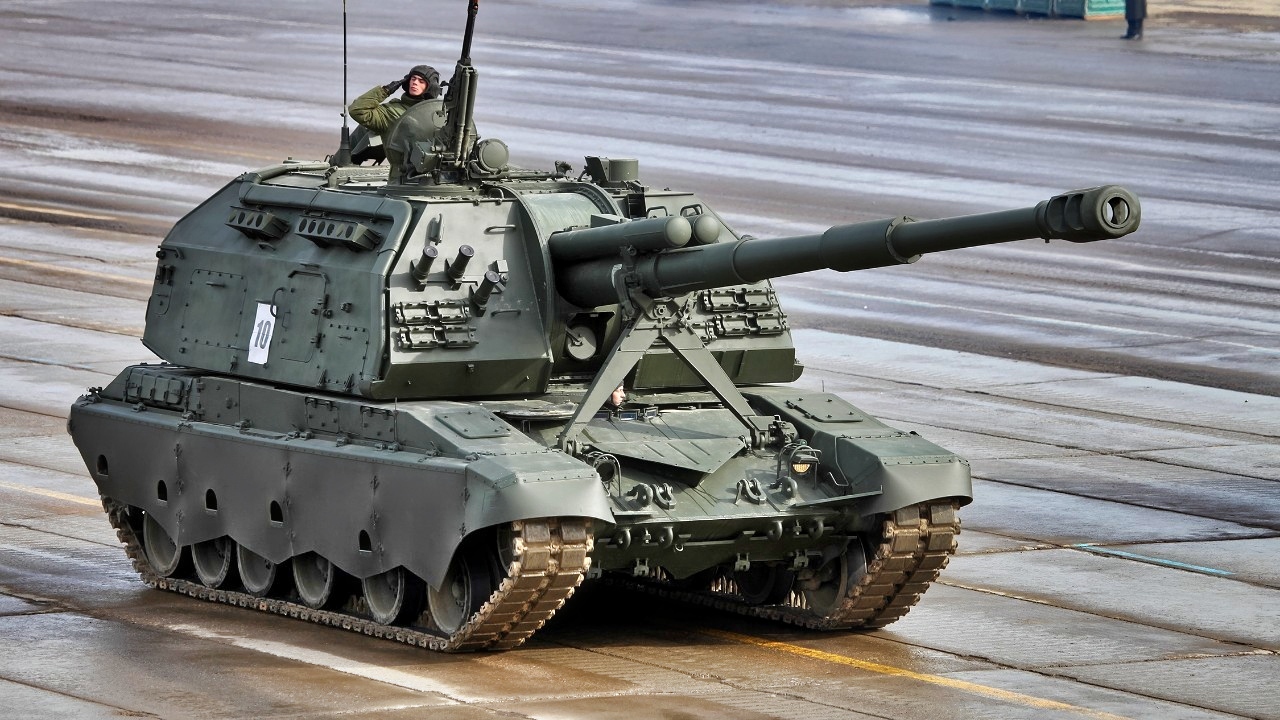
Msta-S Russian Army. Image Credit: Creative Commons.
But last night’s strikes on numerous strategic targets on the peninsula and destroying the main bridge that connects Crimea to the mainland territory of Russia are a significant and symbolic setback.
It has not only contributed to the deteriorating myth of Putin’s invincibility but also to the belief that Russia cannot be defeated to the point of losing the peninsula.
“Ukrainians smell blood now,” said one defense contractor in Kyiv whose company’s operations support the frontline operations of Kyiv’s military.
“The dream of taking back Crimea no longer seems impossible, but actually probable.”
On the night of 22 June, Ukraine struck another major blow to Moscow’s hold on the occupied peninsula.
Ukraine’s drone army has announced that they have destroyed the main railway bridge over the North Crimean Canal in a series of strikes that included some 60 different military targets.
The bridge was a key route for transporting heavy cargo into Crimea, including supplies to support the Russian army’s operations on the peninsula.
The strike has destroyed part of the rail line and caused one of the bridge spans to collapse, according to the Ukrainian military’s official statement.
The First One’s Gone
Removing this and the other bridges disrupts all the military logistics required for occupied Crimea. Strikes against the Russian military in this region have been increasing in recent days, with last night’s toll chalking up several major assets being destroyed.
Besides the bridge, Ukraine’s drone army destroyed several radars for the Russian S-400 air defense system, at least one Pantsir-S1 short-range air defense system, a Nebo-U radar station, an S-300 launcher, and a ZSU-23 anti-aircraft gun.
Other targets eliminated included oil storage tanks at the Kerch thermal power station and the “Western Crimea” electrical substation in the village of Karierne.
The operation to take out these assets – most particularly the bridges connecting Crimea to Russia – appears to be a special campaign undertaken by the Ukrainian Special Operations Forces (SOF), but it is only beginning.
Indicating that there are more of these bridges to be destroyed in the coming days and weeks, the SOF posted messages that this bridge is the “first one” to be eliminated.
“Sorry, but we have an official urgent announcement: the railway bridge across the North Crimean Canal in Crimea no longer exists. The first one’s gone,” the SOF wrote in a statement posted on Threads.
The SOF also posted footage that appears to be the attack on this railway bridge. What is also unusual is that Ukraine’s SOF gave credit to local operatives in occupied Crimea, stating that the attacks were conducted with the support of “underground members of the SOF resistance movement.”
Severing Supply Lines Means Re-Taking Crimea
This bridge supports the rail artery that links the Kerch Strait, which crosses the rest of the occupied peninsula.
By eliminating the bridge and others, it not only cuts off military supply lines to Crimea, but also to areas occupied by Russia in southern Ukraine in the region of Kherson and along the coast of the Sea of Azov.
Destroying the bridge will cause Moscow no end of trouble in moving troops, ammunition, and fuel.
The default method for this kind of supply transport is usually by rail, but since this bridge has been destroyed, it will require rerouting or even moving these supplies by other means.
Taking down this and other bridges is a key element in Ukraine’s strategy to retake Crimea.
Ukraine’s military says that its plan relies on “total resource and logistical exhaustion” and, in the process, makes the peninsula’s military untenable for Russia.
Attempting a direct military incursion or an amphibious landing would be extremely risky and also resource-intensive.
Rather than launching a bloody frontal offensive across the easily defensible Perekop Isthmus, Ukraine is instead implementing a systematic “sieging” strategy that will turn Crimea into an isolated, unsustainable island.
About the Author: Reuben F. Johnson
Reuben F. Johnson has thirty-six years of experience analyzing and reporting on foreign weapons systems, defense technologies, and international arms export policy. Johnson is the Director of Research at the Casimir Pulaski Foundation. He is also a survivor of the Russian invasion of Ukraine in February 2022. He worked for years in the American defense industry as a foreign technology analyst and later as a consultant for the U.S. Department of Defense, the Departments of the Navy and Air Force, and the governments of the United Kingdom and Australia. In 2022-2023, he won two awards in a row for his defense reporting. He holds a bachelor’s degree from DePauw University and a master’s degree from Miami University in Ohio, with a specialization in Soviet and Russian studies. He lives in Warsaw.


