

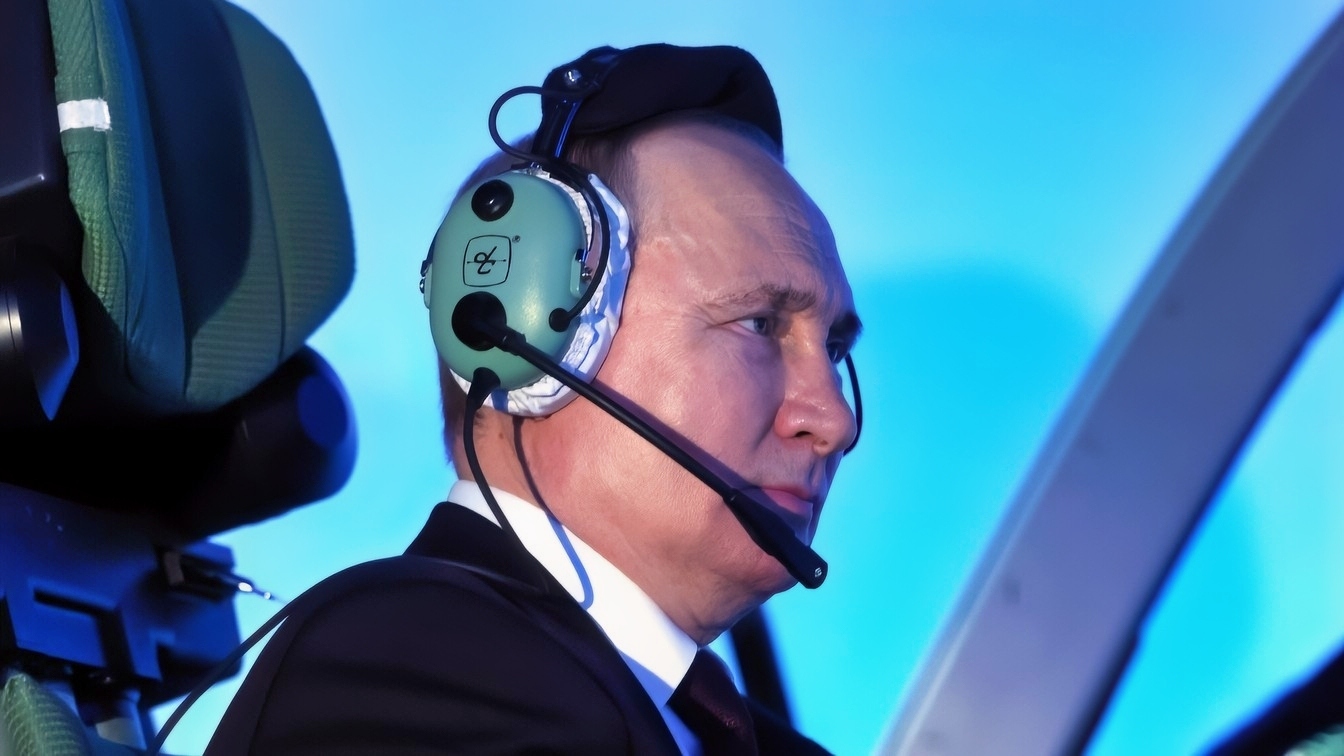
The July 1944 bombing that nearly took the life of Nazi Germany’s dictator, Adolf Hitler, was the last of some 40 attempts to eliminate him.
What kept any of those plots from succeeding was a set of practices that made his movements unpredictable – last-minute changes in schedules and destinations – and an ever-increasing army of protective services that were always around him.

Putin with a Rifle. Image Credit: Russian State Media.
These lessons have not been lost on Russian President Vladimir Putin. Among other adjustments, he has recently increased the innermost circle of his security detail – the “last line of defense” of a hurricane-force architecture of multiple, interlocking layers of bodyguards and palace militia – to more than 800 persons.
One of the characteristics that all dictators have in common is that they all have some “alphabet agency” elite security formation that is supposed to take care of the ruler of the nation first, and everyone and everything come second or third – and to also kill anyone who threatens the “great leader.”
In one of the most repressive and murderous times in Russian history, the Soviet dictator Joseph Stalin was protected by the NKVD.
Its current-day successor is the Russian FSB, which Putin served as director in the 1990s. Hitler had his Gestapo, and Eric Honecker – the long-time East German communist party chief – had the Stasi.

Putin on Direct Line Back in 2019. Image Credit: Creative Commons.
States Within a State
Today, some of the most pervasive analogs of these entities are the Supreme Guard Command, which protects North Korean leader Kim Jong Un, and the Central Security Bureau, which guards the People’s Republic of China (PRC) Communist Party leader, Xi Jinping. Every supreme leader has to have one.
As a profile of Putin’s increasingly paranoid demeanor in The Daily Telegraph published this week points out, as these dictators fall under pressure or become convinced of threats to their position, these security services encourage and benefit from their leaders’ paranoia.
They “become a state within a state, putting millions under surveillance, giving credence to the sniping and jealousies of each informant, and listing the originators as anti-state activists.”
The dictator becomes trapped in a vicious cycle of his own making, and “perpetual personal security becomes an obsession,” reads the profile.
The Stasi, which Putin became so close to during the Cold War period when he was posted to the East German city of Dresden is an extreme example.
Including all its part-time informers, “the East German secret police is reckoned to have employed one secret policeman for every 6.5 East Germans. By comparison, Hitler’s Gestapo deployed one per 2,000 people.”
Since Putin is as fearful or not more “than Hitler was of any threat to his regime, he hopes that technology and his many overlapping security organisations will neutralise any opposition,” reads The Telegraph article.
Wary of Plots
In March 2026, the Amsterdam-based Organized Crime and Corruption Reporting Project (OCCRP) flagged what it had identified as a high-level alert in the Kremlin that had assessed “the risk of a plot or coup attempt against the Russian president. In particular, the fear of drones for a possible assassination attempt by members of the Russian political elite”.
The formation created by Putin, at the top of the security pyramid that serves and protects him and his inner circle, is the 50,000-strong Federal Protective Service (FSO).
The innermost unit is a handpicked, politically reliable force that was recently announced to have increased from 785 operatives to 812. The reason for the increase is suspected to have been the addition of a new detachment of 27 first-rate drone pilots.
With the issuance of this high-level alert, there were immediate orders that staff working near Putin be banned from traveling on public transport or using mobile phones.
Mobile network signals are now jammed when he is anywhere in the vicinity, and his key staff are issued with Kevlar umbrellas.
Putin also employs up to a dozen body doubles and has several identically furnished offices in Moscow, St Petersburg, his various dachas, and aboard his train.
These identical and multiple “film sets” are used by him regularly so that no one ever knows his true location.
The parallels are striking. As a consequence of the elaborate deceptions as to his true whereabouts and the endless security measures, “the Führer became a raving, deluded old man who hid in bunkers and, nine months later, died in one.” Putin, concludes the profile, “appears to be heading in the same direction.”
About the Author: Reuben F. Johnson
Reuben F. Johnson has thirty-six years of experience analyzing and reporting on foreign weapons systems, defense technologies, and international arms export policy. Johnson is the Director of Research at the Casimir Pulaski Foundation. He is also a survivor of the Russian invasion of Ukraine in February 2022. He worked for years in the American defense industry as a foreign technology analyst and later as a consultant for the U.S. Department of Defense, the Departments of the Navy and Air Force, and the governments of the United Kingdom and Australia. In 2022-2023, he won two awards in a row for his defense reporting. He holds a bachelor’s degree from DePauw University and a master’s degree from Miami University in Ohio, with a specialization in Soviet and Russian studies. He lives in Warsaw.


