
Iran Threatens to Block Exports As Hormuz Battle Unfolds: Iran has threatened to stop all oil and natural gas exports from the Middle East following the reimposition of the United States’ naval blockade of its ports and the reignited military campaign against the country. The warning, issued in a statement by the Islamic Revolutionary Guard Corps (IRGC), is one of Tehran’s strongest threats since the fighting over the Strait of Hormuz began and now raises the chances of a global energy shock – precisely the kind of problem U.S. President Donald Trump is trying to avoid by forcefully opening the strait.
The comments come as the U.S. intensifies its campaign against Iran and resumes the blockade on Tuesday, July 14. Within hours, Iranian officials and the IRGC vowed retaliation, while U.S. forces launched yet another wave of overnight strikes that targeted dozens of Iranian military targets.

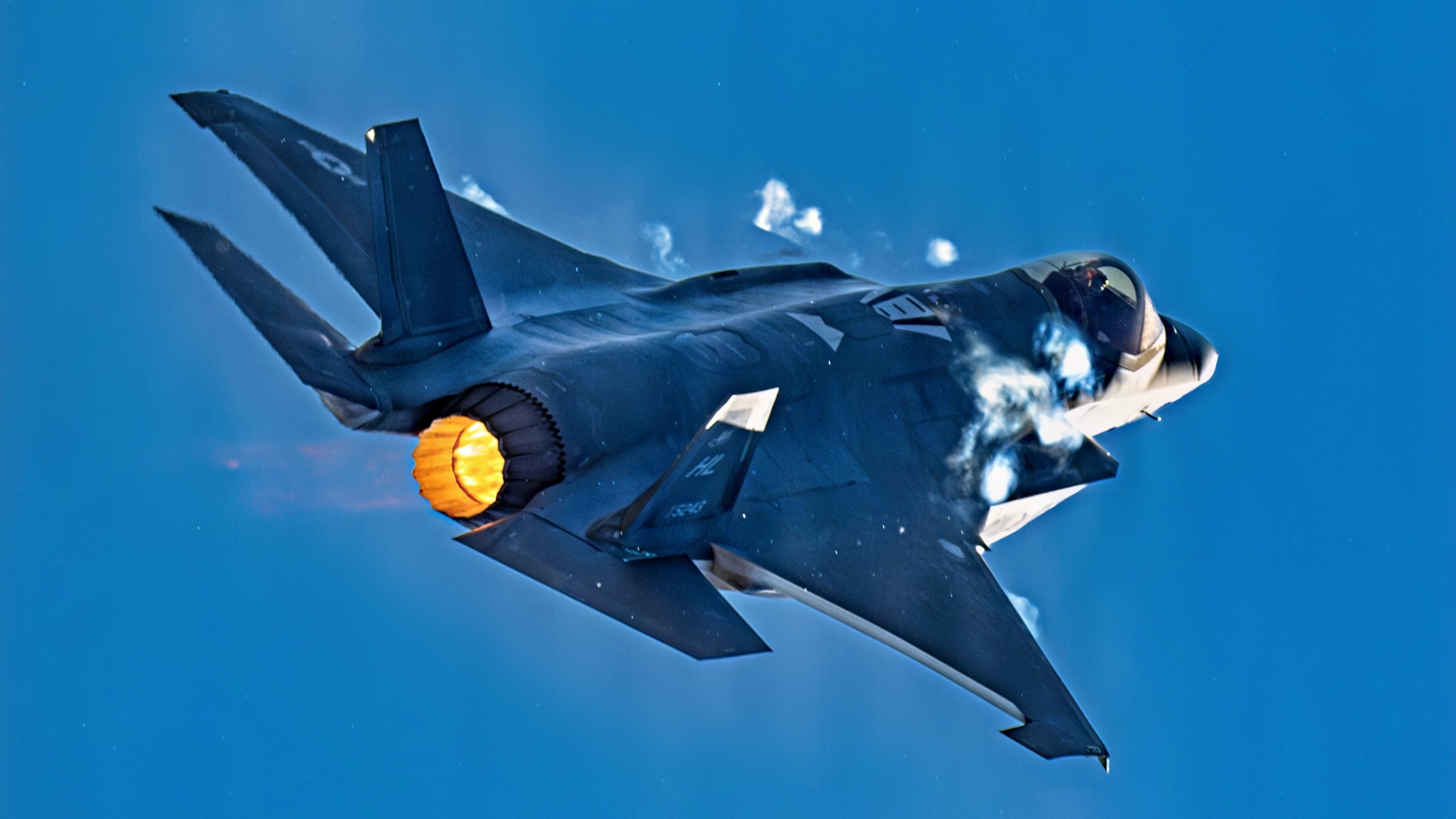
Capt. Andrew “Dojo” Olson, F-35 Demonstration Team pilot and commander performs aerial maneuvers during the Wings Over Houston Airshow Oct. 18, 2019, in Houston, Texas. The show featured performances from the U.S. Air Force Thunderbirds, Tora, Tora, Tora, and Oracle. (U.S. Air Force photo by Senior Airman Alexander Cook)

NAS PATUXENT RIVER, Md. — An F-35 Lightning II test pilot conducts flight test Sept. 10 to certify the carrier variant of the fighter aircraft for carrying the AGM-158C Long-Range Anti-Ship Missile (LRASM). As part of ongoing integration efforts, the Pax River F-35 Integrated Test Force (Pax ITF) team flew two days of test flights to evaluate flutter, loads, and flying qualities with two AGM-158 loaded on external stations. LRASM is a defined near-term solution for the Offensive Anti-Surface Warfare (OASuW) air-launch capability gap that will provide flexible, long-range, advanced, anti-surface capability against high-threat maritime targets. The Pax River ITF’s mission is to effectively plan, coordinate, and conduct safe, secure, and efficient flight test for F-35B and C variants, and provide necessary and timely data to support program verification / certification and fleet operational requirements.
Iran Threatens Regional Energy Exports
In a statement, the IRGC said that “the export of oil and gas from the region will be either for everyone or for no one.”
The IRGC also once again declared the Strait of Hormuz closed until what it described as the “end of America’s evils,” suggesting that Tehran intends to keep fighting to keep the Strait closed for as long as the United States engages in military action against the country. Just as the regime has done since the beginning of the conflict, Iran is effectively using the Strait of Hormuz as leverage in the hope that fear of a global energy shock will be enough to deter the U.S. president from taking further action.
Deputy Foreign Minister Kazem Gharibabadi also told Iranian state television that Washington had destroyed the June memorandum of understanding (MOU) by restoring the blockade before negotiations had begun.
“If the US thinks that by tightening its measures against us, its military actions and its economic blockade, we will return to negotiations, it is making a mistake,” Gharibabadi said.
Crucially, however, the memorandum was violated before the United States declared the agreement “over,” after Iranian forces launched one-way attack drones at several commercial vessels transiting the strait.
Washington Isn’t Backing Down
The Trump administration has made it clear that it intends to increase military pressure until Tehran changes course.
While the president began the conflict in February by calling on the Iranian people to take control of their own destiny and overthrow the regime, the latest round of military strikes against Iran is not intended to directly facilitate regime change but to force what’s left of the Iranian leadership back to the negotiating table. Since reimposing its naval blockade on Iranian ports, Washington has combined air operations with very stern public warnings from military commanders and the president.
U.S. Central Command (CENTCOM) announced on Wednesday that it had completed another wave of strikes against Iranian military infrastructure on Greater Tunb Island – a small and strategically important island in the Persian Gulf.
“U.S. Central Command (CENTCOM) completed a morning round of strikes against Iran at 7:30 a.m. ET on July 15,” the statement reads.
“CENTCOM launched precision munitions against coastal defense systems and cruise missile storage and launch sites on Greater Tunb Island during the 90-minute wave. The strikes further degraded Iran’s ability to attack commercial shipping in the Strait of Hormuz.”
Meanwhile, President Donald Trump is insisting that the strikes will only continue to escalate until Iran engages in productive negotiations. The president even suggested that he would follow through on a threat he made months ago to wipe out Iranian power plants, bridges, and infrastructure that would cripple the regime and its ability to govern.
“We’re going to hit them very hard tonight, we’re going to hit them very hard tomorrow night, we’re going to hit them very hard the night after, and then next week it gets really bad for them,” Trump said on Tuesday. “Because next week comes the power plants, next week comes the bridges.”
Europe Responds
As the United States and Iran battle for control of the Strait of Hormuz, European governments and Gulf Arab states are publicly declaring their opposition to both countries’ attempts to dictate who may and may not use the waterway. During a security forum in Brussels this month, the European Union and the Gulf Cooperation Council issued a joint declaration reaffirming the right of passage through the Strait. The statement noted that transit through the Strait of Hormuz is guaranteed under international law and “cannot be suspended, impeded, or made conditional by any State.”
The statement explicitly rejected any claim of sovereignty over the waterway and opposed “any regime of permits, transit duties or charges imposed on international navigation.” The statement flies in the face of President Trump’s suggestion that the United States may charge a 20% fee on cargo passing through the strait to ensure the safety of passing vessels. That suggestion was quickly reversed, however, when Trump said this week that he would replace that proposed policy with trade deals that effectively reimburse the United States instead.
About the Author: Jack Buckby
Jack Buckby is a British researcher and analyst specializing in defense and national security, based in New York. His work focuses on military capability, procurement, and strategic competition, producing and editing analysis for policy and defense audiences. He brings extensive editorial experience, with a career output spanning over 1,000 articles at 19FortyFive and National Security Journal, and has previously authored books and papers on extremism and deradicalization.


