

US Navy Conducts First-Ever Shipborne Drone Strike Against Iran: Three American drone boats sneaked into the Iranian Bandar Abbas Naval Base on Sunday and made history. The three drones snuck into the port and blew up a submarine and a ship maintenance facility on Sunday. It marked a significant first milestone for the U.S.’s growing fleet of unmanned surface vessels.
The drone boat attacks, which were part of a broader wave of airstrikes, hit Bandar Abbas Naval Base in a kamikaze mission, according to a video released by U.S. Central Command. It was the first time American forces had employed sea drones in that type of combat operation, the command said.

A U.S. Air Force KC-135 Stratotanker offloads fuel to U.S. Air Force F-15 Strike Eagles over the U.S. Central Command area of responsibility, April 11, 2025. The F-15E is deployed to the CENTCOM AOR to reinforce regional stability and deter aggression from violent extremist organizations.. (U.S. Air Force photo by Senior Airman Keegan Putman)
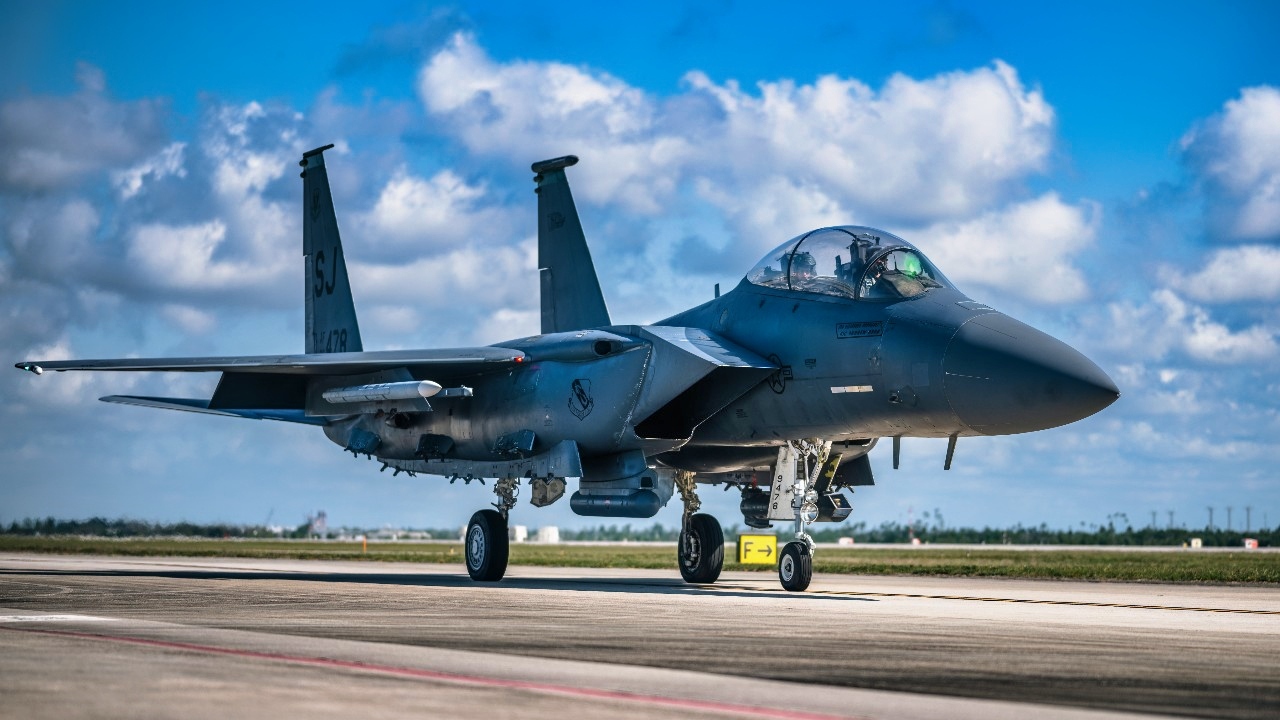
A U.S. Air Force F-15E Strike Eagle assigned to the 335th Fighter Squadron, Seymour Johnson Air Force Base, North Carolina, taxis during Checkered Flag 25-2 at Tyndall AFB, Florida, May 14, 2025. Checkered Flag, one of the Department of Defense’s largest air-to-air exercises, integrates fourth and fifth-generation aircraft to enhance mobility, deployment, and employment capabilities. (U.S. Air Force photo by Airman 1st Class Zeeshan Naeem).
The Louisiana-made drone boats also conducted a first-of-its-kind sea rescue.
Drone Boats Rescue Two Gunship Pilots
Earlier in the air campaign, the same type of drone boats entered the Gulf of Oman and rescued two AH-64 Apache gunship pilots who had been shot down during strikes against Iranian targets.
A 24-foot Corsair uncrewed surface vessel (USV) manufactured by Saronic silently navigated to the survivors’ GPS coordinates after it was deemed too dangerous to send in a manned rescue helicopter.
The gunship pilots, who had survived the shootdown and spent about two hours in the water, were able to get aboard the drone boat. The Corsair then transported them to a safer area, where they were lifted to safety by a rescue helicopter. The drone was operated by the Navy’s Task Force 59, a unit specifically focused on integrating AI and unmanned technologies in the Middle East region.
Corsair Drones Take Out A Midget Submarine
The U.S. military, utilizing the U.S. Navy and Central Command, conducted its first-ever combat strikes using seaborne drones against Iranian targets on July 12. Three Corsair unmanned surface vessels struck a submarine and a ship maintenance facility at the Bandar Abbas Naval Base.
The Bandar Abbas base is Iran’s primary naval complex and headquarters for both the Islamic Republic of Iran Navy and the Islamic Revolutionary Guard Corps (IRGC) naval forces. Located on the Strait of Hormuz, it supports missile boats, submarine maintenance, and maritime operations controlling the region’s shipping lanes.
US Central Command (CENTCOM) posted a 25-second video on X Monday: the Corsairs approach an Iranian pier at Bandar Abbas, near the Strait of Hormuz, with what appears to be a Ghadir-class midget submarine suspended from a gantry above the water.
“Yesterday, using multiple one-way attack surface drones, CENTCOM forces successfully struck a submarine and ship maintenance facility in Iran,” reads the X post. “Three Corsair unmanned surface vessels hit the port at Bandar Abbas Naval Base, marking the first time American forces have employed sea drones in combat operations.”
The attack is part of the Pentagon’s expanding use of autonomous weapons in the air campaign against Iran, which has also seen the US deploy one-way aerial attack drones that are based on Iran’s Shahed UAV.
The Trump administration plans to build fleets of smaller, more economical drones to be used in swarms and cut back on the more expensive Reaper drones.
Meet The Corsair Drone Boats Of The US Navy
The Corsair drone boats are manufactured by Saronic Tech out of Louisiana. The 24-foot drones pack a 1,000-pound payload and have a range of 1,150 miles, with a top speed of 35 knots (40 mph). Saronic is manufacturing about 1,000 boats a year, and that number is set to increase to 2,000 soon.
Unlike traditional drones that require constant satellite uplinks to beam back data, the Corsair is built with edge processing. It analyzes onboard sensor data, keeping the craft functional even if electronic warfare or jamming cuts its communication links.
The vessels are designed to operate autonomously, under human-directed remote control, or as part of collaborative swarms. This allows commanders to saturate and overwhelm enemy defenses or conduct widespread maritime surveillance.
Saronic Awarded A Large Navy Production Contract
Saronic Technologies was recently awarded a $392 million production contract with the US Navy to produce its Corsair autonomous maritime vessels.
Saronic describes Corsair as suitable for blue-water missions ranging from maritime domain awareness to kinetic and non-kinetic strike roles. Corsair and Marauder, another Saronic design, went from initial design to full development in production in just 12 months.
“We are proud to partner with the U.S. Navy to rapidly field advanced autonomous maritime capabilities. From day one, we built our company around rapid innovation and scaled manufacturing, enabling us to transition Corsair from prototype to fielded capability in high-rate production in under a year,” the company said in a statement.
“We approached the Navy with a proven capability and found a partner committed to testing, adopting, and procuring new technologies at scale,” the company continued. “Because we have invested heavily in our own production infrastructure and capacity, we can deliver these new capabilities at the speed and quantity the mission requires.”
The Corsair Is A Glimpse At The Future
The Corsair represents the future of safer, smarter naval operations, reducing human exposure in high-risk operations. It is cheap and configurable for surveillance, reconnaissance, search-and-rescue, logistics, or strike missions.
The unmanned surface vessel (USV) can operate either under remote human control or autonomously using onboard navigation systems and sensors.
In a timeframe where the Navy has struggled mightily to build ships on time and on budget, the Corsair and Saronic Technologies are a breath of fresh air.
The fact that the company can build 1,000 boats a year, and with the increase in production facilities, that number will soon be 2,000, it is building at a tempo that the rest of the Navy can’t even begin to match.
About the Author: Steve Balestrieri
Steve Balestrieri is a National Security Columnist. He served as a US Army Special Forces NCO and Warrant Officer. In addition to writing on defense, he covers the NFL for PatsFans.com and is a member of the Pro Football Writers of America (PFWA). His work was regularly featured in many military publications


