

Days after announcing an embargo on Saudi oil coming through the Red Sea, the Iran-aligned Houthi militia has said that they attacked a pair of Saudi oil tankers this week, the Associated Press reported.
“The Yemeni armed forces have carried out a significant military operation targeting two Saudi oil tankers that violated the ban imposed by the armed forces in the Red Sea,” the Houthis said on an official Telegram channel, as translated by The War Zone.

The French Marine Nationale aircraft carrier FS Charles De Gaulle (R91), and the aircraft carrier USS John C. Stennis (CVN 74) are underway in formation in the Red Sea, April 15, 2019. The John C. Stennis Carrier Strike Group is deployed to the U.S. 5th Fleet area of operations in support of naval operations to ensure maritime stability and security in the Central Region, connecting the Mediterranean and the Pacific through the western Indian Ocean and three strategic choke points. (U.S. Navy photo by Mass Communication Specialist Seaman Joshua L. Leonard)

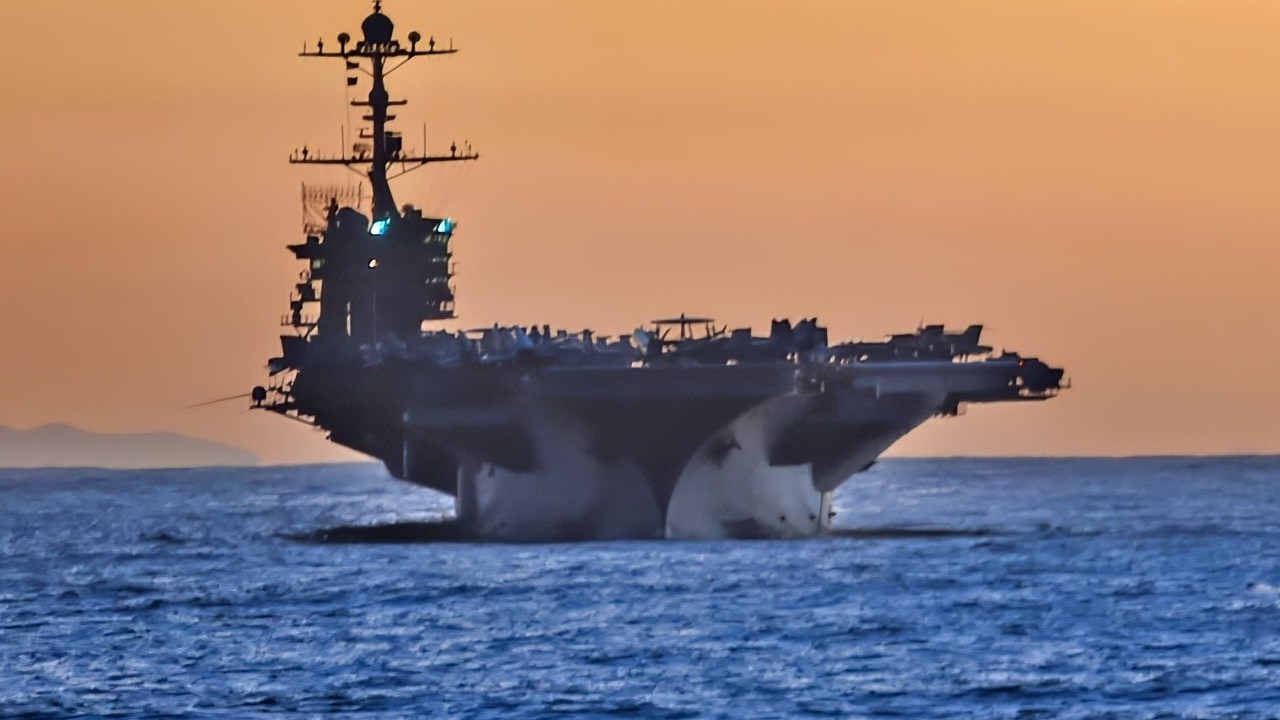
PHILIPPINE SEA(Feb. 22, 2016) USS John C. Stennis (CVN 74) sails through the Philippine Sea. Providing a ready force supporting security and stability in the Indo-Asia-Pacific region, Stennis is operating as part of the Great Green Fleet on a regularly scheduled 7th Fleet deployment. (U.S. Navy photo by Mass Communication Specialist Seaman Cole C. Pielop/Released) .
“The operation involved a number of ballistic and cruise missiles, as well as drones. Thanks to God’s help, the strikes were accurate and caused a large fire on both vessels.”
United Kingdom’s Maritime Trade Operations (UKMTO) confirmed that at least one vessel was struck in the Red Sea. UKMTO stated there were no confirmed casualties.
The U.S.Navy’s Joint Maritime Information Center (JMIC) had issued a warning not long before the reported attack.
“Recent Houthi statements indicated a readiness to target shipping (specifically Saudi-affiliated) if directed,” the JMIC said Tuesday, as noted by TWZ. “According to regional reporting, Iran has instructed the Houthis to stand ready to close the Red Sea oil route should the United States strike Iranian power infrastructure.”
Ship-tracking firm Kpler noted that risks are deepening.
Traffic declined sharply across both chokepoints on 21 July, with Strait of Hormuz crossings down 31% day-on-day to nine vessels and Bab al-Mandeb down 34% to 29 amid a worsening security backdrop,” Kpler stated. “Four confirmed vessel U-turns near the Gulf of Aden suggest operators are becoming more cautious following Houthi threats against Saudi-linked shipping.”
Trump Responds
President Donald Trump has responded by threatening military retaliation against the Houthis, which threatens to open a new full-on front in the Middle East war.
“A year ago the United States of America attacked, very powerfully, the Houthis, for their interference with commerce and trade, by shooting at ships.
Since that time, and during our conflict with Iran, they have acted very responsibly,” Trump wrote on Truth Social on Thursday.
“Unfortunately, now they are starting up again, shooting at two Saudi Arabian ships last night.
Please let this TRUTH serve to represent that if they do this again, the U.S. will hold Iran responsible, in that the Houthis are a Surrogate and/or Proxy of Iran, and major military punishment will be inflicted upon Iran and, of course, the Houthis, themselves, who I am very disappointed with in that they have, until now, acted very professionally and smart.”
That announcement came days after Trump announced a new nuclear sharing agreement with Saudi Arabia, the Houthis’ most bitter enemy.
What It Means
The unrest in the Red Sea means escalation of the current war, placing a final settlement of the military conflict further away, while also putting upward pressure on oil prices, creating a major political problem for Trump and his allies.
Per the New York Times, Brent crude oil exceeded $100 a barrel Wednesday, crossing that line for the first time since May.
“The price rebound in Brent crude oil over the past few weeks reflects the market’s growing concern about the expanding conflict, which now extends from the Persian Gulf to the Red Sea.
Both arteries are vital to the global energy trade,” the New York Times said of the oil market movement.
A successful Houthi blockade of the Saudi oil coming through the Red Sea, the Times added, would cut off about 4 percent of the world’s oil supply, bringing about an additional supply shock. It would also leave Saudi Arabia with “very little access to global markets.”
Analysts have raised the alarm.
“The conflict has entered a decidedly more dangerous phase,” analysts from RBC Capital Markets wrote in a note this week, as cited by the Times. “We still see [oil prices] as a lagging indicator of the extreme pressure building in the region.”
Oil prices are now 40 percent higher than they were before the war started, the Times said. This is the result of both the Iran war and Ukraine striking Russian refineries.
“A resolution to the ongoing conflict that includes a full and unconditional reopening of the Strait of Hormuz will be essential to avoid a further deterioration in global energy security,” Fatih Birol, executive director of the International Energy Agency, told the Times.
About the Author: Stephen Silver
Stephen Silver is an award-winning journalist, essayist, and film critic, and contributor to the Philadelphia Inquirer, the Jewish Telegraphic Agency, Broad Street Review, and Splice Today. The co-founder of the Philadelphia Film Critics Circle, Stephen lives in suburban Philadelphia with his wife and two sons. For over a decade, Stephen has authored thousands of articles that focus on politics, national security, technology, and the economy. Follow him on X (formerly Twitter) at @StephenSilver, and subscribe to his Substack newsletter.


