

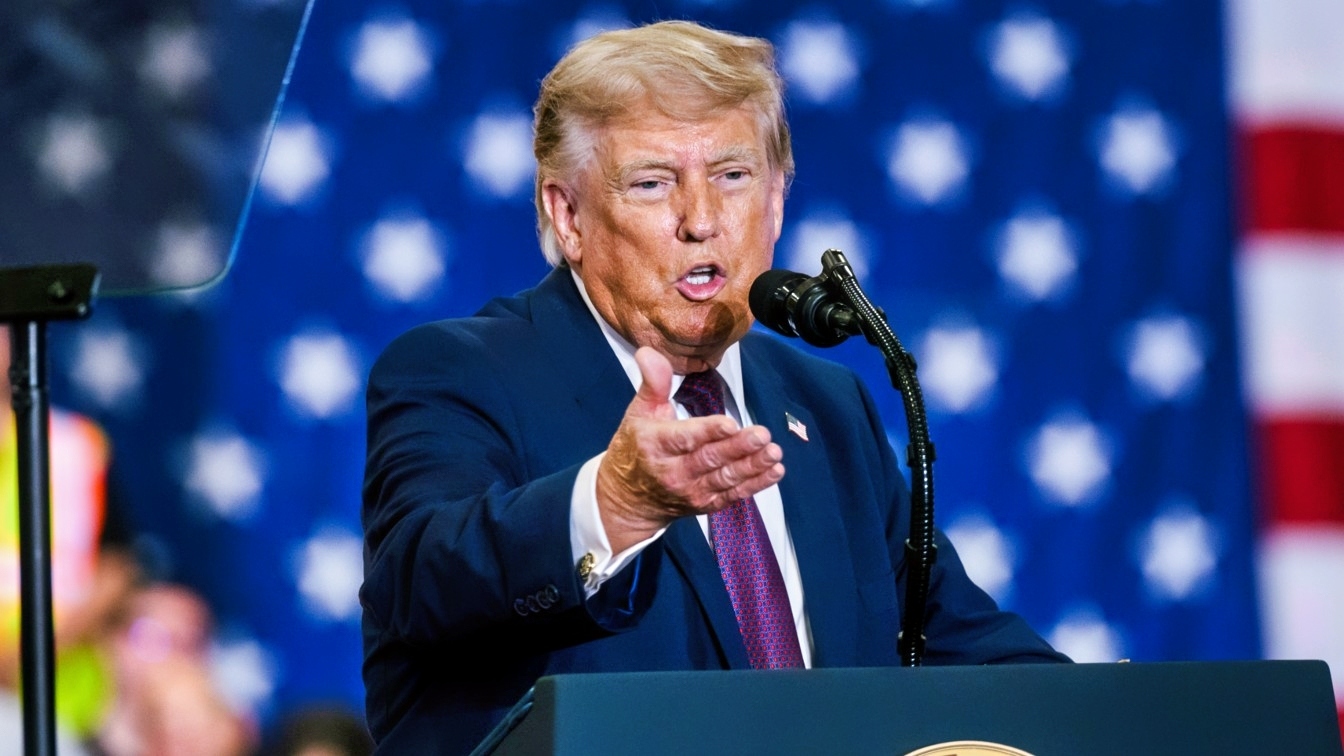
Trump Says Iran Will Pay for the Next Houthi Attack: President Donald Trump says another Houthi attack on commercial shipping will bring major American retaliation against both the group in Yemen and Iran. The warning issued July 23 makes Tehran responsible for future Houthi action and moves the Red Sea closer to the center of the U.S.-Iran war.
“Please let this TRUTH serve to represent that if they do this again, the U.S. will hold Iran responsible, in that the Houthis are a Surrogate and/or Proxy of Iran, and major military punishment will be inflicted upon Iran and, of course, the Houthis, themselves, who I am very disappointed with in that they have, until now, acted very professionally and smart,” explained Trump on his Truth Social media platform.

OVER NEVADA — A B-1B Lancer from the 37th Bomb Squadron, Ellsworth Air Force Base, S.D., streaks through the sky. Carrying the largest payload of both guided and unguided weapons in the Air Force inventory, the multi-mission Lancer is the backbone of America’s long-range bomber force. It can rapidly deliver massive quantities of precision and non-precision weapons against any adversary, anywhere in the world, at any time. (U.S. Air Force photo by Master Sgt. Lance Cheung)

A U.S. Air Force B-1B Lancer flies in the U.S. Central Command area of operations, Oct. 25, 2019. The bomber flew directly from its home station of Ellsworth Air Force Base, S.D., demonstrating the U.S. Air Force’s ability to rapidly deploy strategic bombers anywhere in the world. U.S. Strategic Command regularly tests and evaluates the readiness of strategic assets to ensure we are able to honor our security commitments. (U.S. Air Force photo by Master Sgt. Joshua L. DeMotts)
Why Trump Made the Threat
Trump responded after the Houthis claimed missile and drone attacks on two Saudi oil tankers, Encelia and Layla. Saudi authorities confirmed that Encelia caught fire near Jizan and said its crew was unharmed. The separate claim involving Layla had not been independently verified, according to the Associated Press.
The warning arrived as oil briefly moved above $100 per barrel. Bab el-Mandeb connects the Red Sea to the Gulf of Aden and supports a major share of trade between Europe and Asia. The U.S. Energy Information Administration identifies it as one of the world’s critical energy chokepoints.
American forces were already completing a 12th consecutive night of strikes against Iran. U.S. Central Command said more than 50,000 service members were operating across the Middle East while aircraft targeted Iranian missile, drone, surveillance, and maritime capabilities.
Trump Is Making Iran Responsible for Houthi Decisions
Iran has supplied the Houthis with weapons, training, intelligence, and technical support. The relationship is substantial, but the group also has its own leadership, local interests, and unresolved conflict with Saudi Arabia. A Council on Foreign Relations review describes the Houthis as an Iranian partner with room to make some decisions independently.
Trump’s rule could strengthen deterrence because Tehran knows that another Red Sea attack may produce direct costs inside Iran. It also creates a credibility trap. If the Houthis act without an explicit Iranian order, Washington must either carry out the threatened punishment or weaken the value of the warning.
The policy also gives smaller actors greater influence over escalation. A Houthi commander, a misidentified launch, or an attack with disputed responsibility could trigger a new U.S. operation against Iran. The danger is larger because pressure is now spreading from Hormuz into the Red Sea.
The United States Could Face Two Maritime Fronts
Saudi Arabia moved more oil toward its Red Sea port at Yanbu to reduce dependence on the Strait of Hormuz. Houthi missiles and drones can now threaten that alternative route, leaving Saudi exports exposed on both sides of the Arabian Peninsula.
The U.S. Navy has already shown how demanding a Red Sea defense can become. During the Eisenhower carrier group’s 2023-24 deployment, warships fired 155 Standard missiles and 135 Tomahawks, while aircraft used hundreds of additional weapons, according to the Navy’s official deployment record.
Another campaign would compete with operations around Iran for destroyers, surveillance aircraft, tankers, maintenance capacity, and interceptors. The possibility of two threatened oil chokepoints at once creates a much larger mission than protecting one tanker route.
The economic effect appeared immediately. Reuters reported that Brent crude rose above $100 after the tanker attacks. A sustained Red Sea threat would make Saudi Arabia’s Hormuz bypass less reliable and increase freight, insurance, and fuel costs across global markets.
Trump’s Warning Needs a Clear Threshold
The administration now needs rules for attribution and proportional response before the next incident. Mines, unmanned aircraft, missiles, and small vessels can leave incomplete evidence. Treating every suspected Houthi action as an Iranian attack could produce automatic escalation from uncertain facts.
The warning may still prevent another strike. Shipping companies had already changed routes after the blockade threat, showing that fear alone can alter tanker movements. Military punishment will matter only if it lowers that fear rather than widening the conflict.
The measure of success is commercial behavior. Tankers must resume normal passages through Bab el-Mandeb, insurers must reduce war-risk charges, and crews must accept the route. Until then, the United States faces a security problem that cannot be solved by threats alone.
About the Author: Harry J. Kazianis
Harry J. Kazianis (@Grecianformula) was the former Senior Director of National Security Affairs at the Center for the National Interest (CFTNI), a foreign policy think tank founded by Richard Nixon based in Washington, DC. Harry has over a decade of experience in think tanks and national security publishing. His ideas have been published in the NY Times, The Washington Post, The Wall Street Journal, CNN, and many other outlets worldwide. He has held positions at CSIS, the Heritage Foundation, the University of Nottingham, and several other institutions related to national security research and studies. He is the former Executive Editor of the National Interest and the Diplomat. He holds a Master’s degree focusing on international affairs from Harvard University.


