

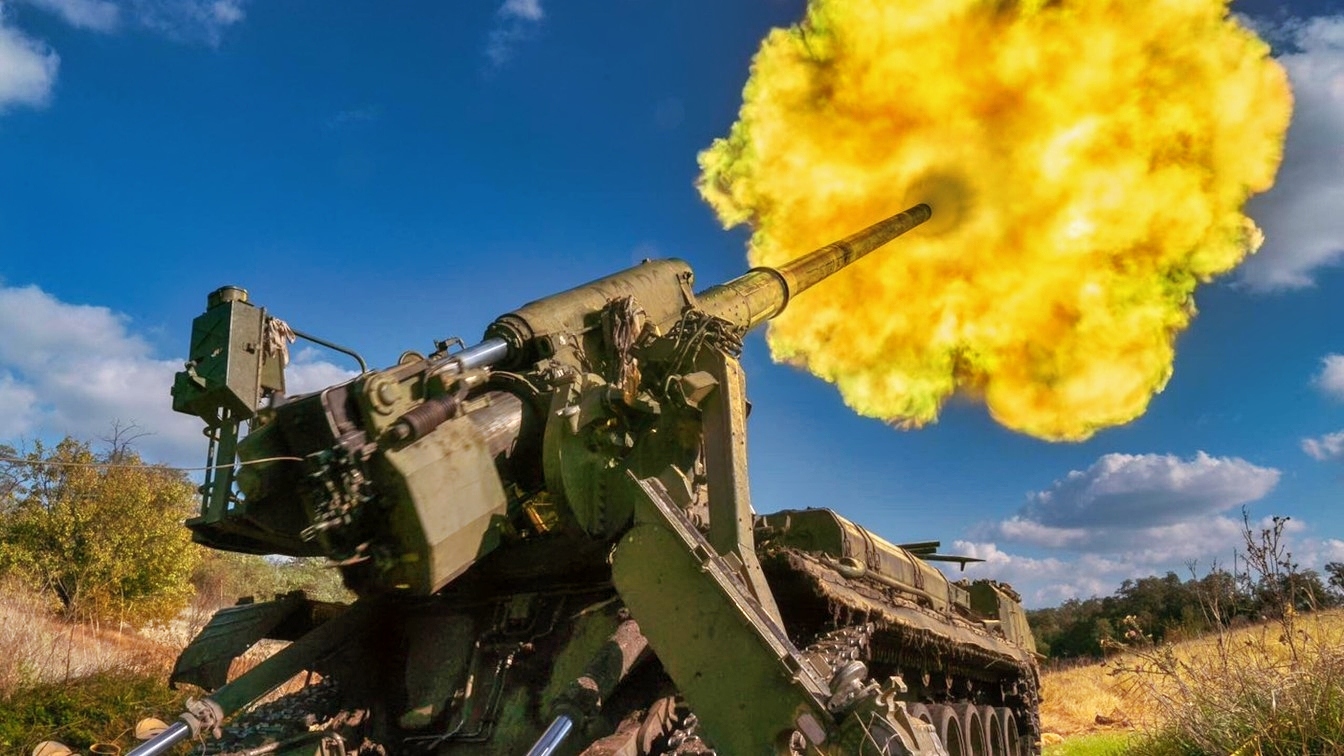
In a somewhat unusual episode, Ukraine briefly came under threat of a ballistic missile attack from Iran. Following an attack on an Iranian commercial vessel in the Caspian, the Foreign Ministry of Iran threatened to respond militarily.
After some harsh rhetoric traded back and forth, Telegram channels linked to the Ukrainian Armed Forces (AFU) began reporting that the Military was preparing for a strike from Iranian missiles.

Russian T-72 Tank Ukraine War. Image Credit: Creative Commons.

Su-34 Fullback. Creator: Vitaly V. Kuzmin. Credit: Vitaly V. Kuzmin
The Foreign Minister of Iran later stated that his Ukrainian counterpart had reached out to him to avoid further escalation; the threat of a ballistic missile strike from the Middle East subsided thereafter.
Tensions between Iran and Ukraine have been high ever since the Islamic Republic began providing attack drones to Moscow.
Showdown Over the Caspian Sea
On Saturday, Ukraine struck an Iranian commercial cargo ship in the Caspian Sea, killing one sailor. According to Kyiv, the ship was proving military materials to Moscow and was therefore a legitimate target. Ukraine has maintained unfriendly relations with Tehran ever since Iran began providing Shahed kamikaze drones to Russia.
Kyiv has in the past threatened to take action against Iran for its role in Russia’s war effort but has never committed to anything until now. “The regime in Tehran is a direct accomplice to Russian aggression against Ukraine, fuelling Moscow’s criminal war with weapons that have killed Ukrainians since 2022,” Ukraine’s Foreign Minister Andrii Sybiha wrote on social media.
The strike against Iranian sailors struck a nerve in Tehran. Seyed Abbas Araghchi, Iran’s Foreign Minister, promised that the attack would not go unanswered. “Zelenskyy has attacked an Iranian commercial vessel, killing a sailor. A blatant UN Charter violation done at Israel’s behest to drag Europe into its war,” he wrote on social media. “Calls with EU High Rep Kallas and [Russian] FM Lavrov, made clear that what the freeloader in Kyiv did CANNOT GO UNANSWERED.” Kyiv dismissed these threats, calling them “unjustified and groundless” and insisting that its attack on the Iranian vessel was completely justified considering Iran’s support of Russia’s war effort.
Yevgen Korniychuk, Ukraine’s ambassador to Israel, compared its war with Russia to Israel’s war with Iran, stating that they were fighting the same “axis of evil” but on different fronts.
Iran Almost Attacked Ukraine
At the same time, the AFU prepared fully for the possibility of a ballistic missile attack from Iran. According to Telegram channels closely linked to the military, the AFU was preparing for a missile attack and expected one to be carried out from Iran within 24 hours (Telegram Channels should, by and large, always be taken with a grain of salt). Of course, we cannot, at this time, confirm these posts.
Other sources inside the AFU confirmed these reports, stating that an attack from Iran was entirely possible. Reports indicated that Iran likely intended to launch a single missile with a small warhead at Kyiv or one of Ukraine’s Black Sea ports more so as a symbolic gesture than a legitimate attack.
Still, any missiles from Iran would threaten to escalate both the war in Ukraine and the war between the U.S. and Iran.
In a worst-case scenario, it could have merged the two conflicts, putting the U.S. and Russia, the two largest nuclear powers on the planet, in direct confrontation.
Thankfully, cooler heads prevailed.
In Tehran, officials argued that opening a new front against Ukraine would be self-defeating and ultimately accomplish nothing. “Ukraine is not a small, insignificant country,” said Mehdi Rahmati, an Iranian analyst from Tehran, in a phone interview with The New York Times. “It has warfare experience, and logistical support from America and Europe. We won’t gain anything by creating a new front in the war.”
Diplomats in Ukraine also recognized that starting a fight with Iran did not serve Kyiv’s interests and reached out to Iran’s Foreign Ministry. “Was assured by Ukrainian FM [Andrii Sybiha] that the attack on an Iranian ship was unintentional and Ukraine seeks no escalation,” Araghchi wrote on social media. “Iran does not seek escalation either, but made clear any attack on our citizens or interests is unacceptable. There must be restitution for losses.”
Getting Too Big for its Briches?
It is possible that the Americans played a role in de-escalating tensions between Iran and Ukraine.
On Tuesday, President Zelensky flew to Washington for a meeting with Trump and to attend Lindsey Graham’s funeral. Shortly afterward, Aragachi wrote his post on X, dismissing the incident as an accident on Ukraine’s part.
This is just speculation from the present author, but it is possible that Trump encouraged Zelenskyy to de-escalate tensions with Iran and avoid broadening the war with Iran.
The U.S. has been attempting to find an off-ramp to the war in Iran for the past month now as the conflict continues to take a political and economic toll on the United States.
The last thing it needs is to have Ukraine escalate the war and risk bringing the United States into a direct military confrontation with Russia.
As Ukraine has improved its medium-to-long-range capabilities, Kyiv has grown bolder and some would argue more reckless in its attacks.
In its attempts to inflict as much damage on Moscow as possible, Ukraine may be losing sight of its own long-term safety.
Earlier this year, NATO fighter jets have intercepted Ukrainian drones in Baltic airspace, which has caused some frustration among the governments of Lithuania, Latvia, and Estonia. Ukraine has also been antagonizing its northern neighbor, Belarus, for its support of Moscow’s war efforts and has filed criminal proceedings against the dictator, Alexander Lukashenko, and has publicly threatened to take military action in the past.
While Ukraine has done an admirable job thus far in slowing down Russia’s advances, incidents like these are not in Kyiv’s interest and only heighten the possibility of fighting a war on two fronts.
About the Author: Isaac Seitz
Isaac Seitz, a Defense Columnist, graduated from Patrick Henry College’s Strategic Intelligence and National Security program. He has also studied Russian at Middlebury Language Schools and has worked as an intelligence Analyst in the private sector.


