
President Donald Trump has long said that his goal in Iran is to ensure that the country never develops a nuclear weapon, but Vice President JD Vance this week seemed to suggest that the administration’s goals have now changed.
Speaking to Fox News on Thursday, August 13, the vice president said that keeping energy affordable for Americans is now “goal No. 1,” putting the issue ahead of preventing Iran from obtaining a nuclear weapon and potentially preparing to soften the blow in the event that the president announces he is withdrawing U.S. forces from Iran without achieving his original stated goals.
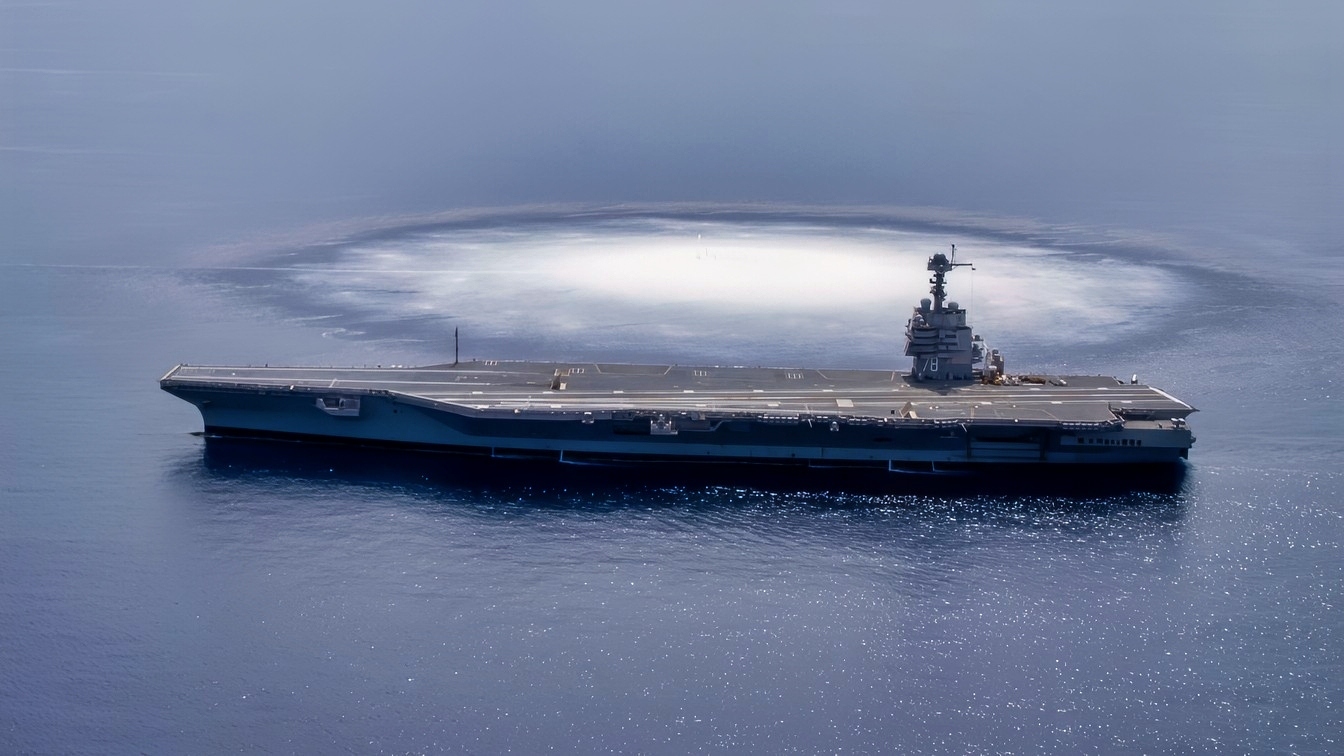
The aircraft carrier USS Gerald R. Ford (CVN 78) completes the first scheduled explosive event of Full Ship Shock Trials while underway in the Atlantic Ocean, June 18, 2021. The U.S. Navy conducts shock trials of new ship designs using live explosives to confirm that our warships can continue to meet demanding mission requirements under harsh conditions they might encounter in battle. (U.S. Navy photo by Mass Communication Specialist 3rd Class Riley B. McDowell)
Libre Aircraft Carrier Naval Group Image
“I know that oil is down today and it’s way down from the highs in the early days of the conflict,” Vance said. “That’s goal No. 1 — keep oil and gas cheap for Americans all over our country.”
No More Nightly Strikes?
The comments come as the United States appears to have backed away from sustained attacks on Iranian infrastructure and military sites, with President Trump indicating that he is now “low-keying it” with Tehran and waiting for the economic impact of the U.S. blockade on Iranian-linked ships to pressure the regime into negotiating.
While oil prices have fallen substantially from their initial wartime highs, they remain far above pre-war levels.
Brent crude traded above $87 per barrel on Friday, and the national average price of gasoline in the United States climbed above $4 per gallon.
Those numbers are far from ideal for a president hoping his party will win the November midterms and give him the power he needs to keep pushing his agenda through legislation, not just executive orders.
High gasoline prices are one of the most visible ways Americans experience the war’s economic consequences, and Trump made lower energy costs a major part of his economic message before returning to the White House.
He also promised no new long wars in the Middle East.
Oil Prices Are A Big Political Problem
The war with Iran began on February 28, when the United States and Israel launched attacks.
The fighting then disrupted shipping through the Strait of Hormuz, through which roughly one-fifth of global oil supplies moved before the conflict began.
While oil prices have fallen substantially from their initial wartime highs, they remain far above pre-war levels. Brent crude was above $87 per barrel last week, and the national average price of gasoline in the United States has climbed above $4 per gallon.
Those prices matter politically with the November midterm elections approaching, and polls suggesting that Democrats may have the advantage.
And more concerning for Republicans is that polls are no longer limiting that advantage to the generic congressional ballot.
A Reuters/Ipsos poll published earlier this month found Democrats leading Republicans 42% to 37% among registered voters asked which party they would support for Congress.
Independents favored Democrats by 12 points.
The same poll found that Democrats had overtaken Republicans on the economy, traditionally one of the GOP’s strongest issues.
Thirty-seven percent of Americans said Democrats had the better approach to managing the economy, compared with 36% who chose Republicans.
It is the first Democratic advantage on the question in Reuters/Ipsos polling in almost a decade.
Putting aside the obvious dangers to the global economy, that change makes continued disruption in Hormuz particularly dangerous for the Republicans.
Rising energy costs feed directly into the wider affordability problem that is already hurting the party and the American people, and affect not only what drivers pay at the pump but also transportation, manufacturing, and, in the end, consumer prices.
Republicans may still have time to reverse those trends before November, and that could be why the vice president is now looking to set expectations and make it politically possible for the president to justify a withdrawal from Iran without a nuclear deal.
Washington Is Preparing A New Iran Strategy
We could know Washington’s next move against Iran within a handful of days.
On Thursday, Treasury Secretary Scott Bessent said that the administration will announce new economic measures against Iran next week, describing a new strategy of combining financial pressure with the U.S. naval blockade.
Bessent said to “watch this space” for more announcements next week – though the statement should be taken with a pinch of salt given his recent record.
Bessent said last Monday that a deal between Oman and Iran could arrive as soon as Monday or Tuesday. Two weeks have passed since that prediction, and no agreement has been announced.
Defense Secretary Pete Hegseth also said recently that the United States can maintain its blockade “indefinitely” by rotating warships through the region, while President Trump also said on Friday that he is planning to declare the Strait of Hormuz “American territory.”
About the Author: Jack Buckby
Jack Buckby is a British researcher and analyst specializing in defense and national security, based in New York. His work focuses on military capability, procurement, and strategic competition, and he produces and edits analysis for policy and defense audiences. He brings extensive editorial experience, with a career output spanning over 1,000 articles at 19FortyFive and National Security Journal, and has previously authored books and papers on extremism and deradicalization.


