

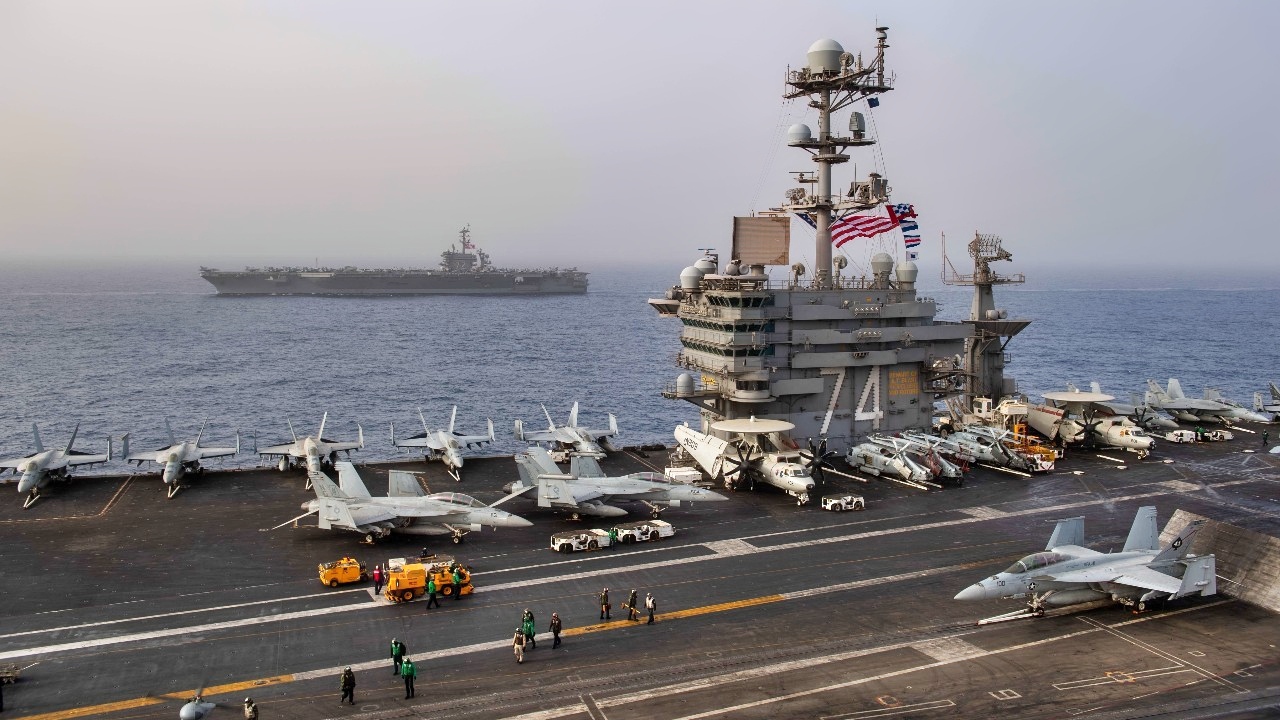
After weeks of reports about horrible conditions on board, including that some sailors had attempted to throw themselves overboard, the US Navy aircraft carrier USS Abraham Lincoln has departed the Middle East, bringing to an end a nine-month deployment.
The carrier’s 5,000 sailors and other personnel are headed back to San Diego, with the George Washington headed to the Middle East to take its place. The journey will take four to five weeks, the New York Times reported.
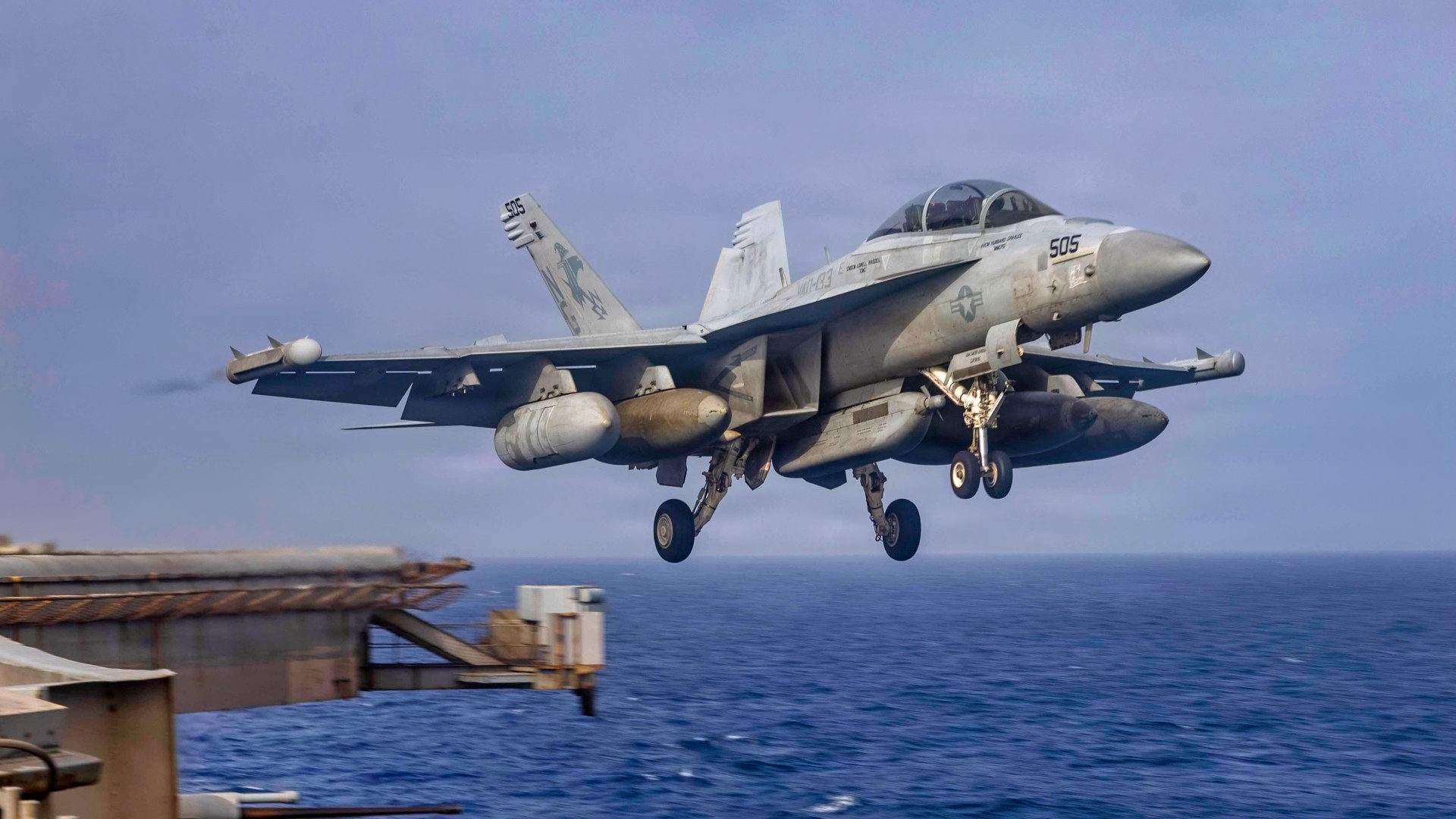
An EA-18G Growler, attached to Electronic Attack Squadron (VAQ) 133, takes off from the flight deck of Nimitz-class aircraft carrier USS Abraham Lincoln (CVN 72), May 21, 2026. Abraham Lincoln is deployed to the U.S. 5th Fleet area of operations to support maritime security and stability in the Middle East. (U.S. Navy photo)
How It Went Wrong on This Aircraft Carrier
MS NOW on Friday shared some details about how Abraham Lincoln ran low on supplies.
The report said the 5,000 people on the carrier “went without basic supplies,” including toothpaste, deodorant, and soap, for long stretches of its deployment.
Why did this happen? It had to do with a Navy base in Bahrain that was struck by Iran, which disrupted supply lines.
Bahrain has, since the late 1990s, been the headquarters of the Navy’s Fifth Fleet logistical headquarters, but the base was reportedly damaged by Iranian missiles early in the war.
And while the Pentagon has not confirmed that damage, Naval leaders told family members that “the base could no longer be used for resupply purposes,” MS NOW said.
Meanwhile, the blockage of the Strait of Hormuz made resupply harder, forcing the Navy to take a longer route and get supplies from the Indian Ocean.
“The net result is that replenishment ships now have to travel more than three times as far to pick up supplies from ashore,” Thane Clare, a retired Navy captain, said in the MS NOW story.

USS Ronald Reagan (CVN 76), USS Kitty Hawk (CV 63), and USS Abraham Lincoln (CVN 72) cruise side-by-side in the Philippine Sea June 18, 2006, during exercise Valiant Shield 2006. The joint exercise consists of 28 naval vessels, more than 300 aircraft, and approximately 20,000 service members from the Navy, Army, Air Force, Marine Corps and Coast Guard. (U.S. Navy photo by Chief Photographer’s Mate Spike Call) (Released)
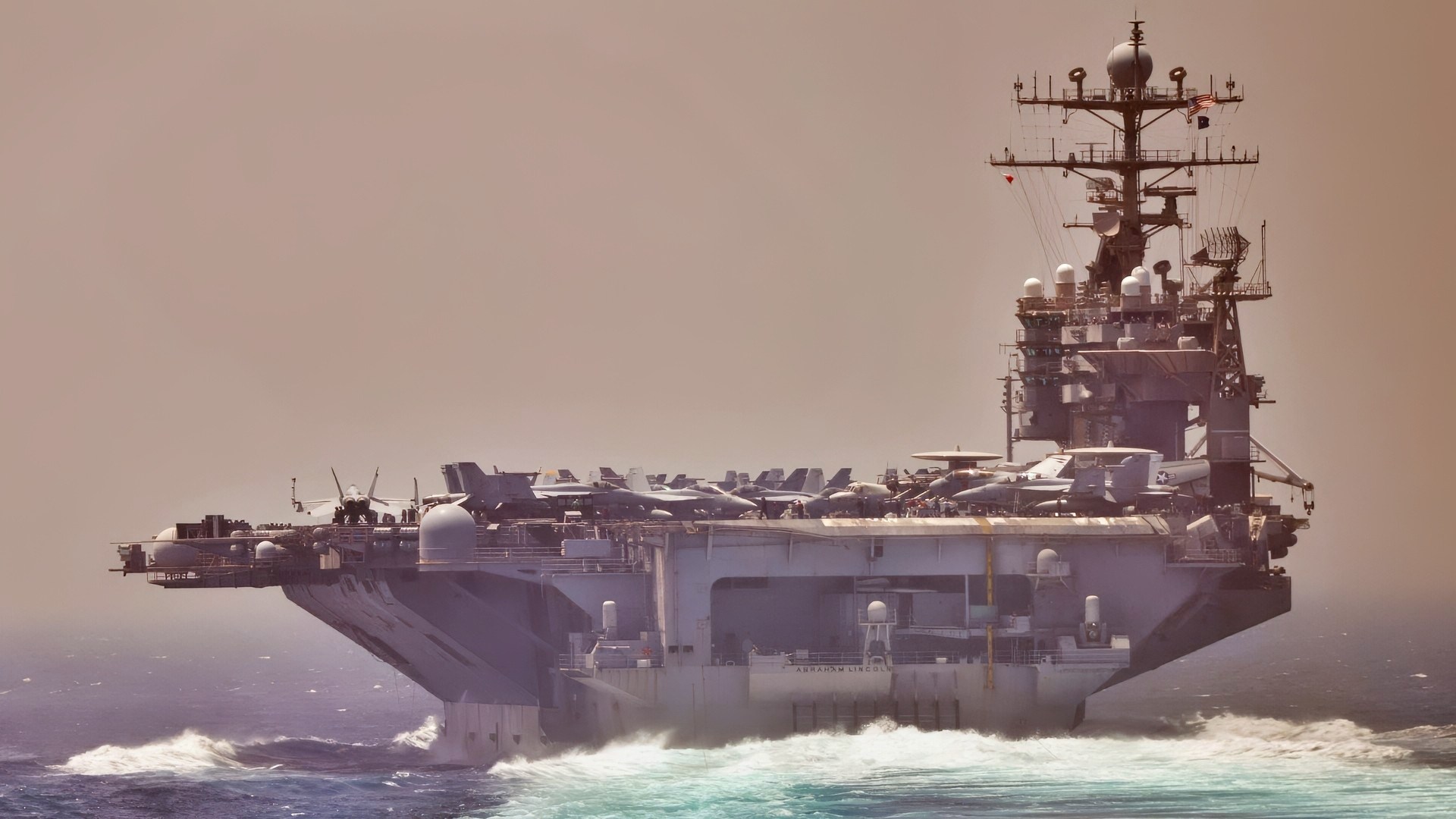
STRAIT OF HORMUZ (May 1, 2012) The aircraft carrier USS Abraham Lincoln (CVN 72), left, and the guided-missile cruiser USS Cape St. George (CG 71) transit the Strait of Hormuz. Abraham Lincoln and Cape St. George are deployed to the U.S. 5th Fleet area of responsibility conducting maritime security operations, theater security cooperation efforts and support missions as part of Operation Enduring Freedom. (U.S. Navy photo by Mass Communication Specialist 3rd Class Alex R. Forster/Released)
Supplying from Bahrain to the Gulf of Oman takes one and a half days, Clare told the outlet.
But getting them from Diego Garcia [The British military base in the Indian Ocean] takes about five days. And that doesn’t even count the need for some round trips.
“A replenishment ship that could have resupplied Lincoln once every three days can now replenish Lincoln only once every 10 days,” Clare added.
The Hudson Institute’s Clark said that the Strait of Hormuz has also been an issue.
“It’s not just the fact that Bahrain got attacked,” Bryan Clark, a retired Navy commander who is now with the think tank the Hudson Institute, told MS NOW. “It’s the fact that we can’t risk sending cargo ships up and down the Strait of Hormuz because the Iranians are attacking shipping.”
And it’s tied to the president’s claims about the Strait of Hormuz.
“So, the Navy doesn’t want to be open about the fact that we can’t control the Strait of Hormuz; therefore, we cannot use the Strait of Hormuz to move shipping up into places where we could get resupplied.”
Lawmakers, led by Sen. Richard Blumenthal (D-CT), acting on behalf of families of those aboard the carrier, had been pushing in recent weeks for answers on the poor conditions. Blumenthal wrote a letter to the Secretary of Defense and the acting Secretary of the Navy asking for answers.
A Lack of Planning?
MS NOW also quoted another retired commander about what went wrong.
“We didn’t plan for this war; we just did it sort of on the fly,” the Hudson Institute’s Clark told the outlet. “And when you fight a war as a pickup game, this is the kind of stuff that happens.”
The Pentagon Fights Back
Defense Secretary Pete Hegseth, MS NOW reported, disputed claims of supply issues, stating that “we make sure every ship, every crew, every captain has everything we can provide them at every single moment.”
In a statement posted to social media earlier this week, CENTCOM Commander Admiral Brad Cooper, who had visited the Abraham Lincoln, called the crew “awe-inspiring.”
“You would beam with absolute pride when witnessing their camaraderie, teamwork, and resilience.” He also stated that of the Navy’s eleven carriers, the Lincoln has “among the lowest number of cases of mental health.”
Cooper made similar statements in a Wall Street Journal op-ed published on August 16.
“Recent media reporting has portrayed varying perspectives on operational tempo, crew morale and the realities facing our deployed forces,” Cooper said in the Journal op-ed. “What I found aboard the Lincoln is that many elements of those stories are old news.”
About the Author: Stephen Silver
Stephen Silver is an award-winning journalist, essayist, and film critic, and contributor to the Philadelphia Inquirer, the Jewish Telegraphic Agency, Broad Street Review, and Splice Today. The co-founder of the Philadelphia Film Critics Circle, Stephen lives in suburban Philadelphia with his wife and two sons. For over a decade, Stephen has written thousands of articles on politics, national security, technology, and the economy. Follow him on X (formerly Twitter) at @StephenSilver, and subscribe to his Substack newsletter.


