

Washington is set to outline what it termed the “toughest sanctions in history” on Iran from next week, U.S. Treasury Secretary Scott Bessent said on Thursday.
President Donald Trump also said “tremendous economic consequences” could follow for states that offer Tehran assistance.

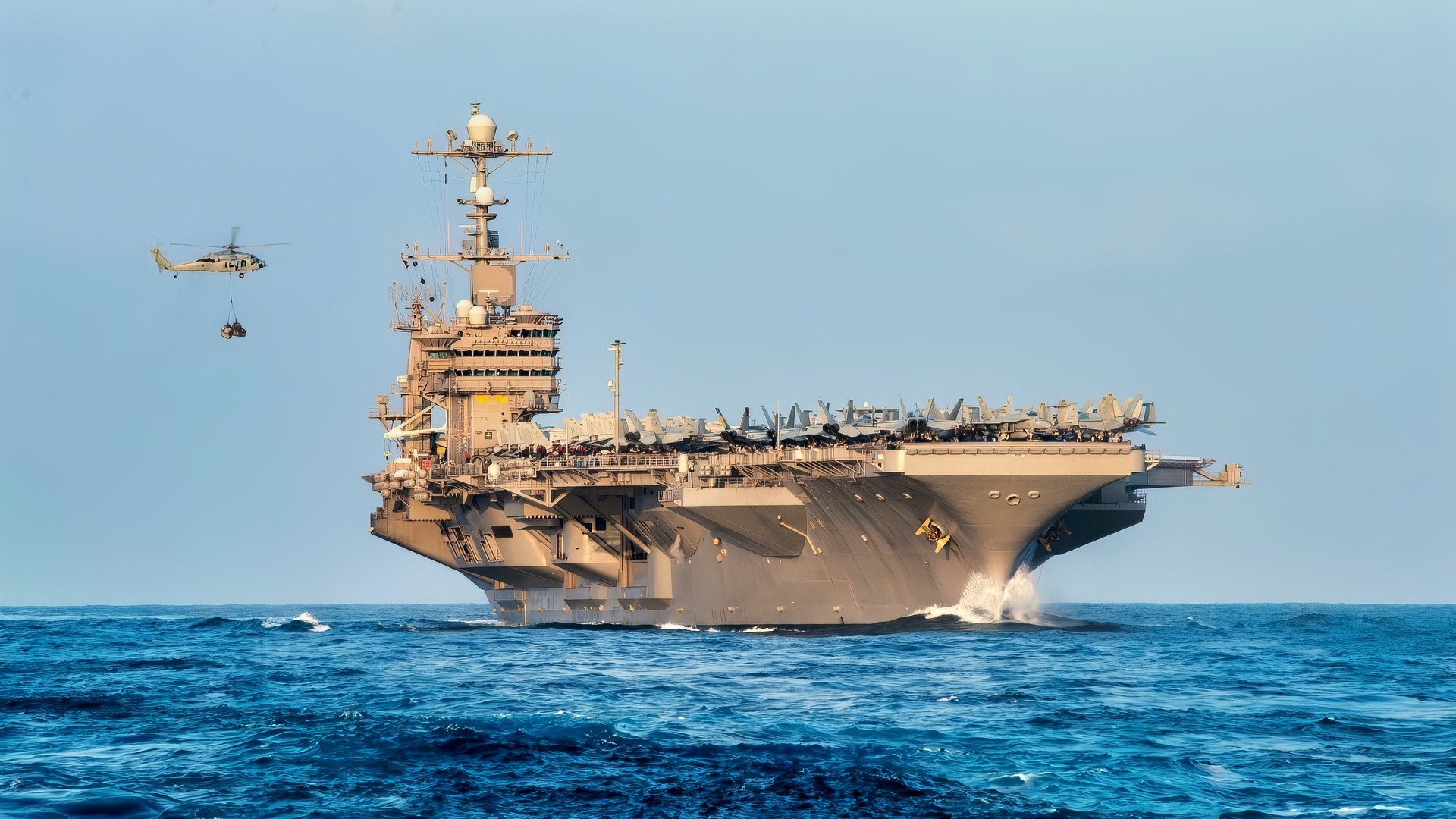
Ford-Class. Image Credit: Creative Commons

The Ford-class aircraft carrier USS Gerald R. Ford (CVN 78) and the Italian aircraft carrier ITS Cavour (CVH 550) transit the Atlantic Ocean March 20, 2021, marking the first time a Ford-class and Italian carrier have operated together underway. As part of the Italian Navy’s Ready for Operations (RFO) campaign for its flagship, Cavour is conducting sea trials in coordination with the F-35 Lightning II Joint Program Office’s Patuxent River Integrated Test Force to obtain official certification to safely operate the F-35B. Gerald R. Ford is conducting integrated carrier strike group operations during independent steaming event 17 as part of her post-delivery test and trials phase of operations. (U.S. Navy photo by Mass Communication Specialist 3rd Class Riley McDowell)
Meanwhile, the oil squeeze is hitting an economy with little room left to absorb another shock. And China isn’t complying with Washington.
Iranian Economy Set to Face Squeeze
The International Monetary Fund expects Iran’s economy to contract by 5.4% in 2026 while average consumer-price inflation reaches 68.9%.
The Associated Press reported Friday that Tehran’s stores remain stocked, but many families can no longer afford what is on the shelves. Rice is around 60% more expensive than before the war began in February, while beef prices have risen about 150%.
An Iranian Labor Ministry official said last week that more than one million jobs had been lost by late May, according to AP. Gasoline remains heavily subsidized, but an aide to President Masoud Pezeshkian warned that domestic consumption now exceeds production.
Ordinary Iranians face much more constrained purchasing power, but that does not suggest the economy is about to implode.
But just how major is the impact on Iran’s oil sales? On Friday, offers of Iranian crude to Chinese buyers slated for September and October delivery fell amid the continued U.S. naval blockade.
Iranian crude currently kept in floating storage outside the blockade zone has fallen from almost 105 million barrels before the fresh blockade to about 80 million barrels, according to Kpler data.
Kpler analyst Muyu Xu told Reuters that about 40 million barrels were already on ships in Malaysian waters east of Singapore, but most of the oil has been promised to buyers.
China’s Love Affair With Iranian Oil
China remains the key global customer, having bought over 80% of Iran’s shipments last year. But Kpler estimates put Chinese imports of Iranian crude at about 534,000 barrels per day so far in August, compared with an average of 1.4 million barrels per day last year.
Sanctions have limitations. While they can inflict some damage, Iran often knows how to work around them. For decades the regime has erected a sophisticated web of front companies, informal payment systems, third-country trade and shadowy oil shipments.
Beijing hit back at the U.S.’s sanctions plans on Friday. Lin Jian, China’s foreign ministry spokesperson, said China believes that “sanctions and pressure tactics are not the solution,” and that dialogue would be preferred.
No End in Sight
Polymarket traders are currently estimating a measly 6 percent chance that traffic will return to normal in the Strait by September 30.
Trump said earlier this week that no direct talks are underway between Iran and the U.S.
When the U.S. launched joint attacks on Iran with Israel in February, Trump urged opponents of the regime to “take over” the Iranian government. An uprising has failed to materialize as of yet, and Iran’s theocratic regime along with its fiercely ideological Islamic Revolutionary Guard Corps (IRGC) still dominate the country’s security and military apparatus.
Hostile States Seek to Push Back
Leland Miller, a commissioner at the U.S.-China Economic and Security Review Commission, has suggested Beijing is ramping up for a retaliation.
Last month, prior to the talk of major sanctions on Iran, he said: “Since President Trump first came into office, China has been searching for an effective way to push back against U.S. pressure. I think Beijing believes it has found that formula by transforming what used to be called the trade war into a much broader supply chain war.”
In other words, the U.S. can certainly use economic pressure on Iran, China, and other hostile states, but it must prepare itself to receive a response in kind.
In their new book Axis of Aggressors, which documents 600-plus instances of significant collaboration between China, Russia, Iran and North Korea, Rear Admiral (Ret.) Mark Montgomery and his co-authors, Bradley Bowman and Elaine Dezenski, warn against underestimating ties between anti-Western powers.
“Europe still looks at this conflict and says these are two co-equal belligerents: Iran and the US. That’s ridiculous. Iran is backed by Russia. It’s backed by China. In the past, it has been backed by North Korea. Yet we still cannot get Europe to support us against Iran,” Montgomery told Radio Liberty.
About the Author: Georgia Gilholy
Georgia Gilholy is a journalist based in the United Kingdom who has been published in Newsweek, The Times of Israel, and the Spectator. Gilholy writes about international politics, culture, and education.


