

The UK Royal Navy currently operates two conventionally powered supercarriers: The HMS Queen Elizabeth and the HMS Prince of Wales.
The ships are three times the size of the Invincible-class carriers they replaced and can carry F-35B fifth-generation stealth fighters.

HMS Prince of Wales. Image Credit: Royal Navy.
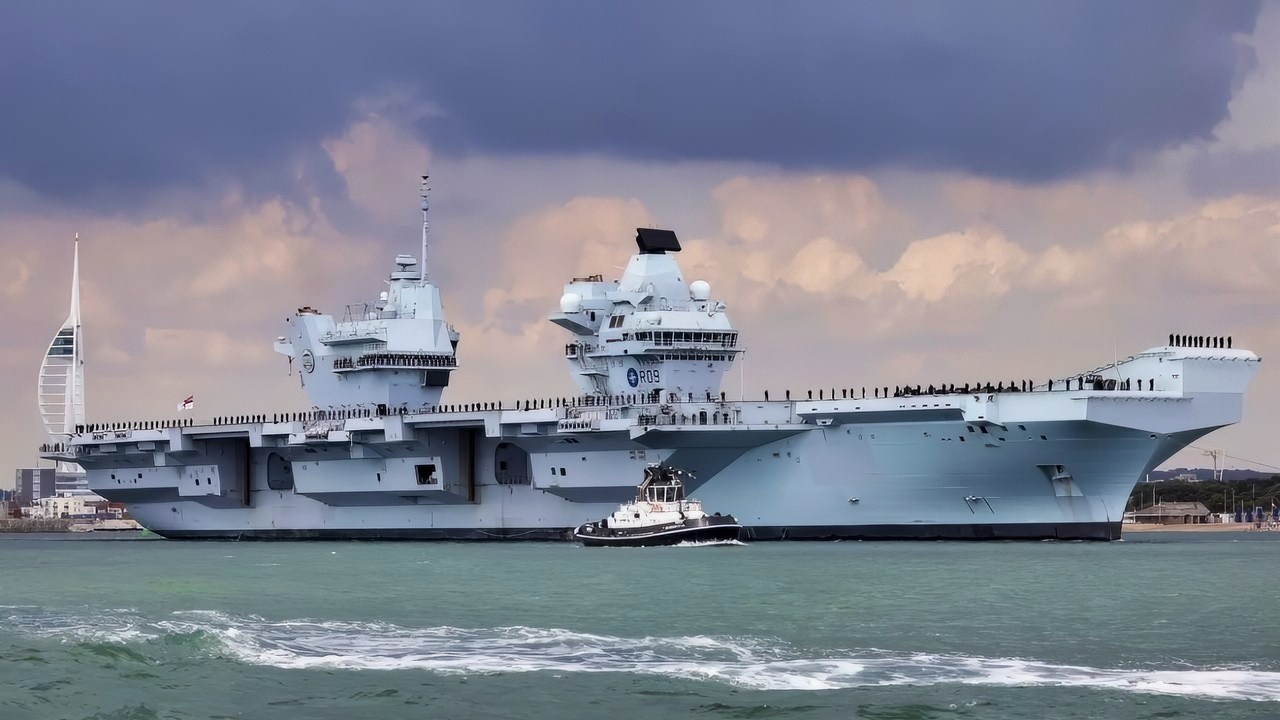
HMS Prince of Wales Aircraft Carrier. Image Credit: Royal Navy.
Queen Elizabeth has made headlines several times, admittedly not always for good reasons.
While the class suffers from reliability issues, there is a lot to say in favor of Britain’s two-carrier fleet.
Despite being smaller than their American counterparts, the Queen Elizabeth-class incorporates a sophisticated radar suite that, combined with its air wing, makes it an invaluable asset at sea and a vital component of the UK’s naval strategy.
Designing the UK’s Newest Carriers
In 1997, the newly elected Labor government, led by Prime Minister Tony Blair, launched the Strategic Defense Review, which re-evaluated every weapon system in the UK, with a few notable exceptions.
In that report, the government concluded that air power was the key to any future conflict, regardless of scale. To that end, aircraft carriers would always serve a purpose in the Royal Navy.
At the time, the UK operated three Invincible-class aircraft carriers, which were incredibly small and limited in their range, hangar space, and endurance. In 1999, the Ministry of Defense began its studies to develop a replacement for its current carrier fleet.
Initially, the UK weighed several options to modernize its carrier fleet, ranging from extending the service lives of its Invincible-class carriers to converting civilian ships into carriers.
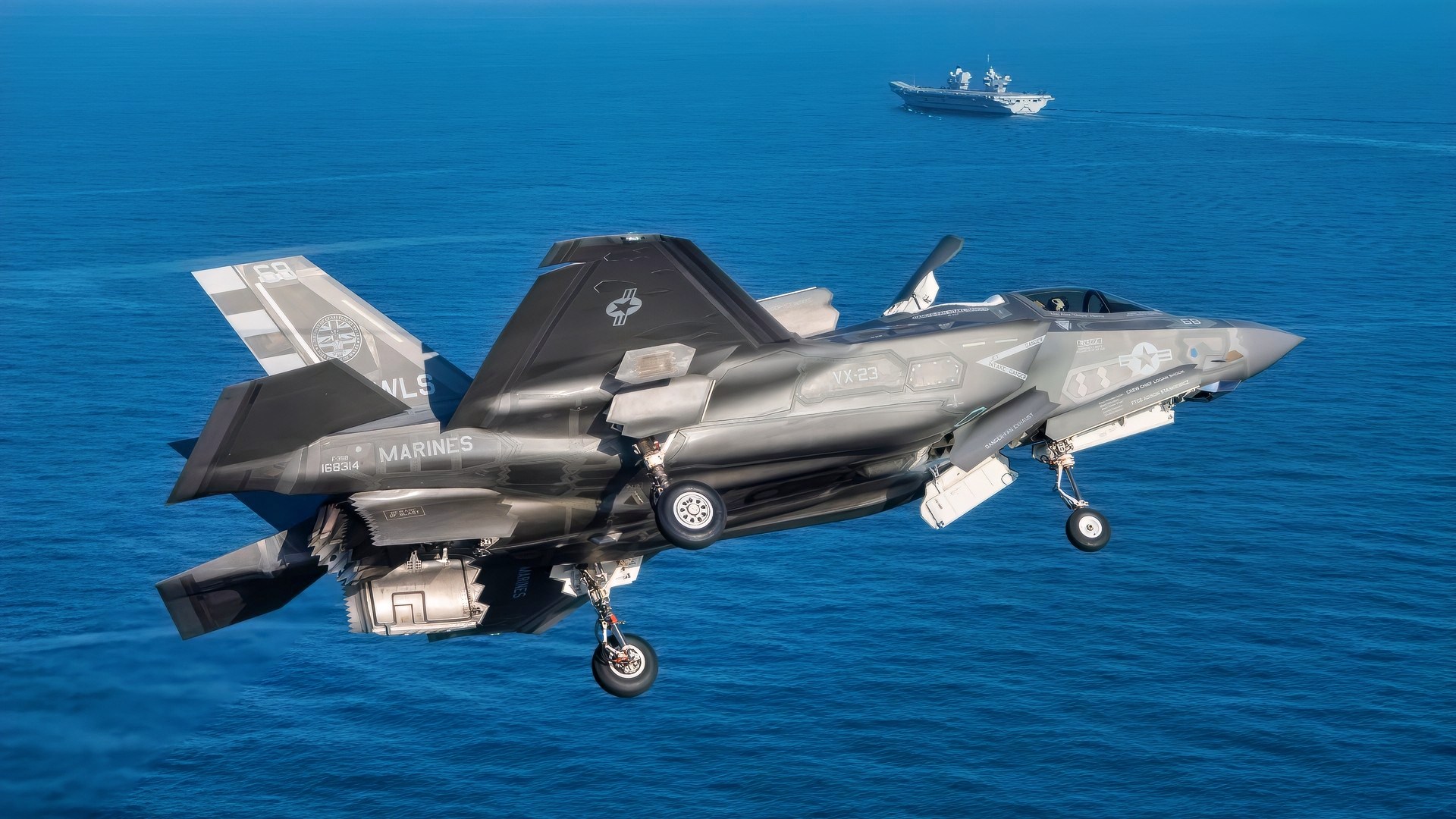
F-35 test pilot Marine Maj. Paul Gucwa from Air Test and Evaluation Squadron Two Three (VX-23), Naval Air Warfare Center Aircraft Division (NAWCAD), flies an F-35B Lightning II fighter aircraft to the U.K. HMS Prince of Wales aircraft carrier in the Western Atlantic Oct. 11, 2023. Gucwa will embark with a detachment from the Patuxent River F-35 Integrated Test Force (ITF) to conduct developmental test phase 3 (DT-3) sea trials with the specially instrumented, short takeoff vertical landing variant of the stealth jet aboard Britain’s largest warship.
The U.K. Queen Elizabeth-class (QEC) aircraft carrier HMS Prince of Wales (R09)’s participation in WESTLANT 23 encompasses a range of U.K. and U.S. naval aircraft trials in the Western Atlantic throughout the autumn of 2023.The HMS Prince of Wales continues to push the boundaries of naval aviation capabilities and operations from QEC aircraft carriers, including increasing the range and lethality of F-35 operations. The U.K. is the only Tier I partner in the F-35 Joint Strike Fighter (JSF) Program. U.K. and U.S. interactions during this deployment are characterized by cooperation and reinforce international relationships, as well as enhance interoperability between the U.S. Navy and Royal Navy.
The F-35 Joint Program Office is the U.S. Department of Defense’s focal point for the 5th-generation strike aircraft for the Navy, Air Force, Marines, and our allies. The F-35 is the premier multi-mission, 5th-generation weapon system. Its ability to collect, analyze and share data is a force multiplier that enhances all assets in the battle space: with stealth technology, advanced sensors, weapons capacity, and range. The F-35 has been operational since July 2015 and is the most lethal, survivable, and interoperable fighter aircraft ever built.
(US Navy photo by Dane Wiedmann)
In the end, however, the MoD opted to build an entirely new class from the ground up. From the beginning, the UK intended to incorporate the Joint Strike Fighter (JSF) into its air wing.
The JSF, later the F-35, was of major interest to the UK, which became a key partner in the program and was involved in its development.
The new carrier would also be much larger than its predecessors, with the Royal Navy aiming for a displacement of around 88,000 tons, placing it in the supercarrier range alongside the American Nimitz-class.

The aircraft carrier USS Nimitz (CVN 68) arrives at Joint Base Pearl Harbor-Hickam, Hawaii, for a scheduled port visit Dec. 3, 2013. The Nimitz was in the process of returning to its home port, Everett, Wash., following an eight-month deployment to the U.S. 5th Fleet, U.S. 6th Fleet and U.S. 7th Fleet areas of responsibility. (U.S. Navy photo by Mass Communication Specialist Seaman Apprentice Rose Forest/Released)
Specs and Capabilities
The HMS Queen Elizabeth began construction in 2010 and began sea trials in 2017 after she was commissioned. She has a displacement of 66,000 tons when running empty and 88,800 tons when fully loaded, and measures 284 meters in length.
Both ships of the class are conventionally powered by two Rolls-Royce Marine 36 MW MT30 gas turbine alternators and four 10 MW diesel engines.
While this does not provide the same longevity as nuclear propulsion, Queen Elizabeth has an operational range of 10,000 nautical miles and a top speed of 32 knots. She can accommodate a total of 1,600 personnel, including her air wing.
In peacetime, the Queen Elizabeth-class carriers carry up to 40 aircraft, but in war, the ships can carry up to 72 fighter jets. As mentioned before, the ships were designed to carry the F-35 Lightning II in its short take off/vertical landing (STOVL) configuration. Queen Elizabeth uses a ski-ramp configuration to launch aircraft.
The MoD had originally intended to convert her sister ship, the HMS Prince of Wales, into a CATOBAR carrier with steam catapults or even EMALS, but the UK abandoned these plans due to the high cost of the program.
The F-35B forms the cornerstone of the carrier’s air wing, complemented by rotary-wing aircraft like the AW159 Wildcat and the Merlin HM2 early-warning aircraft.
More recently, however, the UK has tested the carrier’s ability to launch and recover UAVs like the General Atomics Mojave.
The UK’s Largest and Most Expensive Naval Vessels
Initially, the cost of building the two carriers was estimated at around £3.9 billion. However, the final cost of building Queen Elizabeth and Prince of Wales totaled £6.2 billion, or roughly £3.1 billion per ship (about 5.3 billion USD).
A considerable amount of that funding went towards the development and installation of the ships’ sophisticated radar suite.
Both ships are equipped with an S1850M for long-range wide-area search radar developed by Thales and BAE Systems, the Type 997 Artisan 3D medium-range phased array radar, and the Series 2500 Electro-Optical System.
These radars help with air traffic control and enemy detection.
To increase its detection range, the carriers can deploy helicopters with sonar buoys and other avionics to detect submarines and other stealth ships.
The Queen Elizabeth-class features a dual-island configuration, with one tower handling air traffic control and the other commanding and controlling the ship.

HMS Prince of Wales and HMS Queen Elizabeth pictured at sea for the first time. Image Credit: Royal Navy.
Each tower can assume the role of the other if one is disabled.
For defenses, each carrier is armed with three Phalanx close-in weapon systems (CIWS), with future plans to add four 30-mm DS30M Mk2 guns.
The carriers’ primary defenses are their escort ships and air wings, which protect against incoming missiles, enemy aircraft, and submarines.
The Queen Elizabeth and her sister ship are currently the Royal Navy’s most important vessels, next to the Vanguard-class submarines.
About the Author: Isaac Seitz
Isaac Seitz, a Defense Columnist, graduated from Patrick Henry College’s Strategic Intelligence and National Security program. He has also studied Russian at Middlebury Language Schools and has worked as an intelligence Analyst in the private sector.


