
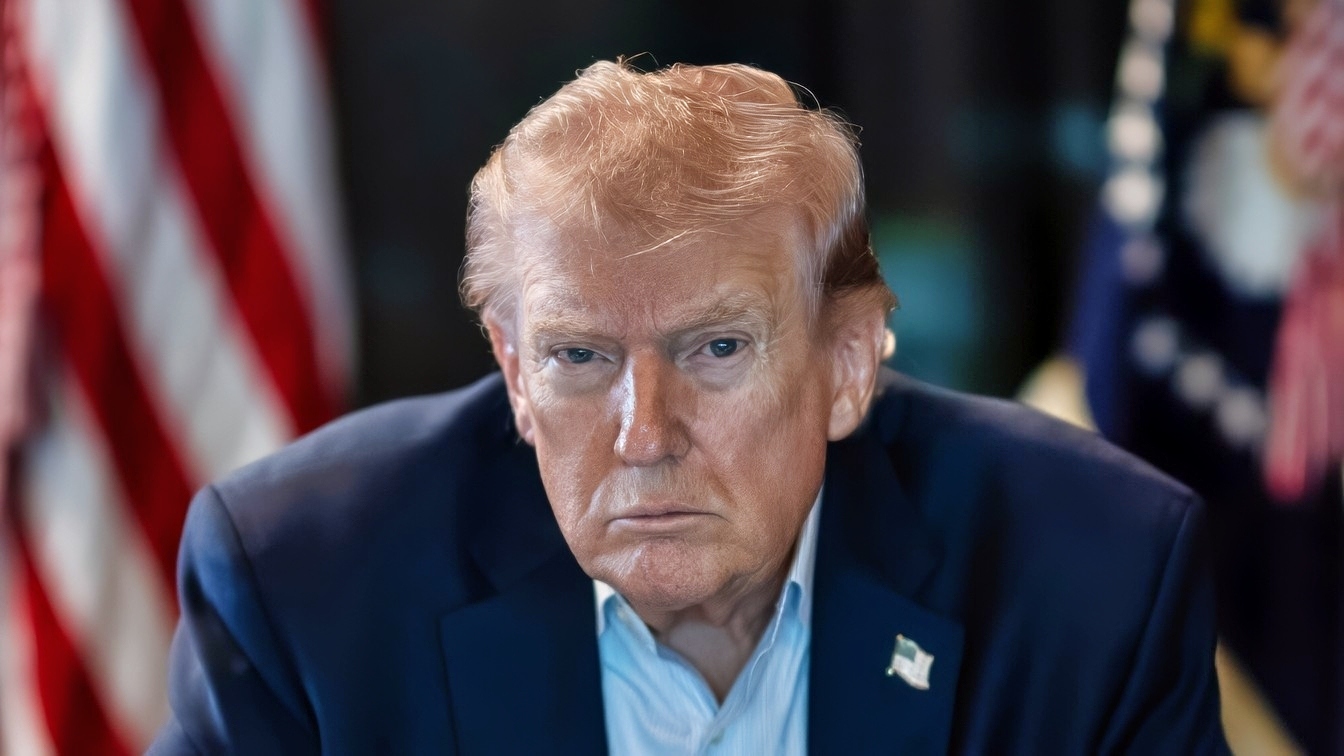
Why Trump Is Threatening Pickaxe Mountain – As the U.S. and Iran exchange fire again, President Trump is threatening to attack one of the few major components of Iran’s nuclear infrastructure that has so far survived the war. On Friday, September 4, Trump said that the United States could make moves to attack the heavily fortified Pickaxe Mountain complex “very soon.”
Speaking to reporters in the Oval Office, Trump said the United States was closely monitoring activity at the site and elsewhere in Iran, declaring that Washington knows “everybody that’s moving at Pickaxe.”

An F-15EX Eagle II Fighter Jet assigned to the 85th Test and Evaluation Squadron, Eglin Air Force Base, Florida, taxis out from Nellis Air Force Base, Nevada, Oct. 21, 2021. The new F-15EX aircrafts are at Nellis AFB to test how effective and suitable the aircraft is for future use in our Air Force. (U.S. Air Force photo by William R. Lewis)

A U.S. Air Force F-15EX Eagle II flies over the Gulf of America, September 16, 2025. The F-15EX, from the 40th Flight Test Squadron at Eglin Air Force Base, Florida, is one of the first F-15EXs in the Air Force, and is going through developmental and operational test series at Eglin to confirm its operational capabilities before it is delivered to the combat Air Force. (U.S. Air Force photo by Staff Sgt. Blake Wiles)
It’s not the first time the threat has been made, or that the president has warned that he would take extraordinary action against some of Iran’s most high-value nuclear sites. But after six months of conflict, the warning may now be a more realistic threat — even if causing damage to the heavily fortified site would prove logistically challenging to the U.S. military even under ideal circumstances.
The warning comes as the U.S. and Iran continue to trade strikes after a roughly month-long period of relative calm, and as Iran shifts its doctrine to an offensive one.
What Is Pickaxe Mountain?
Pickaxe Mountain, also known in Iran as Kuh-e Kolang Gaz La, is located 140 miles south of Tehran and just over a mile from the Natanz nuclear complex that was targeted in prior U.S. strikes. It is one of the centers of Iran’s uranium enrichment program.
Construction began in 2020 after an explosion destroyed an above-ground facility at Natanz that was used to manufacture advanced centrifuges. After the explosion, Iranian nuclear chief Ali Akbar Salehi announced plans to build a large and more modern replacement facility buried deep inside a nearby mountain. That decision was a result of a major vulnerability for Tehran: that its nuclear facilities were being observed by Israeli intelligence and satellites, and that the sites were vulnerable to attacks from much larger nations.
Pickaxe Mountain solved some of those problems by burying the facility deep underground. Satellite imagery analysis indicates that the complex contains two sets of tunnel entrances leading to facilities that may extend to depths of up to100 meters underground. The entrances have also been hardened, making it unlikely that an attack using conventional weapons would damage or destroy the facility.
The facility is secretive, too — though much is still known about it thanks to years of Israeli intelligence operations. That said, the facility has never been inspected by the International Atomic Energy Agency. Iran said in July that no nuclear activity was taking place there, but its proximity to Natanz means that it is still being watched intensely — and is widely believed to be the obvious site for the next evolution of the country’s nuclear program.
Why Iran Needs Pickaxe Mountain
The facility is particularly important for Tehran now because much of its existing nuclear infrastructure has been damaged or destroyed. Israeli and American strikes hit Iran’s three principal nuclear facilities during the June 2025 war, and Natanz has been targeted again during the current conflict.
And with the regime insisting it will continue its nuclear program, it will need a new site to begin rebuilding.
Iran also appears to have preserved some of the equipment it would need to begin rebuilding. Israeli intelligence reportedly concluded that Tehran moved thousands of centrifuges used to enrich uranium into Pickaxe Mountain following the 2025 attacks. Washington shares the same belief.
That equipment, understood to be stored in the mountain today, may be there simply for protection rather than being prepared for operation within the mountain, but the facility’s survival gives Iran hope that the machinery required to restore its enrichment capacity in the future can be used again.
The site might also be home to the 440.9-kilogram stockpile of uranium enriched to 60% that the International Atomic Energy Agency believes survived the recent U.S. and Israeli strikes.
That material, if it is indeed protected and accessible, could theoretically provide enough uranium for several nuclear weapons if enriched further.
Why Is Trump Threatening It Now?
That remaining stockpile and the potential for Iran to use the site to rebuild its nuclear program in a facility far harder to destroy are two good reasons why President Trump is threatening to strike now. Washington likely sees an opportunity that will become much harder to exploit later. Pickaxe Mountain is still under development, and a completed facility buried beneath hundreds of feet of rock could provide Iran with a substantially more survivable nuclear complex. The chances of a ground invasion remain slim because such an operation would require enormous military resources, so preventing the site from becoming operational now sounds more favorable than waiting for it to be built.
Secondly, the threat also gives Washington additional leverage as diplomatic pressure on Tehran intensifies.
At least, in theory.
About the Author:
Jack Buckby is a British researcher and analyst specializing in defense and national security, based in New York. His work focuses on military capability, procurement, and strategic competition, producing and editing analysis for policy and defense audiences. He brings extensive editorial experience, with a career output spanning over 1,000 articles at National Security Journal, and has previously authored books and papers on extremism and deradicalization.


