
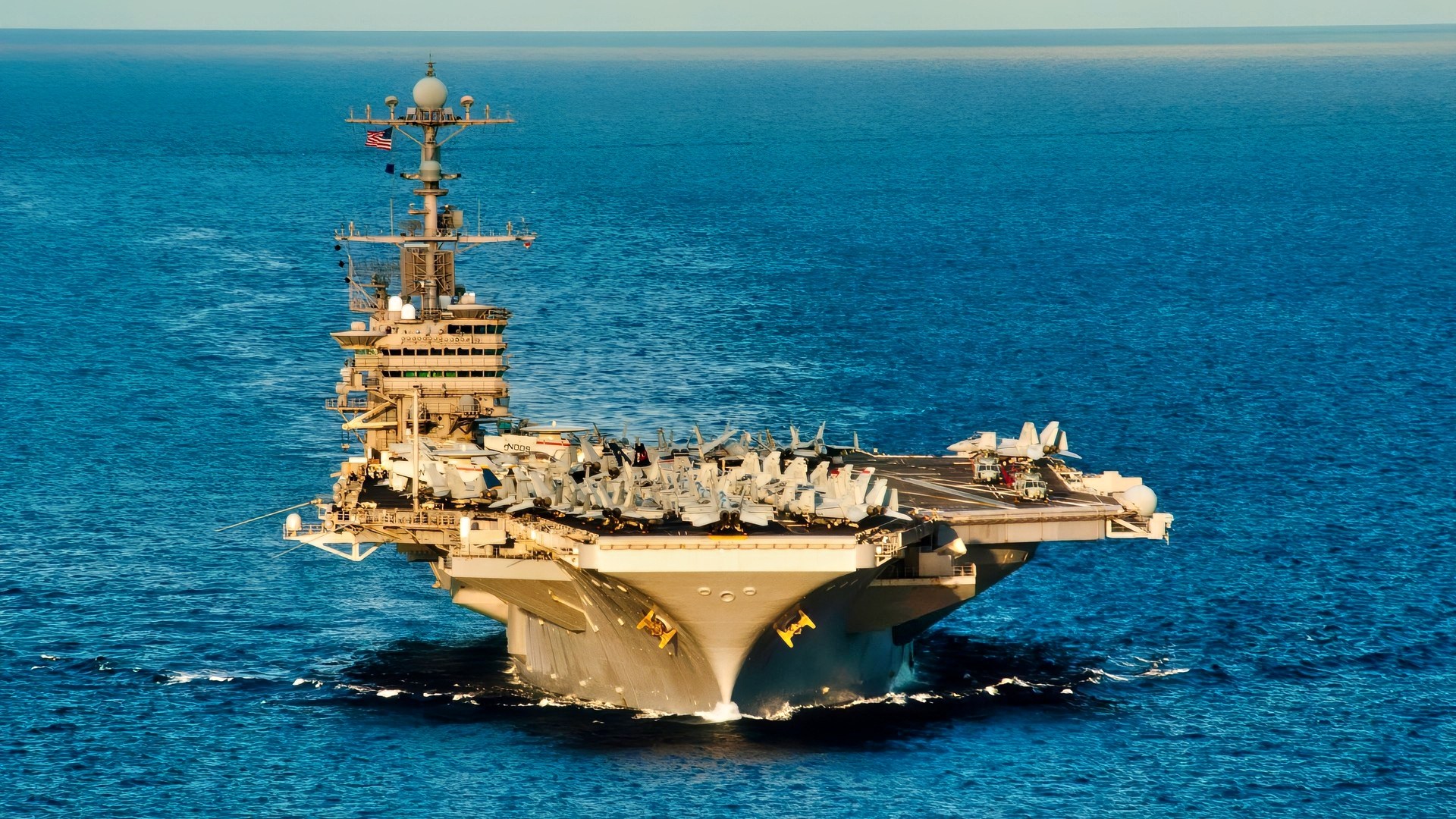
The stalemate between the United States and Iran in the Strait of Hormuz again escalated on Saturday, September 5, after Iranian forces targeted two U.S. Navy warships with ballistic missiles. The United States then responded with attacks on three Iranian oil tankers — a series of strikes that confirmed recent reports that Washington was considering a new “tanker for tanker” approach intended to wipe out Iran’s tanker fleet.
U.S. Central Command said that the Iranian missiles targeted an aircraft carrier and guided missile destroyer, though neither vessel was hit and no American personnel were injured. American forces attacked three crude carriers that form part of Iran’s struggling oil export network.

USS George Washington. Image Credit: Creative Commons.
The strikes come as Washington desperately works to wind the conflict down ahead of the November midterm elections, with fuel prices skyrocketing and Americans growing tired of a war that the president insisted would be over in as little as five weeks.
The U.S. Is Going After Iran’s Oil
The U.S. response to Iran’s attack on Saturday represents a shift in strategy, with the White House now imposing an economic cost on Iran for every military attack.
Iran’s tankers are largely unusable at present due to the ongoing U.S. naval blockade of Iran-linked ships transiting the Strait of Hormuz, but those tankers would theoretically allow Iran to continue its oil trade once the blockade is lifted.
Every tanker destroyed is one more expensive asset that Iran needs to pay to rebuild, which would not only require financial resources that Iran presently does not have, but time, too.
One of the attacks occurred near Kharg Island, the center of Iran’s crude-export infrastructure. Iranian media reported that a tanker near the island was struck by four U.S. missiles and that its crew was evacuated without casualties.
Before the disruption caused by the war and the American blockade, roughly 90% of Iran’s crude exports moved through Kharg.
That makes any tanker operating around the island a particularly valuable target if Washington intends to make Iran’s military escalations more expensive without immediately returning to a much larger bombing campaign that would further degrade the United States’ already depleted stockpile of precision weapons.
Iran Is Changing Tactics
After spending much of the war attempting to defend itself while largely using its missile arsenal to cause disruption in the Strait of Hormuz, Iran is now demonstrating that it is willing to strike first.
Already under extreme economic and military pressure, the regime and its hardline leadership have less to lose than ever and are now signaling that they intend to become more aggressive and begin striking first.
Brig. Gen. Mohammad Akraminia, spokesman for the Iranian army, said during a program broadcast on Iranian state television on Friday, September 4, that the country is changing the rules governing when its forces can attack. “When we face an American threat, we defend ourselves, and international law allows us to defend ourselves preemptively,” Akraminia said.
The comments expanded on other remarks Akraminia made to Iran’s state-run IRNA news agency in August, when he said that the war had gradually pushed Iran from a traditionally defensive military doctrine toward an offensive one.
Under that new strategy, he suggested, Tehran could strike before an anticipated attack and respond to attacks on a larger scale.
For Washington, that presents a major problem.
The White House is trying to de-escalate and leave the war, but Iran is effectively forcing Washington to respond to strikes and continue to deplete its missile stockpile.
Both Sides Think Time Is On Their Side
Iran is willing to accept more risk than ever, having already lost much of its conventional military and now under major economic and military pressure.
The regime has less to lose, and after the United States has proven it cannot force the regime to negotiate or end its nuclear program even after six months of bombing, the regime appears to believe that it can keep fighting at least until after the November midterms.
And if Iran can ensure Trump remains tied up in a war the American people don’t want, it can effectively rob the president of legislative power for the next two years.
Speaking at an event in Mashhad on Friday, Akraminia argued that Washington had miscalculated Iran’s ability to withstand the war and had failed to destroy its missile and nuclear capabilities or destabilize the government.
Iran has also spent the periods of reduced fighting, during which President Trump hoped diplomacy would prevail, rebuilding its forces as best it can.
Akraminia said as much during an interview with Mehr News Agency in late August, in which he said that Iran was preparing new equipment and tactics to reach new targets, including regional energy and communications infrastructure.
For now, neither side is backing down — and escalation seems inevitable.
About the Author: Jack Buckby
Jack Buckby is a British researcher and analyst specializing in defense and national security, based in New York. His work focuses on military capability, procurement, and strategic competition, producing and editing analysis for policy and defense audiences. He brings extensive editorial experience, with a career output spanning over 1,000 articles at 19FortyFive and National Security Journal, and has previously authored books and papers on extremism and deradicalization.


