

Since the United States and Israel launched joint strikes on Iran on February 28, 2026, killing Supreme Leader Ali Khamenei and about 40 of his top advisors, and touching off what is now widely called the 2026 Iran conflict, the conflict has cycled through ceasefires, collapses, and renewed strikes rather than settling into either victory or peace.
As of early September 2026, the pattern is maddeningly familiar: U.S. strikes on Iranian tankers and military sites, Iranian missile and drone retaliation against U.S. bases and shipping, and a Strait of Hormuz that remains a live flashpoint.

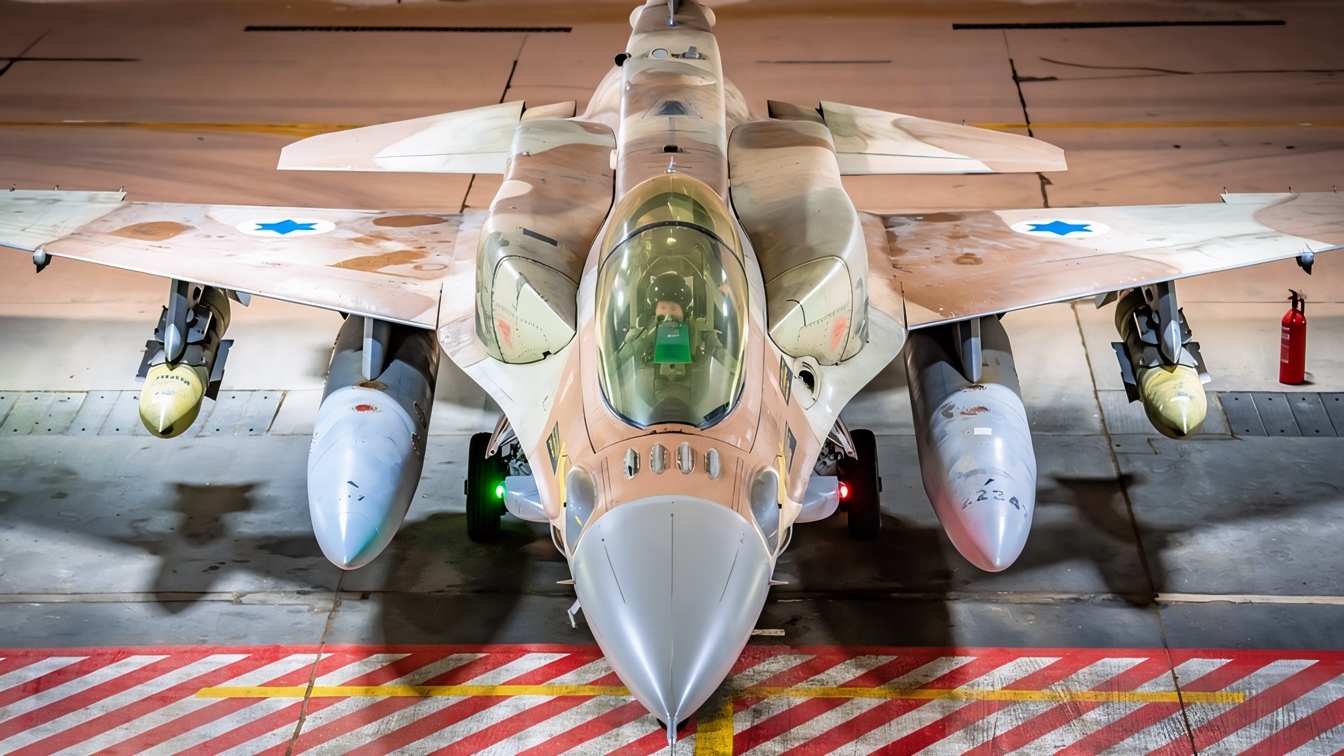
F-16I Sufa. Image Credit: Creative Commons.

F-16I Fighter from Israel. Image Credit: Creative Commons.
The US military’s intent to escalate further is not in doubt.
The harder question for Washington, and one that has dogged the Trump administration since February, is whether escalation serves an achievable political endgame or is simply a self-sustaining cycle.
The Escalation Toolkit Has Had Mixed Results
Washington’s options for widening the campaign are well understood and mostly already in use: expanding the target set beyond military and nuclear-linked sites to energy infrastructure and shipping (as seen in strikes on Iranian oil tankers in the Gulf of Oman); tightening the naval blockade imposed in April, which the Pentagon estimated had already cost Iran billions in lost oil revenue by May; layering on additional sanctions, as happened just before the latest round of strikes; and leaning further into covert and overt support for Iranian opposition groups in hopes of hastening internal collapse.
None of this requires new capability.
It requires only a decision to turn the dial further, and the administration has repeatedly shown willingness to do so, including threats of catastrophic strikes during the failed April negotiations.
What Is The Endgame?
Washington has yet to identify a coherent theory of how military pressure converts into a durable political settlement.
The war’s stated objectives have shifted over time.
At the outset, U.S. and Israeli officials framed the strikes as aimed at dismantling Iran’s nuclear and ballistic missile programs and inducing regime change, two goals that don’t obviously reinforce each other, since a regime fighting for survival has less incentive to negotiate away its deterrent, and a decapitated regime may fragment rather than democratize.
Mossad itself reportedly regarded uprising-focused regime change as unrealistic for years before reversing course after 2025’s Twelve-Day War, according to reporting on regime-change planning.
Diplomatically, the record since February has been one of near-misses.
A Pakistan-brokered ceasefire held, with violations, from April to July, and negotiators reportedly came close to a memorandum of understanding in May, per Britannica’s account of the conflict.
But the deal kept running into the same obstacles: Iran tied any lasting settlement to a halt in Israeli operations in Lebanon, refused to put its ballistic missile program on the table, and, per a House of Commons Library briefing, sought “firm guarantees against future aggression,” recognition of its “legitimate rights,” and reparations, along with a new toll-charging regime over the Strait of Hormuz that both the U.S. and Oman have rejected.
Fighting resumed in July after an Israeli strike on Beirut, and by September the two sides were back to trading strikes on tankers, bases, and missile launches.
That cycle is the crux of the endgame problem: each side has a maximalist precondition the other refuses to grant, and neither has been forced into a position where it must.
Iran’s leadership, decapitated but not dissolved, has adopted a strategy, described by security scholar Robert Pape as horizontal escalation, of spreading the costs of the conflict across the region (strikes on U.S. partners in Jordan, Qatar, and the UAE) in hopes of making the continued fighting too expensive for Washington to sustain, rather than seeking outright victory.
Washington, meanwhile, has swung between demanding capitulation and quietly re-engaging in talks, without settling on which approach it is actually pursuing.
What Would An Endgame Require?
Analysts and officials involved in the failed talks point to a narrower, if less satisfying, path than total victory or total capitulation: an off-ramp built around parallel, sequenced concessions rather than a single grand bargain.
That would likely mean handling the Lebanon situation separately from Iran, so that progress on one doesn’t hostage the other; a face-saving formula on missiles and the Strait of Hormuz freedom of navigation access that stops short of Iran’s toll demands but offers some sanctions relief or reconstruction assistance in exchange for verifiable limits; and a credible security guarantee from Washington that reduces Tehran’s incentive to rebuild deterrent capability covertly, since fear of renewed strikes is itself an incentive to keep escalating in secret.
None of that is even remotely close at hand.
The more strikes accumulate without a matching diplomatic framework, the more the conflict risks becoming what regional analysts increasingly describe it as: a conflict Washington can escalate indefinitely but cannot easily conclude on terms it has publicly defined for itself.
Iran has no intention of agreeing to any of those considerations, despite its economy teetering on the edge of collapse with inflation running close to 80 percent.
Whether the administration treats the coming weeks as an opportunity to reopen the diplomatic track that nearly succeeded in May, or as a green light for further strikes, will likely determine whether 2026 is remembered as the year the conflict ended or the year it became an extended conflict that the Trump administration promised to keep the United States out of.
Military strength without the strategic discipline and endgame goals is a losing proposition, something the United States has struggled with in the past 50-60 years.
The American public has seen that outcome before, and it must be convinced that the US has an achievable goal.
About the Author: Steve Balestrieri
Steve Balestrieri is a National Security Columnist. He served as a US Army Special Forces NCO and Warrant Officer. In addition to writing on defense, he covers the NFL for PatsFans.com and is a member of the Pro Football Writers of America (PFWA). His work was regularly featured in many military publications.


