

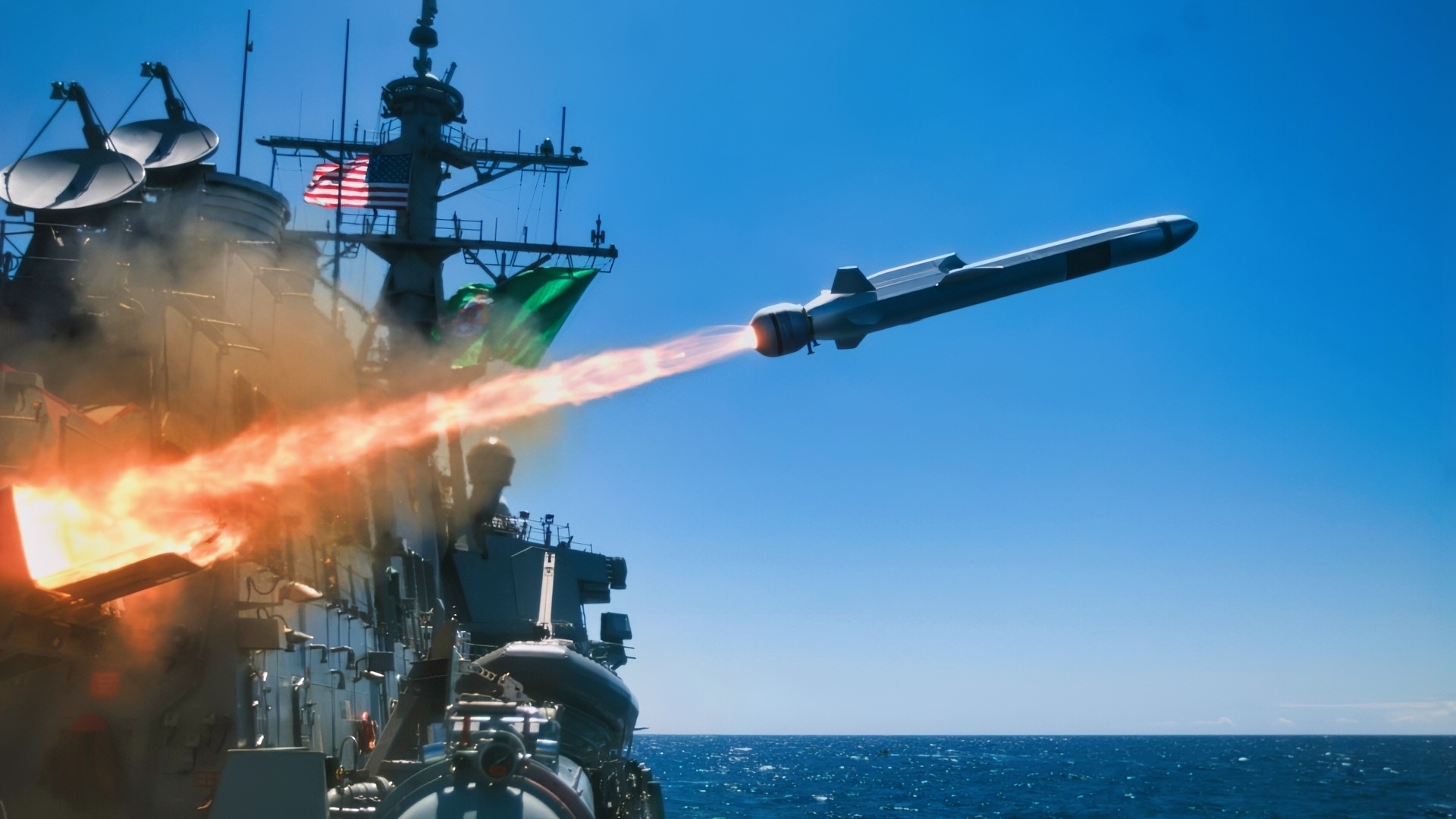
There was much more activity overnight in the war in Iran, as the U.S.S, reacting to what they claimed was an attempt to attack one of their warships, struck five Iranian oil tankers. After that, Iran retaliated by firing missiles at Jordan.
U.S. Central Command issued a statement about the exchanges of fire, which included video of one of the tanker explosions. CENTCOM stated that Iran’s Islamic Revolutionary Guard Corps (IRGC) targeted a Naval warship with ballistic missiles twice in two days, although neither ship was struck, and no American personnel were harmed.

(Aug. 22, 2023) Gunner’s Mate 2nd Class Chase Allen maintains the barrel of a Mark 45 5-inch light-weight gun on the fo’c’sle of the Arleigh Burke-class guided-missile destroyer USS Paul Hamilton (DDG 60) in the Pacific Ocean, Aug. 22, 2023. Paul Hamilton is deployed to the U.S. 3rd Fleet area of operations. (U.S. Navy photo by Mass Communication Specialist 2nd Class Elliot Schaudt)
CENTCOM, as a result, “destroyed the IRGC crude oil carriers M/T Kaviz, M/T Charminar, M/T Horizon 1, and M/T Riesco in the Gulf of Oman as well as M/T Derya near Kharg Island,” the statement said.
“All IRGC attempts against U.S. Navy warships have failed,” CENTCOM added.
According to the New York Times, the IRGC “vowed to retaliate” and warned tankers near Kuwait and Bahrain to evacuate. Soon after that, the Guards said they had fired on two U.S. destroyers and also launched a “heavy missile strike” at Jordan.
Jordan’s military, in turn, said in a statement, per the Times, that of the Iranian ballistic missiles, 18 had been intercepted, while two more fell in unpopulated areas.
Ship For a Ship
Last week, CENTCOM’s commander, Adm. Brad Cooper, had warned the Iranians.
“Let the message to the IRGC be clear: If you shoot at two of our ships, we will impose an even higher economic cost —taking out three of yours,” the Admiral said in a statement by CENTCOM. “We will not hesitate to defend American forces, and if necessary, destroy Iran’s limited and exposed oil fleet.”
The exchanges of fire follow what looked two weeks ago like a pivot on the part of the Trump administration towards sanctions and economic pressure, especially considering the upcoming midterm elections as well as reports about dwindling munitions stockpiles.
But now, it appears, military escalation is back on.
“A Willingness to Escalate”
A separate New York Times analysis, published Wednesday, looked at what the newspaper calls “an increasingly aggressive approach” on the part of the Iranians. One example? This week’s attempted attack on a U.S. naval warship, a first during the war.
Hamidreza Azizi, a senior Iran analyst at the International Crisis Group, told the Times that the attack on the ships represented a major escalation.
“Both sides are trying to dictate their red lines and trying to push the red lines of the other side as far back as they can,” Azizi told the newspaper.
He added that just as Iran has improved its capabilities throughout the war when it comes to attacking military bases with precision, they may have developed a similar capability when it comes to hitting warships.
Iran, the Times said, “faces mounting economic pressure, and they worry that their grip on the Strait of Hormuz is slipping,” as the American blockade has made it more difficult for them to ship oil.
And Iranian leaders have been talking tougher.
Mohammed Bagher Ghalibaf, the Iranian parliament speaker, told lawmakers over the weekend that the time for “proportionate responses” on Iran’s part was over. Security chief Mohsen Rezaei also announced plans to create a “restricted zone” in the Persian Gulf.
“How do you regain the momentum? You escalate,” said Farzan Sabet, an Iran analyst at the Geneva Graduate Institute, told the Times of Iran’s current predicament. Sabet expected Iran to up the pressure without necessarily restarting the war.
“All signs point to a make-or-break moment,” Mohammad Ali Shabani, an Iran analyst and editor of a regional news website, told the newspaper.
“I’m not sure the Iranians are going to wait until after the elections to be attacked if diplomacy fails.”
In the meantime, Iran’s allies in Yemen, the Houthis, launched a major attack this week on Saudi Arabia’s oil infrastructure, which led the price of oil to rise over $100 a barrel for the first time since July.
“The ongoing crisis in the Middle East has diminished hopes of U.S.-Iran talks and a return to normal oil flows soon,” OilPrice.com said.
About the Author: Stephen Silver
Stephen Silver is an award-winning journalist, essayist, and film critic, and contributor to the Philadelphia Inquirer, the Jewish Telegraphic Agency, Broad Street Review, and Splice Today. The co-founder of the Philadelphia Film Critics Circle, Stephen lives in suburban Philadelphia with his wife and two sons. For over a decade, Stephen has authored thousands of articles that focus on politics, national security, technology, and the economy. Follow him on X (formerly Twitter) at @StephenSilver, and subscribe to his Substack newsletter.


