
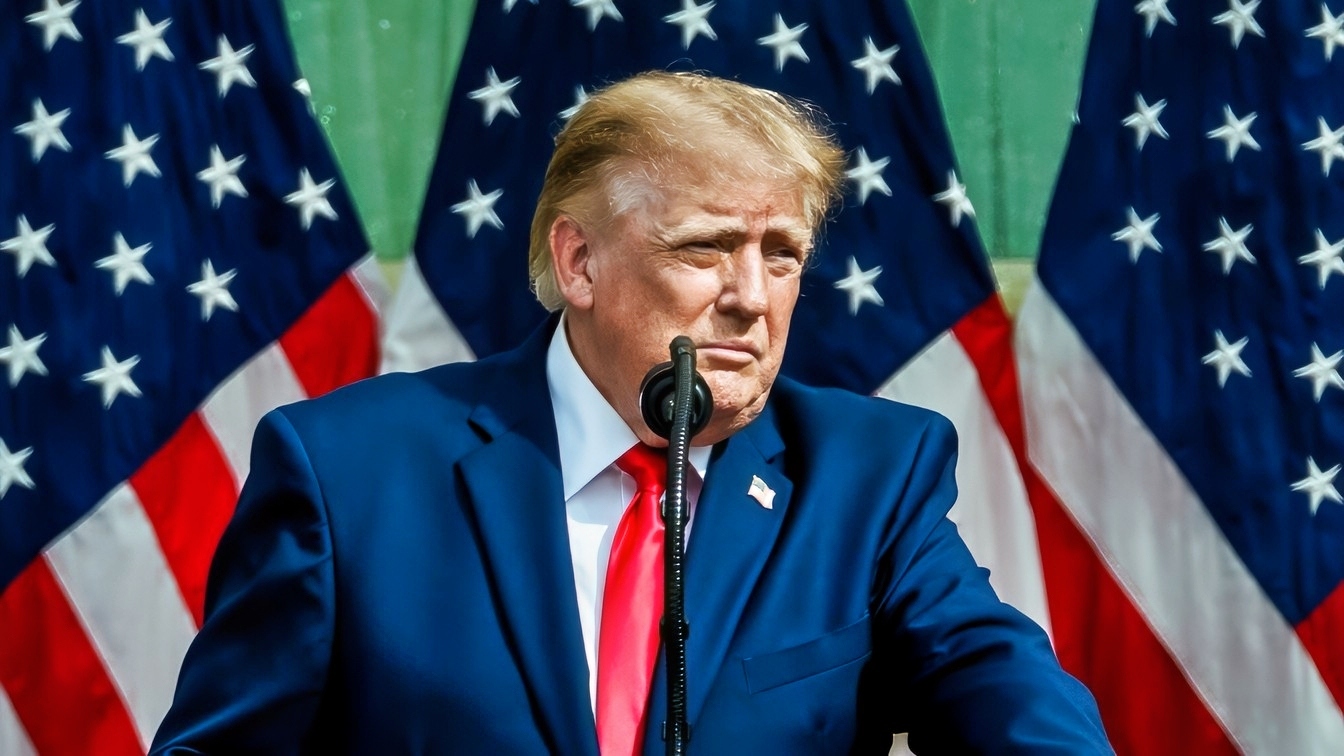
With just two weeks until the midterm elections, the Republican Party is facing an identity crisis.
GOP hopefuls nationwide are distancing themselves from U.S. President Donald Trump, whose popularity among Americans continues to decline.

Donald Trump Speaking at CPAC. Image Credit: Creative Commons.
Two separate polls released this week found that the President’s approval rating has reached record lows not seen during his first term.
However, a Republican candidate unwilling to back a Republican president faces a much larger dilemma than whether to risk disillusioning Trump’s most loyal supporters.
GOP Dissent
The President’s unpopularity is proving troublesome for Republican candidates nationwide.
A Washington Post/ABC News/Ipsos poll released on Monday, 19th October, found that 58% of registered voters would prefer a Democratic-led Congress that held the President to greater scrutiny, compared to just 39% who would prefer a Republican-controlled legislative body to allow the President to complete his second term with the backing of a more supportive Congress.
Trump’s unpopularity has been known for some time; since he returned to the White House in January 2025, his approval has remained persistently low.
Republican dissent isn’t new to the Trumpian GOP, but criticism from party allies has been far more prominent under the current administration than under any that preceded it.

Donald Trump speaking with supporters at a campaign rally at Veterans Memorial Coliseum at the Arizona State Fairgrounds in Phoenix, Arizona. Credit: Gage Skidmore.
A Range of Issues
The Iran war, and perhaps more so the subsequent ramifications on the cost of living, remains a key issue for tens of millions of voters this November.
Candidates in battleground states have been more reluctant to support prolonging the conflict publicly, with GOP Senate hopeful and current Iowa Representative Ashley Hinson calling for an “immediate and successful” end to the conflict amid rising gas prices.
Michigan, too, has seen its GOP Senate candidate break from the Trump administration on key foreign policy, namely the ongoing tariff war with Canada. “Here in Michigan, we know that Canada is not our enemy. We need to end this tariff war now,” Rogers said in a campaign advertisement released earlier this month.
Rogers also called for the Iran war to “end quickly” in a separate campaign ad in September.
In Colorado, State Sen. Mark Baisley has split with the President over support for Ukraine. “I do think that we should supply Ukraine with the weapons that keep them from being taken over by Russia, because I think that would be bad for everybody,” Baisley said to local media.
Little Effect on the Polls
Distancing from the administration has done little to decidedly change the fortunes of GOP candidates vying for a seat in Congress.
A Marist poll released last week found that 48% of Iowa’s likely voters were planning to vote for Democrat Josh Turek over Republican Hinson.
In Michigan, Rogers trails Abdul El-Sayed by just over three percentage points, a deficit that has largely held steady over the past three months, except for a brief period in August when Rogers led his Democratic rival.
Early voting also shows the GOP is struggling to rally its supporters behind its candidates.
In Colorado, 8% of the state’s 4.57 million voters have already voted, but only a quarter of those early voters are registered Republicans.
The indicators point to a Democratic victory in the state former Vice President Kamala Harris won two years ago.
MAGA and Indy
For a speculative Republican lawmaker in 2026, two key, conflicting voter groups must be won over for a spell in Congress: MAGA Republicans and Independents.
The shift away from Trumpism will undoubtedly appeal to the latter group.
Independents generally sit to the left of the Republican Party on the political spectrum, and the MAGA appeal does little to win over voters who could easily swing towards the Democratic Party.
Publicly shifting away from a same-party president, who 71% of Independents say has made them worse off since returning to the White House, is a plausible strategy to win the Independent vote.
That comes at a cost, however, as MAGA Republicans remain overwhelmingly supportive of President Trump. 95% of MAGA Republicans still approve of the President’s performance, compared to just 47% of non-MAGA Republicans who say the same.
Trump has made his feelings clear on those within the party who publicly challenge his decision-making, and a GOP candidate who does the same can expect little sympathy from MAGA Republicans when party turnout is lower than expected.
It leaves a dilemma many Republicans have struggled with: back Trump and risk losing the Independent support, or criticize the President and still rely on the backing of MAGA Republicans.
About the Author: Shay Bottomley
Shay Bottomley is a British journalist. He has written for the Western Standard, Business Insider, Maidenhead Advertiser, Slough Express, Windsor Express, Berkshire Live and Southend Echo.