


The “Big Stick” is heading back to the Middle East. The Pentagon is sending the USS Theodore Roosevelt (CVN-71) carrier strike group and the 13th Marine Expeditionary Unit into US Central Command’s area of responsibility, two US officials confirmed to Fox News this week, as reported by The Jerusalem Post.
The carrier is expected on station by the end of November.
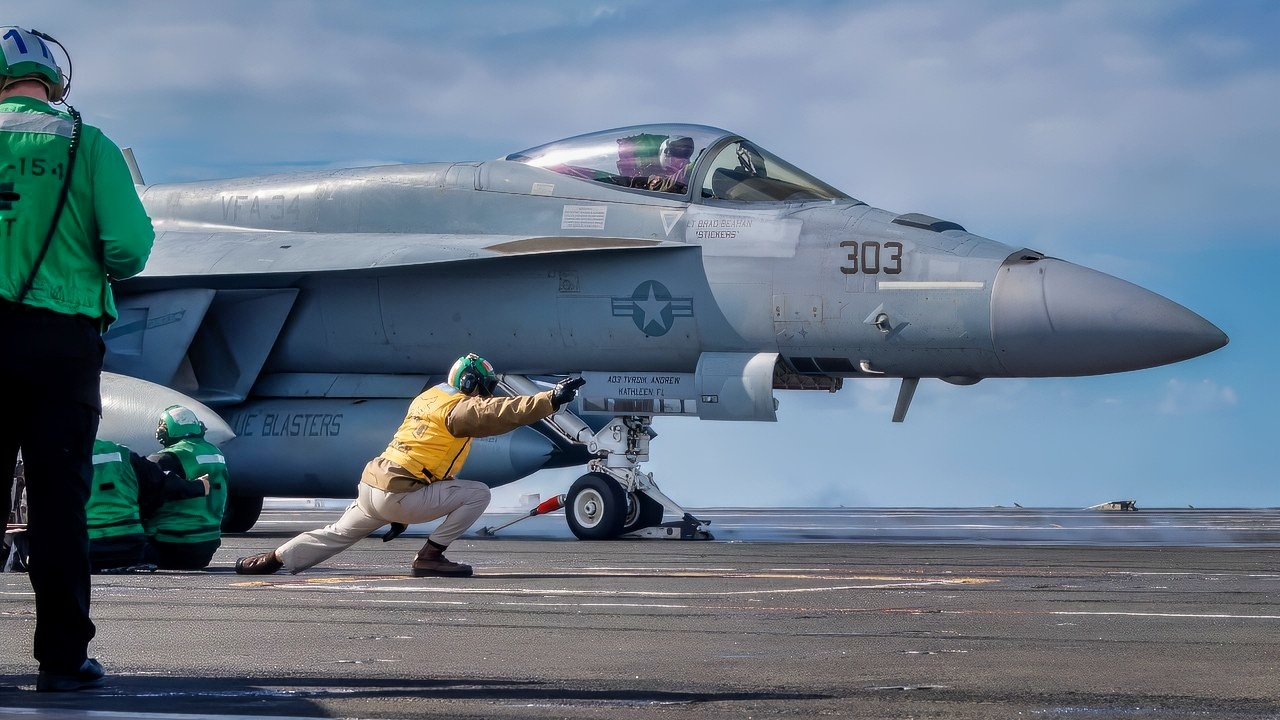
U.S. Navy Lt. Andrew Bentley signals an F/A-18E Super Hornet, assigned to the “Blue Blasters” of Strike Fighter Squadron (VFA) 34, to launch from the flight deck of the Nimitz-class aircraft carrier USS Theodore Roosevelt (CVN 71), Nov. 30, 2023. Theodore Roosevelt, the flagship of Carrier Strike Group Nine (CSG 9), is conducting integrated training exercises in the U.S. 3rd Fleet area of operations. (U.S. Navy photo by Mass Communication Specialist 3rd Class Adina Phebus)
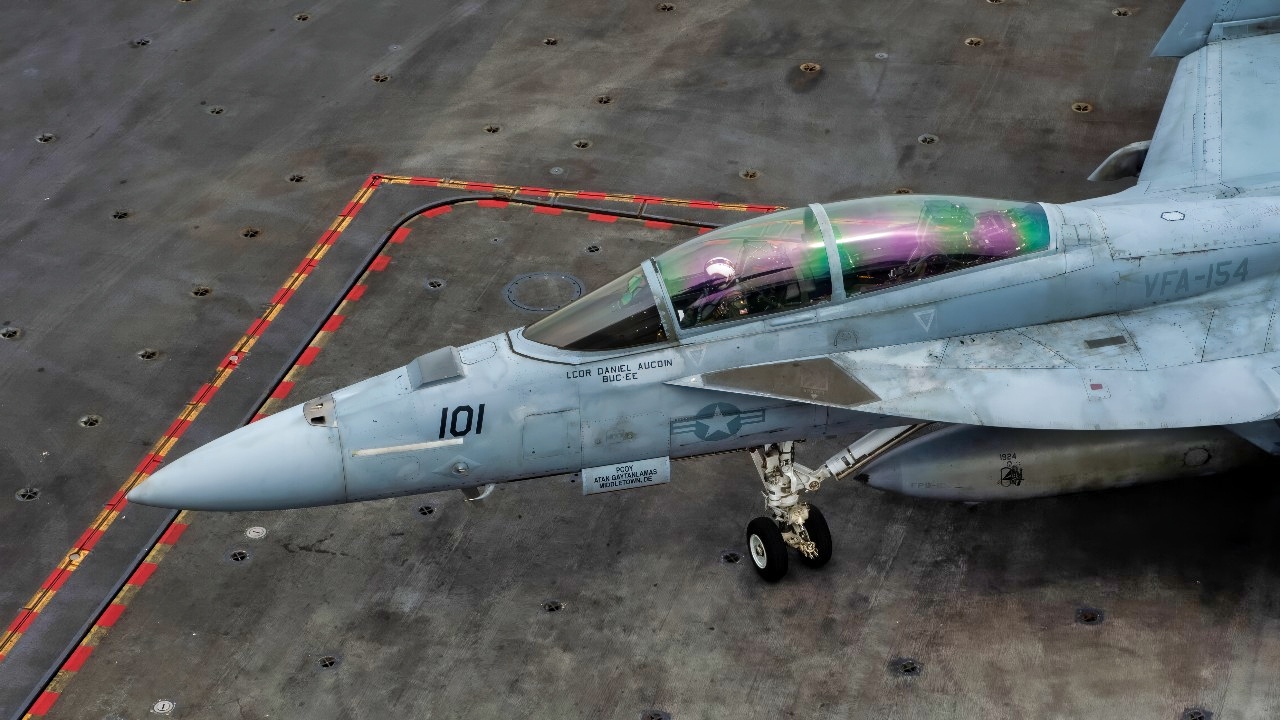
(July 24, 2025) – A U.S. Navy F/A-18F Super Hornet, assigned to the “Black Knights” of Strike Fighter Squadron (VFA) 154, transits the flight deck of Nimitz-class aircraft carrier USS Theodore Roosevelt (CVN 71), July 24, 2025. Theodore Roosevelt, flagship of Carrier Strike Group (CSG) 9, is underway conducting exercises to bolster strike group readiness and capability in the U.S. 3rd Fleet area of operations. (U.S. Navy photo by Mass Communication Specialist Seaman Maddix Almeyda)
That timing is no accident.
Fox News Chief National Security Correspondent Jennifer Griffin wrote that the deployment gives the US more options as President Trump reportedly weighs ramping up strikes on Iran after the November 3 midterms.
The president said he would not resume the bombing of Iran before the midterm elections.
But the feeling has always been that it would resume immediately after those.
And now the Roosevelt’s carrier strike group is already moving.
A Quiet Departure From San Diego
The Roosevelt slipped out of North Island on September 27 with no advance announcement, and sailors weren’t even manning the rails, according to the Times of San Diego.
The next day, the USS Makin Island Amphibious Ready Group followed, with the amphibious transport docks USS Anchorage and USS John P. Murtha, and the 13th MEU embarked.
Combined, that’s roughly 6,000 sailors in the strike group and about 4,200 Marines and sailors in the ARG, per The Week.
The strike group sailed with the Ticonderoga-class cruiser USS Chosin and the destroyer USS Decatur, and it pulled into Yokosuka, Japan, on October 16 on the way west.
It also brought a drone ship along.
Acting Navy Secretary Hung Cao confirmed at the AUSA conference that the TR is the first carrier strike group ever to deploy with a medium unmanned surface vessel, later identified as a Leidos Seahawk, per DefenseScoop.
Cao called it a “force multiplier,” which it is. A drone ship that can scout, carry sensors, and soak up risk near the Strait of Hormuz will probably be deployed out front, especially when the Iranians have spent months threatening shipping.
The Seahawk previously operated alongside the Roosevelt’s strike group and participated in the Rim of the Pacific exercise over the summer.
However, its first real-world deployment is happening in a live combat theater. How it fares and is used will bear close watching.
Relief Or Reinforcement?
The Jerusalem Post article noted that two carriers are already in the region: the USS George H.W. Bush, there since April, and the USS George Washington, which arrived in August to relieve the USS Abraham Lincoln.
However, USNI News reported that the Roosevelt is headed to CENTCOM to relieve the George Washington. One carrier in, one carrier out.
However, all three carriers will probably remain on station for a few weeks in the Middle East.
The George Washington is the Navy’s forward-deployed carrier in Japan, and US policy calls for at least one carrier in the western Pacific at all times. She has to go home.
However, CENTCOM is expected to overlap the two carrier strike groups for a few weeks.
The Maritime Executive noted the rotation appears scheduled for the end of November, giving Central Command useful options if Trump decides to renew the bombing campaign.
Three carrier strike groups for a short window, right as the midterms disappear in the rearview mirror.
The Navy has done this before. It had three carriers in the region simultaneously back in April, the first time since 2003, according to U.S. News.
The Crew And The Long Deployment Are Considerations
The USS Abraham Lincoln spent more than 250 days at sea supporting the blockade of Iran, and that deployment produced reports of low morale and supply strain for roughly 5,000 crew members, according to The Washington Times.
The Ford logged 326 days over this year and last. By the end of November, the Bush will have been at sea for about 200 days.
The Navy knows it. Master Chief Petty Officer of the Navy John Perryman said the TR’s skipper told the crew to plan on eight months, and the ship maxed out its loadout of food, retail items, and hygiene products while converting unused spaces into extra storage.
That’s a carrier packing for a long war.
And that’s what keeps a ship in the fight.
Veterans, especially Navy vets, know how this plays out.
Long sea deployments are harder on people, and you pay for it later in retention, maintenance, and mistakes.
The President Has Been Clear About The Calendar
Trump has been unusually open about the timeline. He said earlier this month the US won’t resume strikes before the November 3 vote.
In a TIME interview, he called ramping up the bombing after the midterms “possible,” and he told reporters Iran would be hit very hard.
Diplomacy hasn’t gone anywhere. Indirect talks stalled after Washington rejected an Iranian proposal to reopen Hormuz in exchange for lifting the US blockade, releasing $12 billion in frozen assets, and waiving sanctions on Iran’s oil.
The Treasury Department widened sanctions to hit Iran’s auto and rail sectors, per CNBC.
The Iranians have used Trump’s self-imposed lull in airstrikes to rebuild its shattered air defenses, build more ballistic missiles, and to attack shipping in the Gulf with impunity.
Their stated goal was to strike oil tankers to drive up prices to influence the US mid-term elections. They’ve been quite overt about this.
The oil markets are feeling the pinch. Brent crude has been hovering between $103 and $105 a barrel.
So Why Send The USS Roosevelt Now?
Pressure. Iran’s economy is teetering on the edge of failure.
New airstrikes would reportedly consist of targeting oil refineries, production facilities, and related energy installations to pressure the Iranian economy, in addition to military targets.
A nuclear-powered carrier steaming toward the Arabian Sea sends a clear message to Tehran.
The administration wants the regime to understand that the window after November 3 is real, and that the US will have the airpower on station to use it.
Whether that pushes Iran back to the table or sets the stage for the next round of strikes is the question no one in Washington or Tehran can answer yet.
Teddy Roosevelt told us to speak softly and carry a big stick. The Navy is sending the stick. Washington knows Iran doesn’t respect the “speaking softly” part… that doesn’t bode well for a fair negotiated settlement.
About the Author: Steve Balestrieri
Steve Balestrieri is a National Security Columnist. He served as a US Army Special Forces NCO and Warrant Officer. In addition to writing on defense, he covers the NFL for PatsFans.com and is a member of the Pro Football Writers of America (PFWA). His work was regularly featured in many military publications.


