

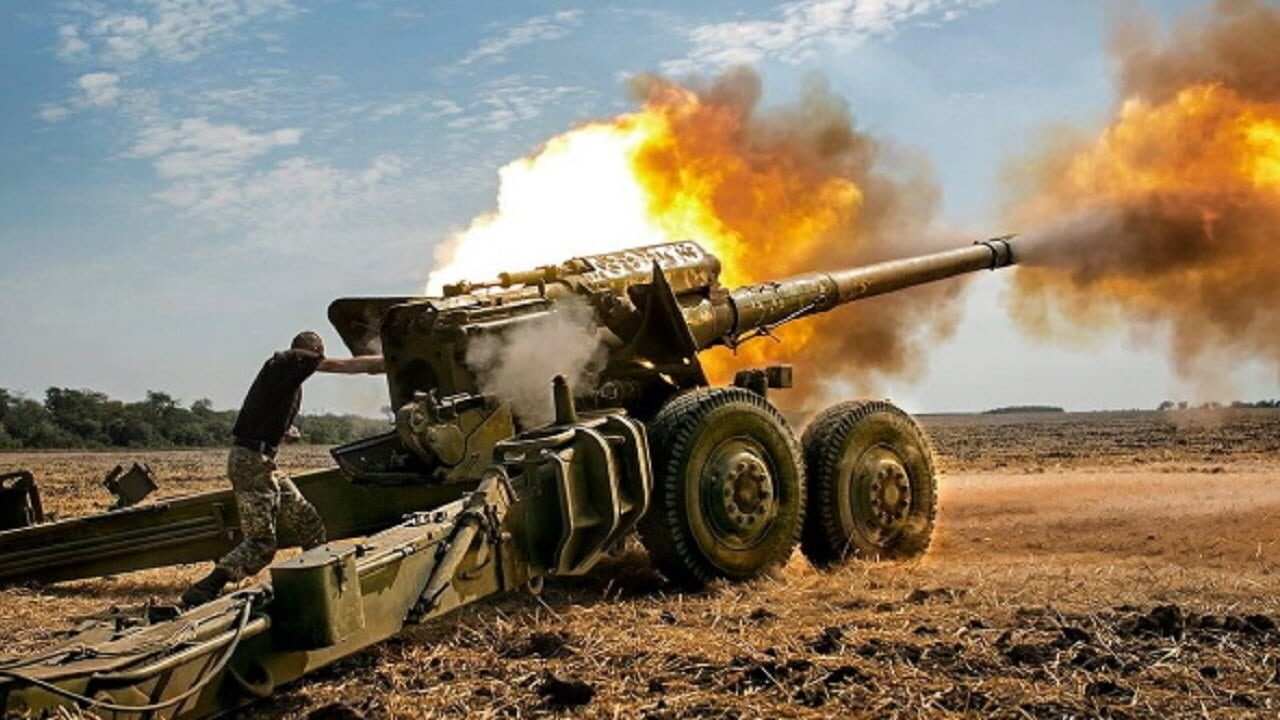
Europe’s Baltic countries issued alerts warning their citizens to take cover from potential errant drone strikes as both Ukraine and Russia exchanged a flurry of strikes on each other’s territory. Russian strikes overnight on Ukraine rained down on Kharkiv, Ukraine’s second-largest city, as well as on Kryvyi Rih, an industrial hub, and in Zaporizhzhia.
Lithuania, Latvia, and Estonia each warned that drones could enter their airspace from Russia or Belarus, and NATO fighter jets were reportedly scrambled in response to the attacks.

Russian T-90 Tank. Image Credit: Creative Commons.

T-90M from Russia. Image Credit: Creative Commons.
One video published by CNN shows the moment Russian munitions struck a below-ground fortified bunker used by Ukrainians to shelter from such attacks.
Ukraine has also launched formidable strikes on Russia, managing to strike a Russian oil refinery at Kirishi, near St. Petersburg, and also the country’s second-largest refinery by volume. Ukrainian drones also reportedly targeted infrastructure in the Leningrad Region, to the northwest of Moscow.
But even as strikes by Russia and Ukraine are ongoing, peace talks are unfolding between the two parties in the Middle East.
Prospects for Peace and Talks in the Middle East
Just yesterday, negotiators for Ukraine and Russia met in Abu Dhabi, the capital of the United Arab Emirates, marking a restart of peace negotiations for the first time since February this year. While American and Ukrainian officials played down the talks — Secretary of State Marco Rubio called the discussions productive, and Ukrainian President Volodymyr Zelensky described them as “constructive and quite substantive” — it is unclear what exactly the talks can achieve, if anything.
Moscow and Kyiv’s positions appear to be largely irreconcilable. While Russia’s leader Vladimir Putin would like to see all of Ukraine’s eastern Donbas region subservient to the Kremlin, Zelensky and the Ukrainian population would find any territorial concessions untenable. But despite the gulf between Ukraine’s and Russia’s desired outcomes for this war, some interlocutors from the United States tried to strike an upbeat note.
Both President Trump’s son-in-law, Jared Kushner, and Steve Witkoff, the president’s peace envoy, seemed to try to cast the talks between Ukraine and Russia in a positive light. Posting to X, Kushner explained that “our work has focused on four interconnected priorities: ending the fighting, developing credible postwar security guarantees and arrangements that reduce the risk of renewed conflict, preparing a comprehensive economic and prosperity plan for Ukraine, and advancing humanitarian measures to alleviate suffering and address the human consequences of this war.
“An important part of this process is encouraging all parties to begin thinking seriously about what comes after the war,” Kushner explained. “By discussing postwar security, economic recovery, and the mechanisms needed to prevent future conflict, we hope to shift the focus from managing the war toward building the foundations for a durable peace.”
Russian Losses Staggering
Despite— or perhaps because of—the uncertainty surrounding the likelihood of the Abu Dhabi talks reaching any kind of agreement, the war in Ukraine grinds on without an end in sight. This summer has been particularly punishing for the Kremlin’s forces, and recently uncovered Russian data on losses has newly contextualized the scope of Moscow’s setbacks on the battlefield.
Hacker groups targeting Russia’s Federal State Statistics Service, also called Rosstat, breached a database replete with information about Russian casualties. The hack, carried out by groups Silent Crow and Kiberpartizany BY, showed that between 393,000 and 450,000 Russian soldiers have been killed in Ukraine — a figure that does not include the wounded.
It is more battlefield losses than the Kremlin has endured in all wars fought since the Second World War combined. It is also, to date, the highest estimate of Russian losses thus far, partly because the data is believed to be high-quality and relatively up to date.
During a recent call with the President of the European Commission, Ursula von der Leyen, President Zelensky warned that Russia is aiming to split Ukraine in half along the Dnipro River that bisects Ukraine on a north-south axis. A particular target of Russian ire, President Zelensky said, was Ukraine’s bridges and power infrastructure.
Only a handful of bridges span the Dnipro, and Russia’s aim, he said, is to “make life as difficult as possible for people, for our cities and villages.”
About the Author: Caleb Larson
Caleb Larson is an American multiformat journalist based in Berlin, Germany. His work covers the intersection of conflict and society, focusing on American foreign policy and European security. He has reported from Germany, Russia, and the United States. Most recently, he covered the war in Ukraine, reporting extensively on shifting battle lines in Donbas and writing about the war’s civilian and humanitarian toll. Previously, he worked as a Defense Reporter for POLITICO Europe. You can follow his latest work on X.


