

The US Wages an Economic War on Iran Rather Than an Actual War — Iran will control the Strait of Hormuz (SoH) whenever the Iran War ends. The Trump administration continues to rave that the SoH must be restored to its prewar conditions. That won’t happen as long as the Islamic Republic remains in power in Iran.
Even if the Trump administration renews large-scale strikes on Iran along with the Israelis, the chances that the US and Israel can oust the Islamic Republic with military action are low — especially given the limits imposed upon American (and Israeli) arsenals by the depletion rate of key defensive systems and long-range standoff weapons.
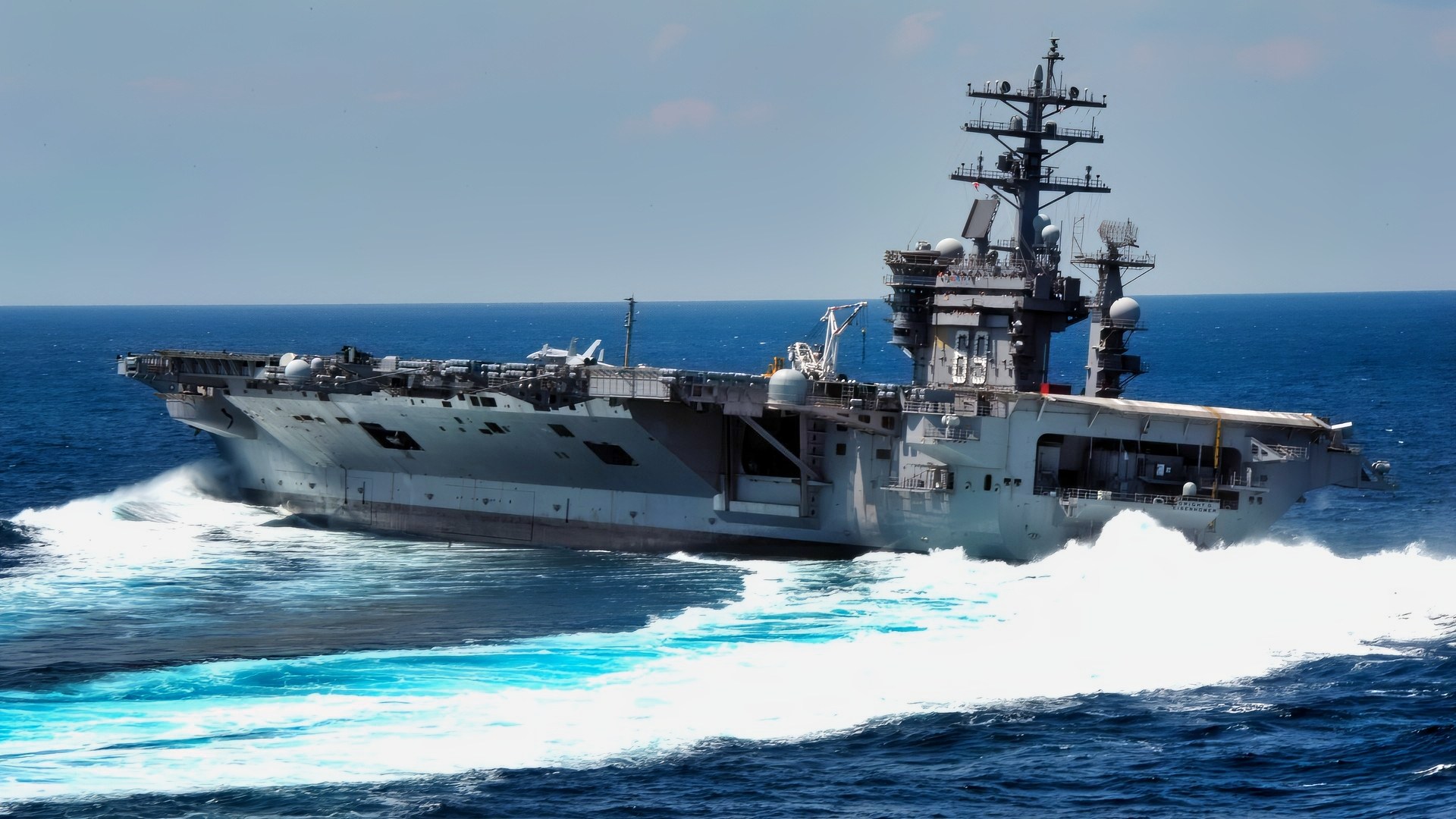
The Nimitz-class aircraft carrier USS Dwight D. Eisenhower conducts rudder turns during sea trials. Dwight D. Eisenhower completed a nine-month planned incremental availability at Norfolk Naval Ship Yard on June 10, 2011.
With that in mind, it is important to understand what might be achieved under realistic conditions. For that, it is important to acknowledge that there is honestly no viable military solution to the impasse the United States finds itself in: Trump and Netanyahu want to end the perceived threat of the Islamic Republic. Netanyahu clearly wants to change the regime.
At the start of the war, it was obvious that Trump sought that, too. However, as the war dragged on without a clear outcome, Trump appears to have moderated his view. Trump has fixated on the nuclear weapons threat from Iran.
Yet, if he was really fixated on only that, he could have easily walked away from the conflict because he had degraded Iran’s nuclear weapons capacity enough to buy the world some reprieve from that particular threat for years—long after he left office.
The Alternatives
But Trump seems to want to put all the toothpaste back in the tube. And the idea of Iran controlling the SoH on any level is anathema to him. Nevertheless, that is precisely the condition he now finds himself in. And Trump may entertain fantasies of using military force to topple the Iranian regime and reset conditions. It won’t work.
So, if we can enjoy a moment of rationality, let’s look at what a negotiated settlement might entail. First, it’d involve Iran, Oman, and the Gulf Arab states. Second, the Trump administration might huff and puff, but the president has already indicated an unwillingness to employ direct military force against Iran. Instead, he wants to follow the economic blockade approach to break the Iranian regime over time.
Even if Iran’s leadership went along with that game, this strategy is unlikely to break them.
Before the war, one-quarter of global maritime trade in petroleum products and nearly one-fifth of global liquefied natural gas (LNG) shipments passed through the SoH. Since the war began, Tehran has successfully disrupted the SoH, causing backlogs in the global energy market and driving up the prices of those products, shipping, and nearly anything touched by petroleum and LNG products in the process.
Those price spikes played a significant role in the recent electoral defeat of President Donald Trump’s Republican Party in the American Midterm Elections. It is likely that Trump’s reticence to reengage militarily against Iran after the Midterms was largely influenced by how drastic the Republican Party’s defeat was. The Iranians understand the potency of holding the SoH. Tehran won’t surrender it so easily.
Over time, however, Iran’s leverage over the SoH could diminish — especially as the world’s energy producers create viable workarounds to the SoH. Other countries have powerful incentives to diversify their energy supplies.
A Frozen Conflict?
US Naval War College maritime law professor James Kraska has proposed an international framework known as the Hormuz Declaration. This new deal would recognize the interests of both Oman and Iran, while ensuring international navigation. China, Europe, and the United States would support the framework. Meanwhile, Washington and Europe would reduce sanctions on Iran and restore Iran’s access to frozen assets.
It’s a great idea, and in a saner age, it would be how the world’s great powers would decide to proceed. Sadly, President Trump remains obsessed with being seen as beating the Islamic Republic. That’s why he won’t drop his hostile stance toward Tehran, even though Iran has clearly defeated the United States at the strategic level.
All the Americans and Israelis can do is destroy Iranian infrastructure without getting the victory they seek. Instead, what such an attack would produce would be a robust Iranian counterattack that would annihilate the Gulf Arab states, decimate the remaining US military facilities in the region, and likely culminate in the destruction of the Dimona nuclear power plant in Israel.
The economic warfare doctrine and the blockade come with their own inefficiencies; notably, the US and its allies have sanctioned Iran for decades, and the Islamic Republic has consistently demonstrated a capacity to endure those sanctions. As for the blockade, the US Navy cannot sustain it indefinitely. Whatever harm it does to the Iranian economy, the aircraft carriers, destroyers, and other ships involved in the blockade will eventually need to return to port for maintenance, leaving significant gaps in the blockade. The Iranian regime is unlikely to implode any time soon.
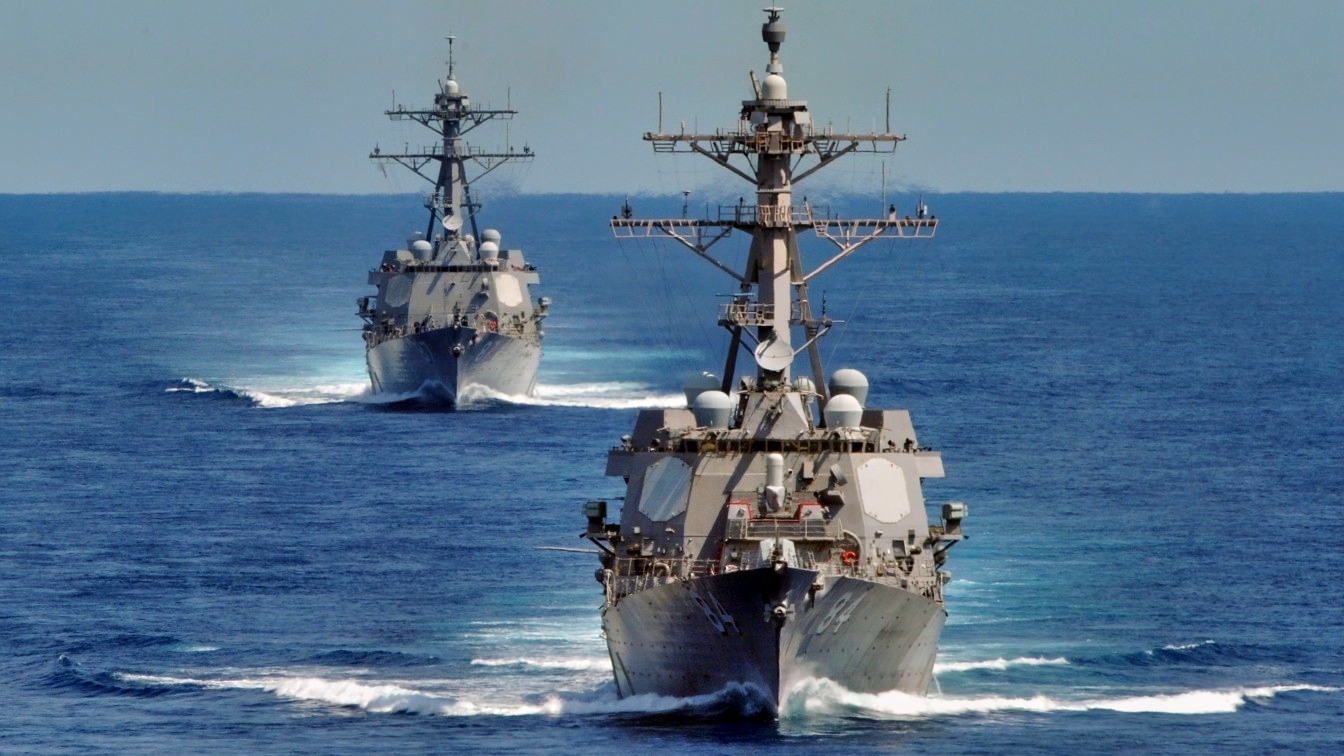
The Arleigh Burke-class guided-missile destroyers USS Bulkeley, right, and USS Mason participate in a strait transit exercise. Bulkeley and Mason are part of the Enterprise Carrier Strike Group and are conducting work-ups and flight operations in preparation for an upcoming deployment. (U.S. Navy photo by Seaman Jared M. King)
And choosing a long-term strategy like a blockade is strange, given both the logistical constraints on the US military and the impending political constraints imposed by the overwhelming Democratic majority in Congress beginning on January 3. These competing pressures, coupled with Trump’s preference for economic war, will likely lead to an uncomfortable new normal of intermittent confrontation, with phased de-escalations allowing some of the region’s energy to move through the SoH.
Two Years and Then a New President Gets a New Deal with Iran?
American forces might still enforce restrictions on Iranian commerce while Tehran periodically threatens shipping. Negotiations might produce temporary accommodations without resolving the underlying dispute over maritime governance. Professor Kraska assesses that this condition could persist for up to two years — putting the United States in the hands of an entirely new president, who will undoubtedly seek to cut a more comprehensive deal with Tehran (especially if that new US president is a Democrat).
Trump might declare the war to be over. Unless Washington and Tehran reach a durable agreement over the SoH, though, the strategic confrontation that emerged from the war will continue long after the president declares victory. But the risk of the US military being totally broken by the Iran War would dissipate, and the region could start creating alternative systems and deals to circumvent the decaying US-led regional order that existed before the war began.
About the Author: Brandon J. Weichert
Brandon J. Weichert is the Senior National Security Editor at 19FortyFive.com. He also manages The Weichert Brief on Substack. Weichert is the co-host of The Mario Nawfal Show on Twitter/X. He is the author of four bestselling national security books, most recently A Disaster of Our Own Making: How the West Lost Ukraine (Encounter Books). His next book, Fortress Americas: A New Monroe Doctrine (Tucker Carlson Books), is due out December 8. Follow him via Twitter/X @WeTheBrandon.


