

An early-warning radar station in Bahrain belonging to the United States has allegedly been destroyed by the Islamic Revolutionary Guard Corps (IRGC) on November 13. At least, if you believe Iran.
Washington denies that the attack succeeded.

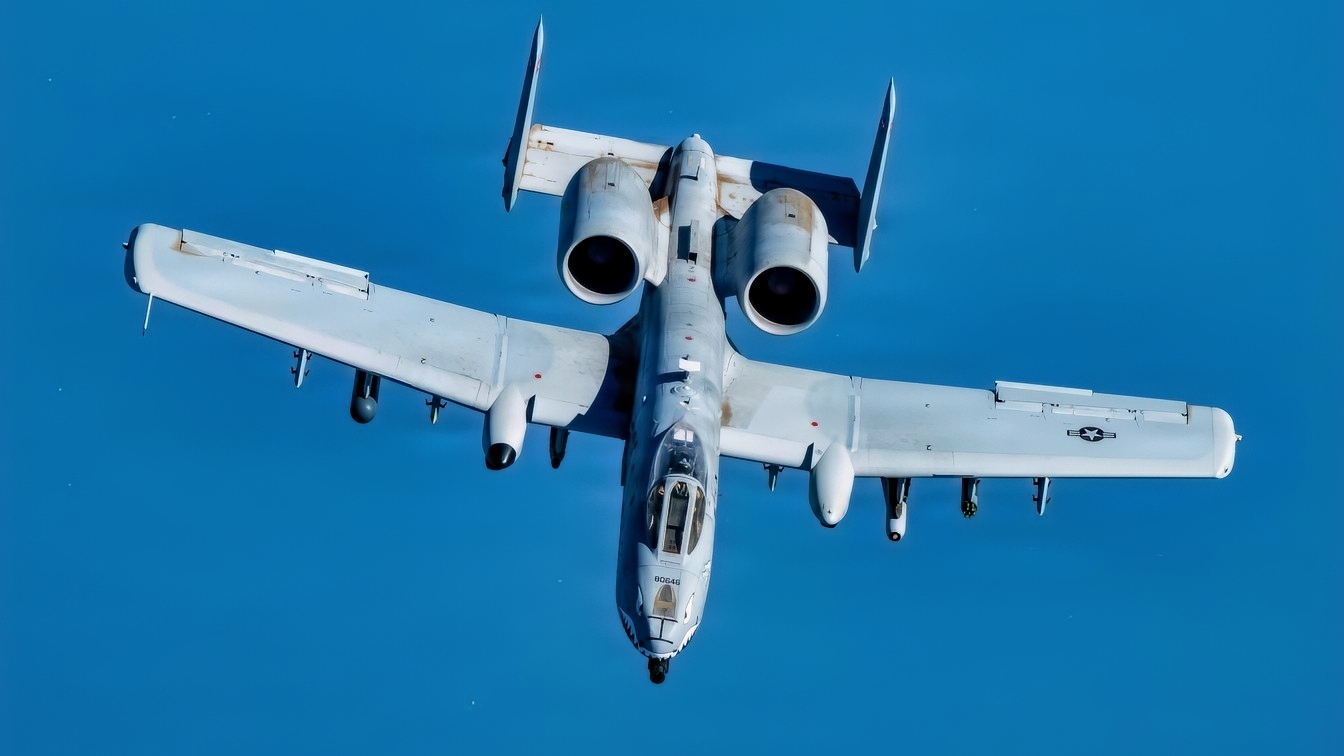
A-10 Warthog. Image Credit: Creative Commons.

U.S. Air Force Major Lindsay “MAD” Johnson, A-10C Thunderbolt II Demonstration Team commander and pilot, flies during the National Cherry Festival Air Show in Traverse City, Mich., June 29, 2024. It took a team of highly skilled individuals to keep the A-10 flying and make Johson’s demonstrations possible. (U.S. Air Force photo by Senior Airman Devlin Bishop)
This incident marked the first publicly claimed Iranian attack against American military assets in a Persian Gulf country since early September.
Iran Claims Retaliation
Iran’s official news agency, IRNA, claims Sirik came under attack Thursday evening.
The IRGC subsequently claimed that its Aerospace Force had destroyed the American radar installation.
The Iranians claim the operation was a warning against further aerial attacks and unauthorized oil shipments through the Strait of Hormuz (SoH).
Tehran also threatened additional military action should such incidents continue.
That precise radar system has not been officially identified. Bahrain’s government has not yet commented on the incident.
Bahrain is home to the headquarters of the US Navy’s Fifth Fleet and US Naval Forces Central Command (NAVCENT). These forces have been hosted in Bahrain for decades.
Interestingly, Bahrain is a majority Shiite nation ruled by a Sunni monarchy.
The Americans established a key presence in the country in 1949.
Bahrain was once part of the British Empire; in 1971, it was formally granted independence, and Washington immediately expanded its military presence.
After Desert Storm in 1991, the Americans established the Fifth Fleet headquarters in 1995.
Over time, as the Americans increased their presence in the region, the Fifth Fleet’s operational area came to encompass 2.5 million square miles–from the Persian Gulf to the Arabian Sea, all the way to the Gulf of Oman and the Red Sea.
After 9/11, this area became Washington’s most important strategic zone of concern.
The base in Bahrain forms the nucleus of much of America’s presence and role in the region. Without it, the US military’s ability to sustain operations is drastically reduced.
Early-Warning Radar
Iran’s targeting of key early-warning radars in this area is itself a warning to Washington that Tehran can effectively neuter whatever long-term military operations the Americans have planned in the region.
Early-warning radars are the backbone of integrated air and missile defense systems.
They detect incoming airborne threats–including ballistic missiles, cruise missiles, drones, and hostile aircraft–that air defenses then launch at.
Depending on the system, early-warning radars can also provide tracking information to naval vessels equipped with missile defense capabilities.
Iran has repeatedly employed ballistic missiles and attack drones against American military installations throughout the Persian Gulf during the current conflict.
The Battle for the Strait of Hormuz
The confrontation comes amid the continuing dispute between Washington and Tehran over maritime traffic through the Strait of Hormuz (SoH) and real fears that the US president, along with the Israeli prime minister, might restart the Iran War.
The Iranians, meanwhile, have steadfastly clung to their control over the SoH since the first bombs dropped on Iran on February 28.
Before the war, around 20.9 million barrels of petroleum passed through the SoH daily. That was around one-fifth of worldwide petroleum consumption.
The waterway also accounted for more than 20 percent of global liquefied natural gas (LNG) trade during the first half of 2025.
The Kingdom of Saudi Arabia and the United Arab Emirates (UAE) possess alternative oil export pipelines, but their combined capacity to bypass Hormuz is around 4.7 million barrels per day.
Tehran wants to put as much pressure on the US administration as possible by causing extensive economic pain to the world.
So, since the start of the war, the Iranians have restricted commercial traffic through the SoH.
That economic pressure might help explain how the Republican Party lost the Midterm Elections earlier this month, setting the stage for a potential generational shift to the Democratic Party within the American electorate.
Can Negotiations Work?
The latest back-and-forth between Iran and the United States comes as the Qataris (along with other regional actors) work to mediate a diplomatic resolution to the conflict.
Tehran has demanded that US naval forces cease their blockade of Iran’s ports and that Washington relax economic sanctions, including an end to the restrictions on Iranian petroleum exports.
Iranian leaders say they would reopen the SoH only if the Americans met these demands.
Following his humiliating defeat at the hands of the Democrats in the Midterm Elections, President Trump indicated he wanted to pursue some form of diplomacy with Iran rather than escalate.
At the same time, Trump removed his pro-peace Vice President, JD Vance, from the negotiations and indicated that no further talks were needed.
In fact, earlier today, the Trump administration’s CIA Director, John Ratcliffe, had an intensive briefing about the prospects of restarting the Iran War with the Israeli Mossad chief.
No outcome of this discussion is known as of the time of this writing.

A U.S. Air Force A-10 Thunderbolt II approaches a KC-135 Stratotanker for refueling over the U.S. Central Command area of responsibility, May 31, 2025. The KC-135 is the premier long-term aerial refueling capability for the U.S. Air Force, effectively providing fuel to fixed-wing aircraft operating with the USCENTCOM AOR. (U.S. Air Force Photo by Staff Sgt. John C.B. Ennis)
The USS Theodore Roosevelt is set to arrive in the Middle East this Sunday.
The Israeli security cabinet has ordered the Israeli military to be ready to restart hostilities with Iran at a moment’s notice.
Iran might claim to have destroyed an American radar station in Bahrain, but Washington maintains that the attempted attack was successfully intercepted.
Is this just more of the back-and-forth that has defined the conflict between the United States and Iran since this summer, or is this more about shaping operations in the run-up to a serious escalation that restarts the kinetic phase of the war?
About the Author: Brandon J. Weichert
Brandon J. Weichert is the Senior National Security Editor. He also manages The Weichert Brief on Substack. Weichert is the co-host of The Mario Nawfal Show on Twitter/X. He is the author of four bestselling national security books, most recently A Disaster of Our Own Making: How the West Lost Ukraine (Encounter Books). His next book, Fortress Americas: A New Monroe Doctrine (Tucker Carlson Books), is due out December 8. Follow him via Twitter/X @WeTheBrandon.


