

While the blockade of Iranian ports by the United States Navy continues unabated, Iran’s theocrats in Tehran remain in power.
Around a month ago, Iran is believed to have sold the last of the oil it had beyond the blockade, and the last Chinese payments for oil sold in the past are anticipated in about another month.

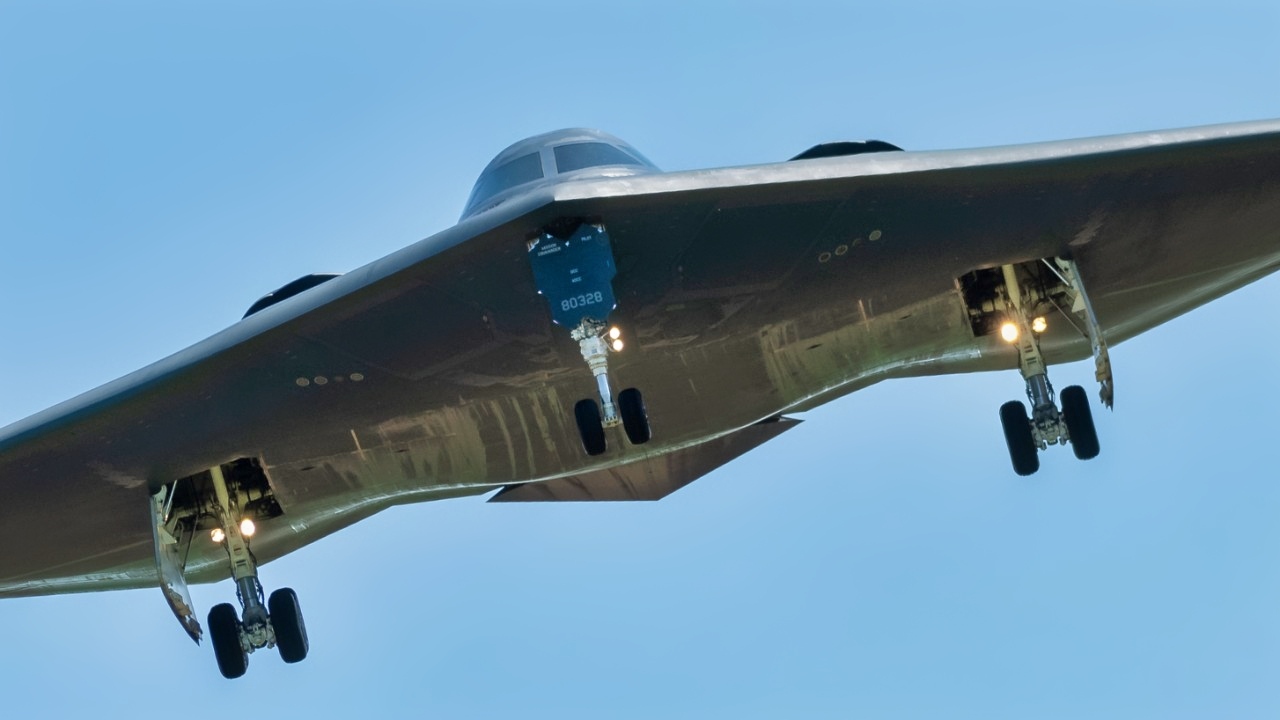
A U.S. Air Force B-2 Spirit demonstrates the aircraft’s capabilities during the March Field Air and Space Expo 2018 at March Air Reserve Base, California, April 7, 2018. The March Field Air and Space Expo is celebrating 100 years since March Field was established and 70 years of the U.S. Air Force. (U.S. Air Force photo by Master Sgt. Eric Harris)

Right Up Front B-2 Bomber USAF Museum. Image by Harry J. Kazianis/National Security Journal.
But then what will happen?
That is when Iran will potentially lean more heavily into its land routes.
Iran borders seven countries: Afghanistan, Armenia, Azerbaijan, Iraq, Pakistan, Turkey, and Turkmenistan.
The country also has a Caspian Sea Coastline.
Some of Iran’s most consequential corridors run west through Turkey and onward to Europe, east through Pakistan to Karachi, Port Qasim, and Gwadar, and northeast through Turkmenistan to Central Asia, Russia, and, effectively, China. Across the Caspian, Iran has access to Russian and Central Asian ports.
Iraq is perhaps a less vital gateway to Iran, but it still facilitates access to regional markets and serves as a route for limited fuel and commercial traffic.
Turkey’s Bazargan crossing is its busiest land gateway, though congestion, customs bottlenecks, and limited rail capacity constrain how much additional trade can be diverted there.
Lifelines, but with Limits
For ordinary imports and high-value, low-volume exports, these routes can be a genuine lifeline for Iran. They can carry grain, medicine, machinery, components and regional goods, while the International North–South Transport Corridor and the Caspian Sea link Tehran and Russia.
For oil, however, the calculus is more difficult. A large crude tanker can carry around 1.5 to 2 million barrels of oil.
Replacing that with trucks could require thousands of vehicles, fuel, drivers, secure corridors, and willingness from states to transit goods to and from Iran.
While land routes may move some refined oil products or smaller crude oil volumes, they cannot viably replace Iran’s main Asian exports.
Task Force Iron Gate
United States Central Command established Task Force Iron Gate in early November to extend enforcement beyond just the Gulf naval blockade to include Iran’s land borders and maritime borders. The task force, according to Central Command, “will coordinate with other U.S. government agencies on preventing the movement of advanced weapons systems, dual-use technologies, sanctioned materials, and illegal revenue streams across Iran’s land borders and the Caspian Sea.”
It is relatively small—according to Central Command, only around 20 individuals make up the task force —and it is far from a border-closing body.
Its practical effect will depend on whether Washington can persuade Turkey, Iraq, Pakistan, Central Asian states as well as the countries bordering the Caspian Sea to inspect trucks and vessels and enforce the controls Washington hopes to levy against Iran.
Therein lies the task force’s task: the logistics of sanctions evasion, including front companies, trucking and rail networks, and illicit payment channels.
And while that certainly makes Iranian smuggling slower and more expensive, it does not guarantee completely sealed borders.
The China and Russia Angles
China and Russia have emerged as some of the most significant state backers of the regime in Tehran, though both Moscow and Beijing provide somewhat different support to Iran.
For China, support to Iran is not ammunition and weapon systems but rather dual-use technologies as well as access to their market that can be leveraged for military purposes.
These include a variety of components related to drones and missiles, including subsystems such as batteries, a variety of sensors, and semiconductors.
Beijing has also provided Iran access to BeiDou, a Chinese aviation system, which Iran has leveraged to improve the accuracy of its missiles and drones.
Russia, on the other hand, offers Iran a northern economic and logistical partnership through the Caspian Sea and the International North–South Transport Corridor.
However, embroiled in its own war in Ukraine, Russia has less surplus capacity to provide to Iran. Its economy has also been battered by international sanctions and is on a war footing.
This means that while Russia is a valuable partner for Iran, it is hardly a limitless alternative to Iran’s pre-war supply chains.
Could Iran Really Become Sealed Off?
It could be theoretically possible to completely seal off Iran’s borders, but only via a combination of military occupation, naval and air blockade, border fortification, through-country compliance, as well as financial isolation.
It would require securing complete control over seven land borders, the Caspian Sea, air routes to Iran, and cyber links and smuggling networks.
As a durable, implementable policy, it is, however, unrealistic.
Iran’s frontier areas are rugged and mountainous, include sections of remote desert, and are rather porous. A potentially more plausible strategy would be a course that denies Iran the bulk of its oil exports, raises the cost of military procurement, and disrupts specific weapons and dual-use goods supply chains.
That can degrade Iran’s revenue and replenishment rates over time. But creating — and enforcing — a hermetic seal around the country is unrealistic.
About the Author: Caleb Larson
Caleb Larson is an American multiformat journalist based in Berlin, Germany. His work covers the intersection of conflict and society, focusing on American foreign policy and European security. He has reported from Germany, Russia, and the United States. Most recently, he covered the war in Ukraine, reporting extensively on shifting battle lines in Donbas and writing about the war’s civilian and humanitarian toll. Previously, he worked as a Defense Reporter for POLITICO Europe. You can follow his latest work on X.


