


Iran has carried out a third drone attack on U.S. military targets in Bahrain in less than five days.
A statement released by Iran’s Islamic Revolutionary Guard Corps (IRGC) said it had attacked an American radar system being operated at Sheikh Isa Air Base.
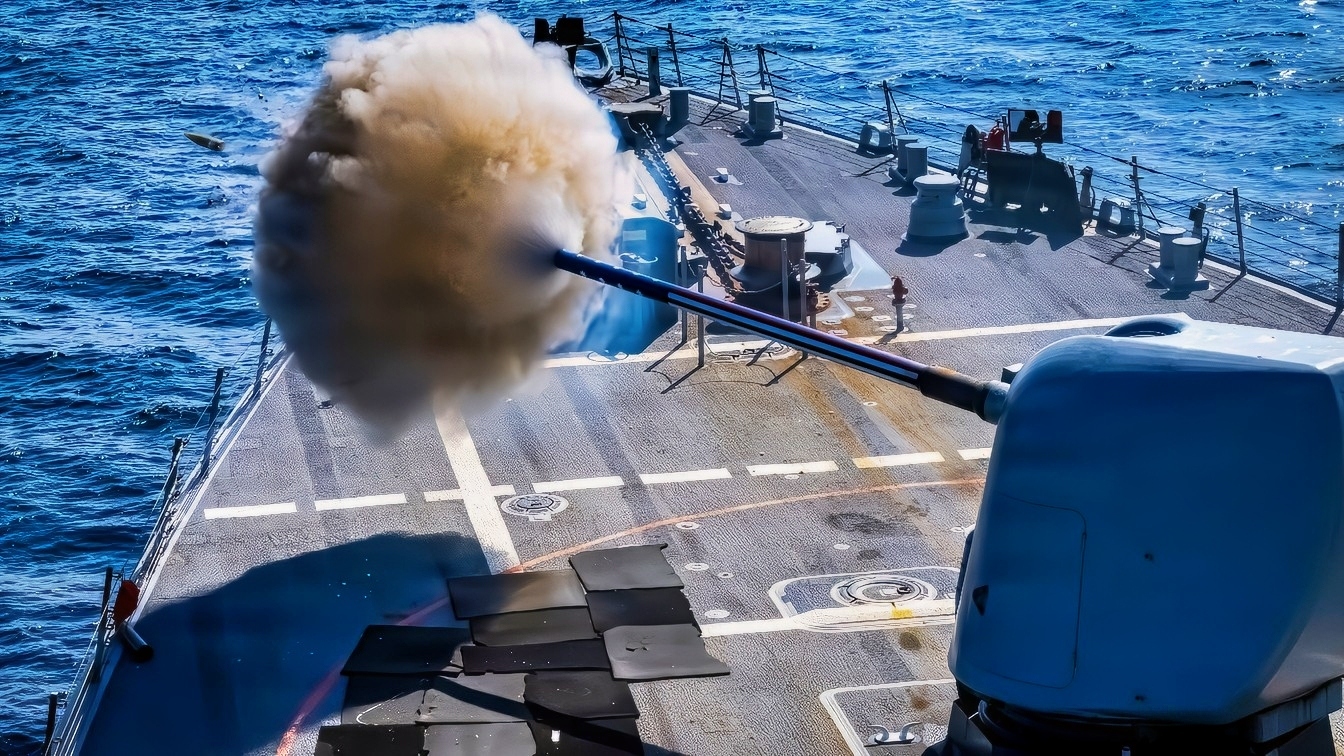
PACIFIC OCEAN (April 27, 2026) U.S. Navy Arleigh Burke-Class guided-missile destroyer USS John Paul Jones (DDG) 53, fires its Mk.45 5-inch deck cannon during a live fire exercise, April 27, 2026. John Paul Jones, part of the Theodore Roosevelt Carrier Strike Group, is underway in the U.S. 3rd Fleet area of operation conducting advanced training to bolster strike group readiness and capability. (U.S. Navy photo by Mass Communications Specialist 2nd Class Ryan Holloway)
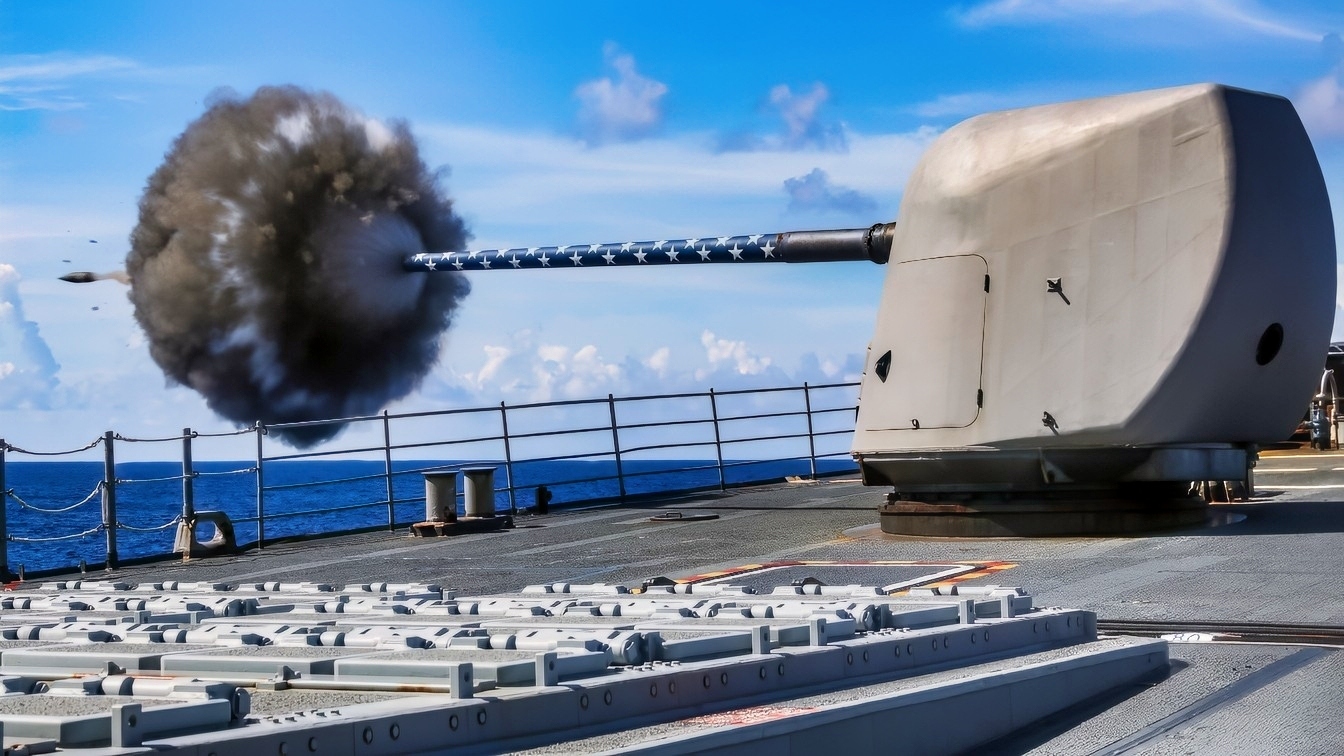
PACIFIC OCEAN (July 29, 2025) The Ticonderoga-class guided-missile cruiser USS Princeton (CG 59) fires its forward Mark 45 5-inch gun during a weapons maintenance shoot, July 29, 2025. The Carl Vinson Carrier Strike Group is underway conducting routine operations in the U.S. 3rd Fleet area of operations. (U.S. Navy photo by Mass Communication Specialist 1st Class Jacob I. Allison)
The U.S. Central Command (CENTCOM) announced that the drones had in fact been shot down with no damage or injuries.
The attacks follow a roughly two-month lull in Iranian strikes on U.S. military targets in Bahrain, and raise concerns that Tehran may be poised to carry out a fresh round of escalation.
Third Attack Targets U.S. Radar
The IRGC fired a volley of drones at the base early on Tuesday, claiming it was in retaliation for American military drones carrying out operations in Iranian airspace.
The IRGC, which Washington lists as a foreign terror group, described the attack as a “precision operation” and accused the U.S. of “repeated violations of Iranian airspace by U.S. military drones.”
“Multiple Iranian one-way attack drones launched by the IRGC today towards Bahrain were intercepted,” the command said.
They also noted that no damage to any U.S. assets and no injuries to U.S. personnel resulted from the attack.
The Bahraini Interior Ministry warned citizens of a “possible threat” and instructed them to move to safety.
Bahrain confirmed that its air defenses had intercepted the Iranian aircraft.
Three Attacks in Five Days
This comes after two similar attempted attacks on American radar systems in the region.
Iran claimed to have hit an early warning radar system in Bahrain on November 13, after accusing U.S. forces of attacking a telecommunications tower in southern Iran.
CENTCOM denied this was the case, saying it had shot down two Iranian drones with no casualties or damage.
The IRGC called its operation a “serious warning” and said its Aerospace Force was ready to respond to further American actions, Al Jazeera reported.
Two days later, on November 15, Iran claimed to have fired six drones at Bahrain’s air defense radar at its Al-Riffa helicopter base.
However, Bahrain reported that it had successfully intercepted the drones.
The kingdom’s Foreign Ministry accused Iran of “turning its territory into an arena for settling scores,” Radio Free Europe/Radio Liberty reported.
So far, there has been no independent confirmation that Iran has successfully hit any of the radar systems.
Washington Steps Up Naval Presence
The new attacks come as Washington increases its naval presence in the region.
The Associated Press said that the USS Theodore Roosevelt carrier strike group had arrived in the region, joining the USS George H.W. Bush and USS George Washington.
This brings the number of U.S. aircraft carriers deployed across the wider region to three, as U.S. President Donald Trump weighs whether to increase military operations against Iran.
Bahrain hosts the U.S. Navy’s Fifth Fleet, meaning the nation plays an important strategic role in U.S. operations across the Persian Gulf.
The IRGC has warned that any operations launched from bases across the region against Iran “will not go unanswered.”
However, Iran’s repeated claims that it has successfully hit targets often differ from the U.S. and Bahrain’s reports.
Iran Moving Toward a More Proactive Strategy
Mostafa Najafi, a security analyst in Tehran, told the Associated Press that Iran was moving toward a “more active, preemptive strategy” focused on disrupting American military operations before threats develop.
Other analysts have questioned how much impact limited drone attacks could have on Washington’s thinking.
Sascha Bruchmann, a defense analyst at the International Institute for Strategic Studies based in Bahrain, said Iranian attacks on shipping had not achieved anything decisive.
“This is not it – yet,” he added.
Hamidreza Azizi, senior Iran analyst at the International Crisis Group, wrote that Tehran was also considering whether “the costs of continued restraint” had become greater than the risks of escalation.
Diplomatic Efforts Continue
The attacks have come amid diplomatic efforts to try to reach a deal ending the conflict, which started when U.S. and Israeli forces attacked Iran on February 28.
Iranian Foreign Minister Abbas Araqchi was in Oman on Tuesday, and talks were being held on securing maritime routes through the Strait of Hormuz.
Despite this, Washington continues to impose a naval blockade, and Iranian restrictions and attacks have caused disruption to shipping.
Mahdi Mohammadi, an adviser to Iran’s parliamentary speaker, has accused Washington of trying to cause a “security crisis” at home by imposing economic sanctions.
About the Author: Georgia Gilholy
Georgia Gilholy is a journalist based in the United Kingdom who has been published in Newsweek, The Times of Israel, and the Spectator. Gilholy writes about international politics, culture, and education.


