

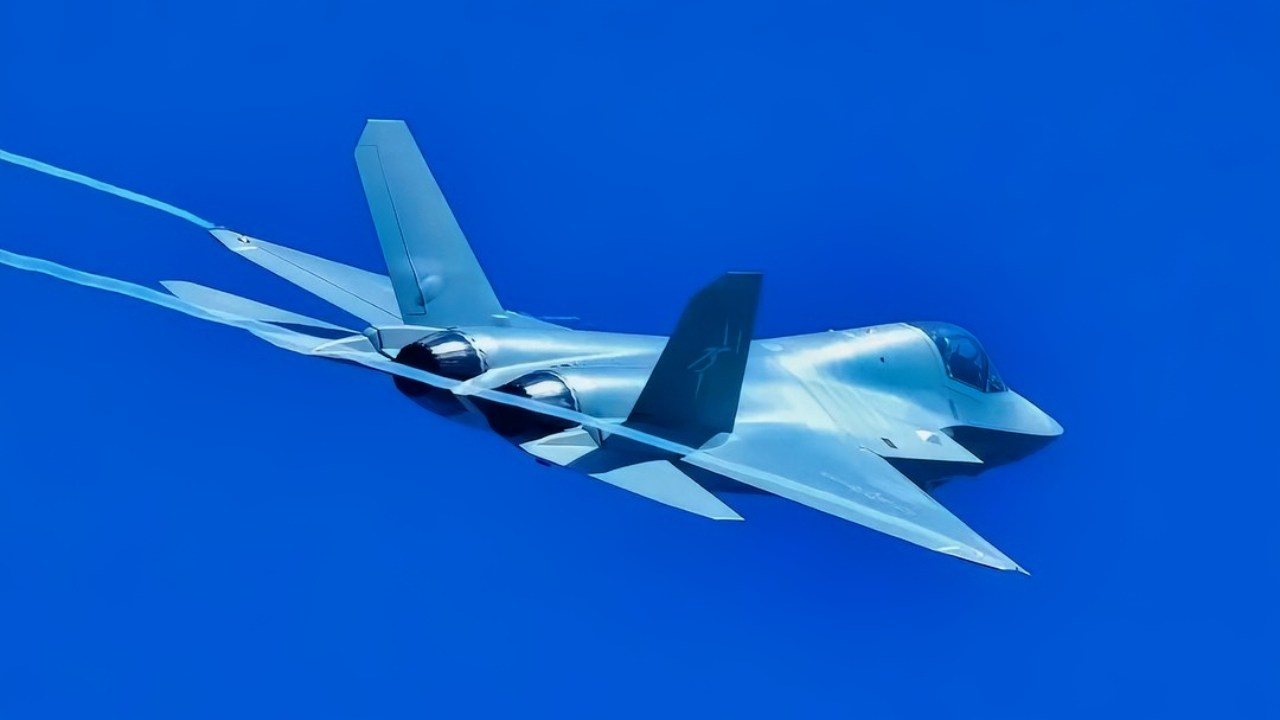
China’s J-35A stealth fighter is about to get stronger. Beijing wants the world to know it, too. The South China Morning Post reported this week that state broadcaster CCTV has laid out a roadmap for the land-based version of the Shenyang stealth jet.
The headline was simple: more power, more weapons.

J-35 Creative Commons Image.
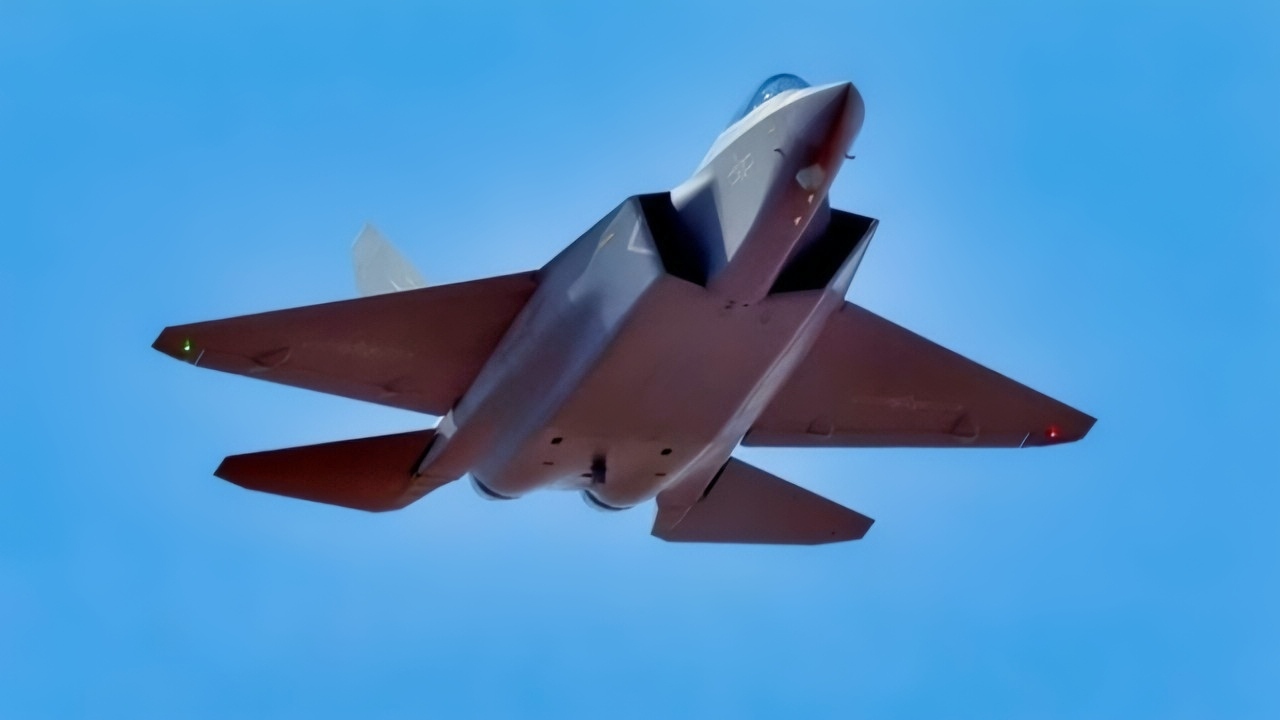
J-35 Fighter from China. Image Credit: PLAAF.
CCTV military commentator Shao Yongling identified four areas where the fighter will improve, starting with a “full version” of China’s WS-19 engine and a wider range of weapons carried inside the airframe.
Two years ago, the J-35A debuted at the Zhuhai air show, making China the second country after the United States to field two different stealth fighters. Now the PLA is signaling that the airplane we saw then is only the starting point.
China’s New J-35A Has a New Engine
According to the SCMP, Jane’s senior Asia-Pacific aviation reporter Akhil Kadidal estimates that each WS-19 in the initial production J-35As produces about 98,000 newtons of thrust, roughly 10,000 kilograms-force.
The two engines give the jet about 196 kN, or a little over 44,000 pounds of combined thrust.
For those keeping score at home, the single Pratt & Whitney F135 in the F-35 is rated in the 43,000-pound class. So on paper, China is already putting comparable total thrust into a twin-engine, medium-weight fighter.
However, raw thrust doesn’t tell you anything about reliability, fuel burn, or time between overhauls. Chinese engine makers have struggled with all three for decades.
Full Version WS-19?
That’s why the “full version” phrasing is most intriguing. It strongly implies the jets flying today carry an interim, not fully matured WS-19.
The early FC-31 demonstrators flew on the WS-13, an improved copy of the Russian RD-93, and analysts told Reuters the WS-19 could be up to 10 percent more powerful.
Military Watch Magazine wrote that a mature engine would improve acceleration, climb, and sustained high-speed flight while giving planners more room to trade between fuel and weapons. No timeline has been announced.
More Missiles, Same Low Signature
The second upgrade is the weapons bay. Global Times, reporting on the same CCTV segment, said Shao wants the internal bay optimized to carry more new munitions and to expand the list of targets the jet can hit while staying in stealth mode.
The aircraft’s designers already told CCTV last year that the carrier-borne J-35 can carry up to six missiles.
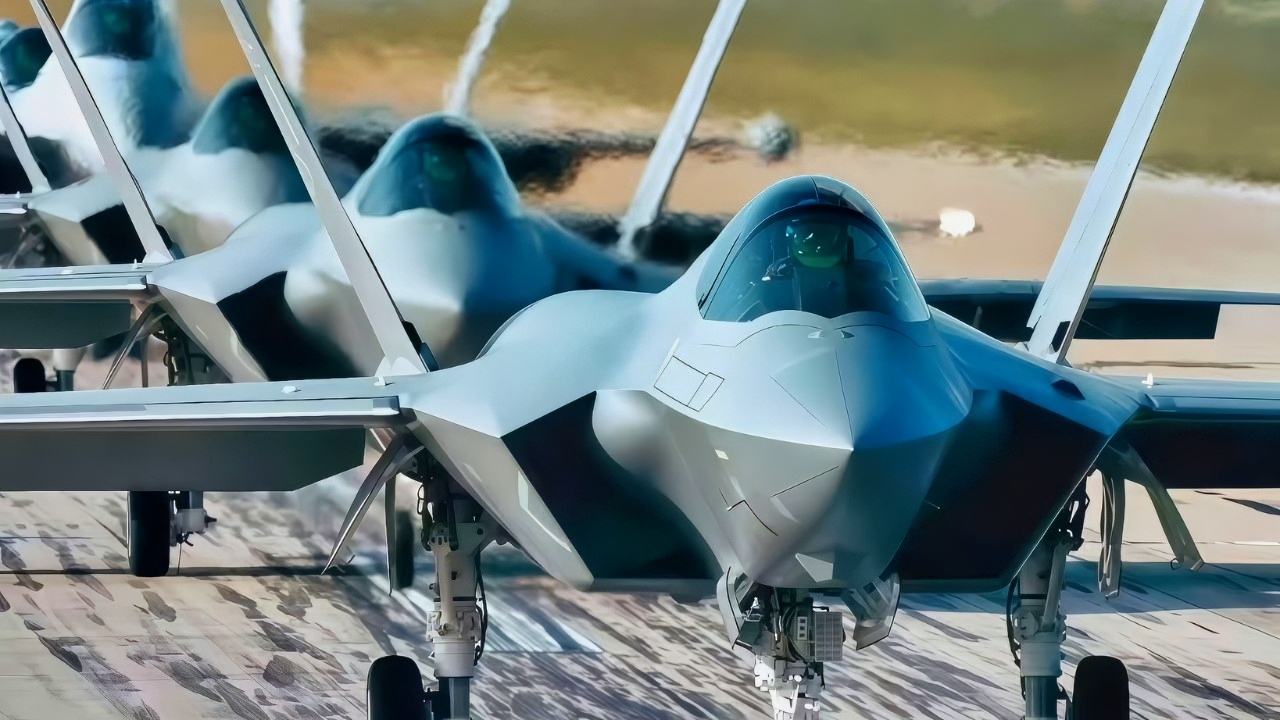
J-35 Fighter In Elephant Walk PLAAF Photo.
Internal weapons bays are the end-all, be-all for a fifth-generation fighter. Ordnance suspended under the wings raises the radar cross section.
The J-35A does have external hardpoints for air-to-ground and anti-ship weapons, but using them means giving up the stealth that justifies the airplane’s price tag.
The Diplomat noted in 2024 that new air-to-air and strike weapons were in development for both the J-20 and J-35 families, and that a shared bay geometry would speed integration.
Sensors, Stealth And Unmanned Wingmen
Shao also suggested that J-35As could operate alongside J-20 fighters as well as uncrewed wingmen and airborne early-warning aircraft, sharing information to improve surveillance, reconnaissance and targeting.
She also floated a two-seat variant that could serve as a command platform for unmanned wingmen, plus a dedicated electronic warfare version. Neither is an official program.
However, the two-seat concept tracks with where every serious air force is heading, including our own push for Collaborative Combat Aircraft (Loyal Wingman).
Why The J-35 Gets Our Attention
The Chinese, like the Russians, are well-known for overstating their capabilities. Shao herself said the upgrades won’t arrive all at once, describing a “small-step, fast-iteration” approach rolled out in batches.
That is exactly how China turned the J-20 from a curiosity into a credible fighter. Field it with what you have, then keep improving it.

J-20 Fighter In All Yellow. Image Credit: Creative Commons.
There are still plenty of unknowns. Few verifiable details exist about the jet’s actual stealth performance, and it has no combat record. Military Watch also raises a fair question about how much the PLA will invest in the J-35 with the J-20 already in service and sixth-generation fighters expected in the early 2030s.
The naval variant faces its own physics problem on ramp-launch carriers, where it gives up fuel and weapons compared to a catapult launch from the Fujian.
However, none of that changes the bottom line. The J-35A doesn’t need to beat the F-35 one-on-one. It needs to be good enough, in large numbers, close to home. Every small step gets it closer.
About the Author: Steve Balestrieri
Steve Balestrieri is a National Security Columnist. He served as a US Army Special Forces NCO and Warrant Officer. In addition to writing on defense, he covers the NFL for PatsFans.com and is a member of the Pro Football Writers of America (PFWA). His work was regularly featured in many military publications.


