


Every interceptor has a price. Every inventory has a bottom: Over two years, Iran spent an estimated $4–6 B firing missiles and drones, while forcing its enemies to spend more than $7 B, or more, defending themselves. It is being acknowledged that Iran has achieved a strategic victory. This is a victory achieved on a spreadsheet, rather than in the air. This article tells you the story of this spreadsheet war.
The war lasted for two years over four phases. It was fought using every possible weapon available in modern warfare: missiles, drones, live aircraft, ships, mines, and artificial intelligence. Over 15000 projectiles were launched in all, and the author cataloged each projectile in detail using OSINT and agentic AI. This resulted in a unique database with over ten spreadsheets, 22 parameters per projectile, and seven tiers of information, each rated for its veracity. Each launch has been rated for its ability to evade detection and interception, each defender on its ability to intercept and/or prevent damage & destruction, with the damage/destruction caused as the final outcome. These, on the expense ledger of each belligerent, decided the win.
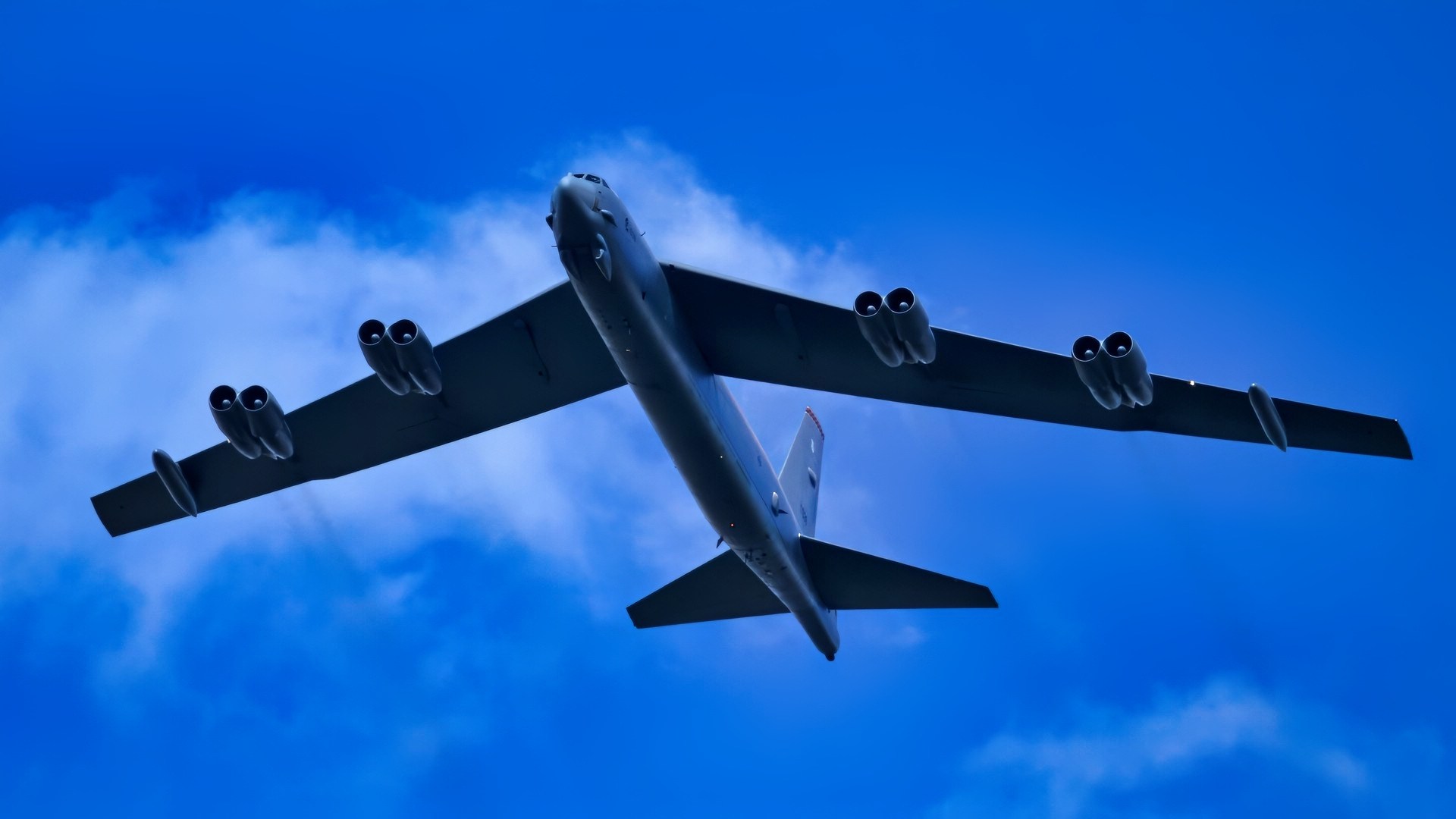
Boeing B-52H Stratofortress. Image Credit: Creative Commons.

Capt. Karla Arango, 20th Bomb Squadron pilot, communicates to crew inside a B-52 Stratofortress during Global Thunder 2019 at Barksdale Air Force Base, La., Nov. 3, 2018. Global Thunder is an annual U.S. Strategic Command (USSTRATCOM) exercise designed to provide training opportunities to test and validate command, control and operational procedures. The training is based on a notional scenario developed to drive execution of USSTRATCOM and component forces’ ability to support the geographic combatant commands, deter adversaries and, if necessary, employ forces as directed by the President of the United States. (U.S. Air Force photo by Senior Airman Philip Bryant)
It is both instructive and interesting to see how each side learned through the various phases of each war. These lessons, like various opening gambits or castling in a chess game, will become planning imperatives for times to come. We will see how, as the war progressed, Iran did not beat intercepts. It just made intercepts irrelevant to its strategy.
Phase-1 (Op True Promise-1)
Phase-1 of the war started in Apr 2024, and Iran tried the textbook approach of a staggered attack using 185 slow drones (Shahed-136) to saturate defenses, followed by 36 fast jet-powered Shahed-238 drones and then 120 ballistic missiles, all reaching in quick succession. After all, till then this is how the war was meant to be fought. However, the defenders managed well, with an interception rate of 99%. Nine missiles did manage to slip through and hit two airbases, but all that was achieved were a few scattered craters, which did not stop operations. Phase-1 goes to the defenders.
Phase-2 (Op True Promise-2)
Phase-2 in Oct 24, went in a fashion similar to True Promise-1, with a 99% interception rate and nothing to show for the ~200 projectiles fired by Iran.
Iran did try to change tactics here. No drones were launched. About ~160 conventional missiles Emad/Ghadr-110/Kheibar Shekan and ~35 Fattah-1 hypersonic glide vehicles (HGV) were fired. We see it graduating from liquid-fuelled Emad/Ghadr missiles to solid-fuel Kheibar Shekan and Fattah-1 HGV. It also compressed whole salvos into 45 min, rather than the hours-long staggered attack of Phase-1, perhaps hoping to overwhelm the defenses.
The defenders too had to change tactics. Since there were no drones, the Iron Dome went largely unused. Most interceptions were done using Arrow-2/3, David’s Sling and the SM-3.
The direct consequence of this was that the cost of interception went up. In Phase-1, the defenders spent approx $400 M, intercepting an estimated ~335 of the ~341 projectiles fired over a six-hour period on 13-14 Apr 24 (ph-1), while Iran too spent close to $350-400 M. In Phase-2, while Iran spent a similar amount on its 45-min salvo of 200 projectiles (approx $360 M), the cost of defense went up to $740 M.
Phase-3 (The Twelve Day War)
Things start getting much more interesting in Phase-3. Over the 12-day period between 13-24 Jun 25, Iran fired ~525 ballistic missiles and ~1000 drones against Israel and 14 ballistic missiles against the US base at Al Udeid, Qatar.
The biggest surprise unfolded on 13 Jun 25, when Israel simultaneously activated 60+ drones and IED packages, smuggled into Iran months to years in advance. They simultaneously destroyed multiple S-300 missile launchers, HQ-9B launchers, and indigenous Bavar-373. This destroyed approx 70% of Iran’s long-range SAM capability in a single strike. This allowed 1200+ strike sorties to go in every day, unopposed.
The interception rate against drones remained the same, hovering at around 99%. On the other hand, the rate of interception of ballistic missiles fell from 99% in phase-2 to 86% in phase-3. This is despite the fact that Iran used the same missiles in phase-3 as it did in phase-2 (Emad/Ghadr/Kheibar Shekan/Fattah-1/110).
The reasons for the falling rate are not explicitly available, so one is constrained to make a few educated guesses. Israel started using David’s Sling, specifically designed for heavy and slow cruise missiles to intercept ballistic missiles, instead of Arrow 2/3 that had been used in Phase-2, with predictably less effective interceptions. The possible reason is that David’s Sling (Skyceptor/Stunner) cost $1 M per shot, against ~$2.5/3 M per shot of Arrow-2/3. It appears that for the first time the arithmetic lessons started sinking in – after all, one can’t shoot accountants/auditors along with the enemy.
The result was most telling on 15 Jun, when 60–80 missiles, with an 86% interception rate, resulted in damage to 61 buildings in Bat Yam, a mall hit in Kiryat Ekron, and residential collapses in Rehovot, resulting in nine civilians killed, two hundred injured. Overall, in Phase-3, a hospital was damaged, 12+ military/energy/government sites were hit, BAZAN oil refinery pipework was damaged, ~20+ killed and ~400+ injured
The attack on the US base at Al Udeid was especially interesting. As the US had still not entered the war officially, Iran had warned the US of the attack, and aircraft had been evacuated from the base. THAAD and Patriot batteries defended the base with a 93% interception rate. The solitary missile that avoided interception (13/14 were intercepted), destroyed a radome and MET satellite terminal.
It was within this same Phase-3 window that the US and Israel landed their two most consequential blows. On 13 Jun 25, Israel’s Operation Rising Lion struck Natanz and Fordow, and a parallel decapitation strike that killed Chief of Staff Mohammad Bagheri along with five IRGC generals and 15+ other senior officers, using Rampage Supersonic+ Air Launched Missiles.
Nine days later, on 22 Jun 25, the US Op Midnight Hammer gave the GBU-57A/B Massive Ordnance Penetrator its ‘show-stopper’ moment. Fourteen bombs, delivered at an estimated total cost of $636 M, were dropped on Fordow, Natanz and Isfahan, against nuclear facilities whose replacement cost is estimated between $50-100 B. These early successes, on the one hand, emboldened the alliance, and on the other, gave them some measure of complacency.
Phase-4 (Op Epic Fury)
Phase-4 opened on 28 Feb 26 with the single most consequential strike of the entire war: a joint US-Israeli decapitation strike on Supreme Leader Ali Khamenei’s compound in Tehran, which killed Khamenei himself along with the IRGC commander, the defense minister, the army chief of staff and the secretary of the Supreme National Security Council. This greatly raised the stakes of the conflict, and the weaponry deployed thereafter became correspondingly more diverse and intense.
Beyond the decapitation strike, Epic Fury and the parallel Israeli Operation Roaring Lion had high claims of destroying 90% of Iran’s surface combatants and more than 95% of its naval mines, alongside an estimated 85% of the country’s defense-industrial base and 70% of its missile launchers. The GBU-57 and Rampage, having proven themselves in Phase-3, remained workhorses of this campaign, used again against follow-up targets such as the Taleghan-2 enrichment site.
Iran, on the other hand, lay low as it recovered from these early shocks. It then changed strategy, which brought the war from the air to the spreadsheet. Three important factors bear mentioning.
The first game-changer was the Khorramshahr-4 cluster ballistic missile, which changed the meaning of a successful intercept. The bomblets penetrated despite the interception and resulted in widespread damage, making the missile very effective (09 Mar, 17 Mar and 18 Mar 26). It is only when it was intercepted by the Arrow-3, at around 100 km above ground level, that it could actually be neutralized.
The second (unexpected) move by Iran was to widen the scope of the conflict throughout the Gulf region. This spread the allies thin and also dragged them into a diplomatic quagmire. In addition, it increased the requirement for interception missiles, which eventually led to depletion and prohibitive cost of missiles.
The third game-changer for Iran was the improvement in the accuracy of missiles. Unlike Phase-1, where nine missile hits barely damaged the runway, in Phase-4, examples include a single missile hit causing a synagogue to collapse (Beit Shemesh), or a three-story apartment collapse (Ramat Gan). Increased accuracy manifested in a direct hit on the Dimona perimeter and a full operational shutdown of Emirates Global Aluminum.
The interception rates for the ballistic missiles are best estimated in the 87–90% range in Phase-4, slightly higher than the 86% of Phase-3, though there is still a lack of confirmed sources. The cost of interception steadily crept up to $4.4 B in Phase-4. On the other hand, stocks of interception missiles steadily depleted, and by 10th Apr 26, when a ceasefire was negotiated, many were reaching a floor figure of 30-40%. Israel started repurposing the Tamir missile of Iron Dome for ballistic missile defense with mixed results.
Essentially, we see Iran’s tactics moving from ‘overwhelm the decision cycle’ in Phase-1 to ‘exhaust the interceptor stockpile’ in Phase-4, as the cost of interception crept up from $400 M in Phase-1 to $4.4 B in Phase-4.
Related to the above is the fact that the cost return on missile interception – a well-documented 9:1 ratio against Iran during the Twelve Day War (Phase-3) – appears, on the available evidence, to have fallen sharply by Phase-4. The US alone fired 943 Patriot interceptors in four days in early Phase-4, and Gulf partners burned through an estimated 86% of their Patriot stockpiles within five weeks. While authentic cost-exchange figures are not available, the qualitative picture of interception becoming financially unsustainable is well supported.
Summary
Iran’s expenditure through all four phases of the war is best estimated at $4–6 billion. The US, on the other hand, according to Linda Bilmes, a public finance professor at the Harvard Kennedy School, will end up spending up to $1 T in the long term once veteran-care and interceptor-replenishment costs are included
This does not include a separate, $300 B conditional reconstruction fund, said to be Gulf-financed and contingent on a peace settlement, which US officials themselves have given conflicting accounts of.
This is not a story of expensive vs cheap war. This is a story of a four-figure cost multiple, which became unsustainable for the largest economy in the world.
This war on a spreadsheet is here to stay. Not just in the Middle East, but in any war of the future. We understand that any large power will be able to put up defenses – at least initially. The question is, will it be able to sustain it? Or is it a time to get economists to sit with military planners?
About the Author:
Anupam Agarwal (retried Air Vice Marshall, India) is an independent consultant aviation human Factors and Safety.


