


Summary and Key Points: The F-111 Aardvark was retired in 1998 primarily due to a “maintenance crisis” and the aging architecture of its 1960s-era variable-geometry wings.
-Despite being the most successful strike aircraft of Operation Desert Storm, its high upkeep and specialized low-level mission set were deemed redundant as the F-15E Strike Eagle matured.
-The move was a “strategic disaster” for long-range, unrefueled penetration; the Air Force lost the ability to fly Mach 1.2 at just 200 feet for 2,500 miles without tanker support.
-Today, the Aardvark’s legacy as a “fast-jet” electronic jammer and “bunker buster” remains a significant gap in the U.S. strategic arsenal.
-BONUS – National Security Journal recently visited the F-111 at the National Museum of the Air Force back in July of last year. We have included extensive original photos of the visit.
From El Dorado Canyon to the Graveyard: The Tragic Fall of the F-111 Aardvark
The US Air Force F-111, known as the Aardvark, was developed during the Cold War under the Tactical Fighter Experimental Program (TFX), when Robert McNamara was Secretary of Defense.
When it first entered service, it was an outstanding platform capable of performing multiple roles in the skies. The “Aardvark” was also the first production airframe to feature a variable-sweep wing that could be changed in flight.

F-111. National Security Journal Photo.
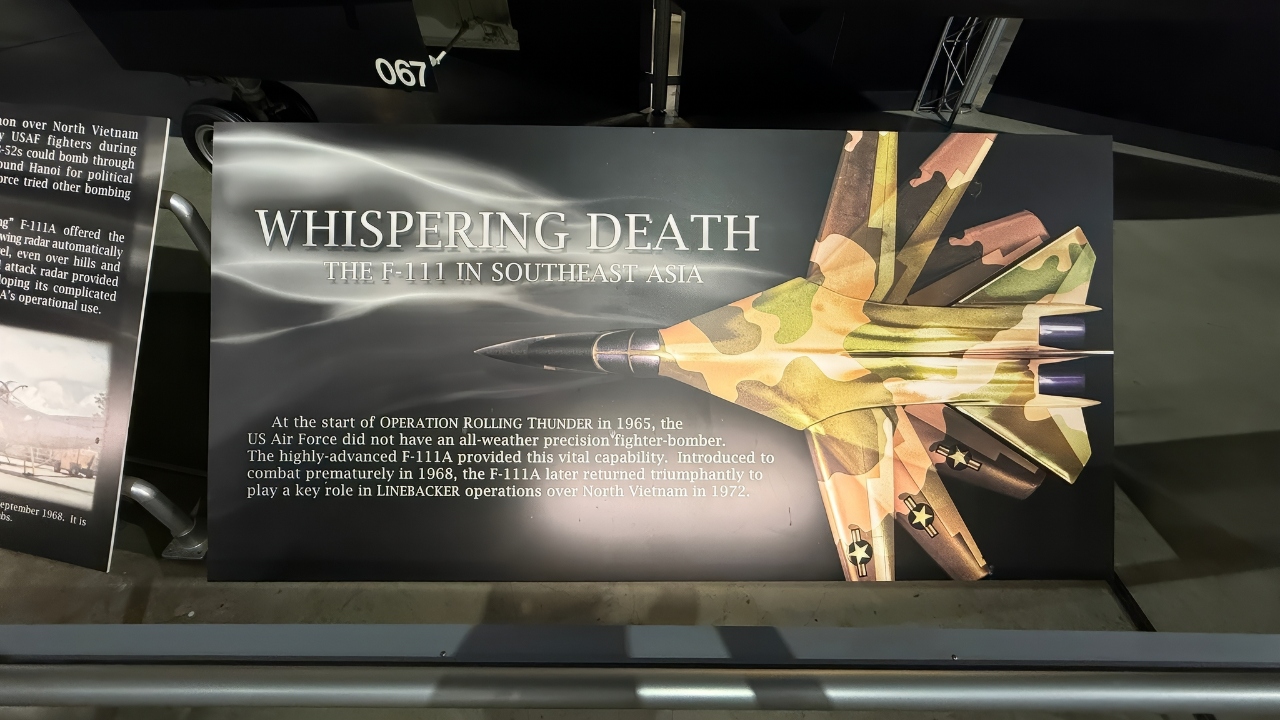
F-111 Photo from USAF Museum in Dayton. Image Credit: National Security Journal.
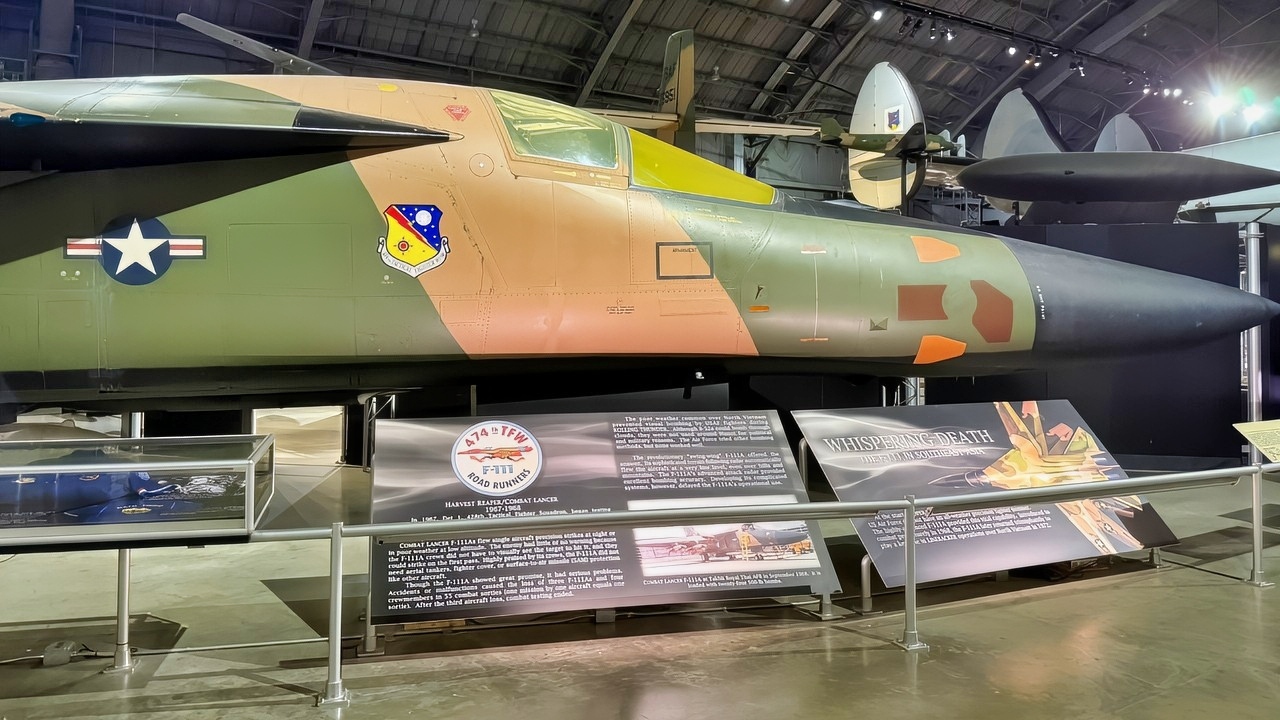
F-111 In USAF Museum July 2025 NSJ Image Taken by Harry J. Kazianis.
When it was retired in the late 1990s, it was considered a necessary move; however, it left a hole in the Air Force’s capabilities.
Background of the Development of the F-111
During the height of the Cold War, the US was not aware of how advanced the Soviet Union’s anti-aircraft defenses were until Francis Gary Powers’ U-2 spy plane was shot down over the skies of Russia.
McNamara ordered a jet to meet the Navy’s and Air Force’s needs. Initially, the Secretary sought a high-altitude jet. But General Dynamics built the aircraft from the ground up. It was developed with two-seat and twin-engine features.
Powered by two powerful Pratt & Whitney TF30 afterburning turbofan engines with 25,100 pounds of thrust, the F-111’s top speed was 1,452 mph. The pilot and weapons officer sat side by side in the cockpit. The variable-sweep wings’ span in full forward and full sweep varies from 16° to 72.5°.
The swept wings extended and swept to achieve supersonic speeds at both high and low altitudes, enabling shorter takeoff and landing distances.
The F-111 aircraft conducted its maiden flight in December 1964 and entered service with the Air Force in 1967. Production ceased in 1976 after 566 aircraft had been built in various versions. The F-111 variants were in service with the Air Force until 1998.
Meet The F-111 Aardvark
The FB-111A was a strategic bomber variant developed for the U.S. Air Force Strategic Air Command. It had increased load-carrying capacity and range and used the SAC Mark IIB avionics suite. It had Triple Plow II intakes and a TF30-P-7 engine. The main armament of FB-111A was the Boeing AGM-69 short-range attack missile.
The internal bay could carry Mk 117 type (340kg) bombs, and up to Mk 118 (1,400kg) was cleared. The F-111 could carry various free-fall nuclear weapons such as B43, B57, and B61 bombs. The F-111C can launch AGM-142 Popeye stand-off missiles, AGM-84 Harpoon anti-ship missiles, and AGM-88 HARM anti-radiation missiles.
The avionics systems included communications, navigation, terrain following, target acquisition and attack, and suppression of enemy air defense systems.

F-111. Image Credit: Creative Commons.

F-111. Image Credit. Creative Commons.
The F-111’s automatic terrain-following radar system maintained a constant altitude above the ground, following Earth’s contours, known as the Nap of the Earth. It enabled the aircraft to fly in valleys and over mountains, day or night, regardless of weather. A fail-safe automatic climb was initiated in the event of any system malfunction.
The radar bombing system was synchronized with a laser spotting system to deliver weapons precisely at night or in bad weather.
Long, Distinguished Combat Record
It flew over 4,000 missions in Vietnam with only six losses, one of the lowest loss rates of the war. During the 1972 Linebacker raids, the F-111 Aardvark finally demonstrated its potential. Flying beneath North Vietnam’s extensive radar network at night, F-111s blasted North Vietnamese airfields and air defense batteries, weakening the resistance to incoming B-52 raids.
Aardvarks didn’t require the fighter escort, electronic warfare support, or midair refueling that other bombers required and could operate in inclement weather.
In 1986, tensions with Libya rose with the United States after the bombing of the La Belle nightclub perpetrated by Libyan agents in Berlin killed two U.S. servicemen. President Reagan ordered an attack on Libyan dictator Muammar al-Qaddafi’s personal compound near Tripoli, codenamed Operation El Dorado Canyon.
Because the United States couldn’t obtain approval from mainland European countries (France) for the raid, the Aardvarks took off from the UK and had to circumnavigate Spain, increasing the total flight time to 13 hours.
In total, they would need to refuel six times on the round trip. It was the most extensive fighter mission in history. Qaddafi escaped because the Prime Minister of Italy tipped off Qaddafi at the last minute.
The Aardvark could land and take off from shorter runways, which also enhanced its effectiveness during the Vietnam War, the Cold War, and Operation Desert Storm. The US sold the F-111 to Australia, whose pilots affectionately called it “the Pig.”
Why Did The US Retire The F-111?
The F-111 Aardvark was retired by the U.S. Air Force (USAF) in the late 1990s primarily due to high maintenance costs, its aging 1960s technology, and the emergence of newer, more versatile aircraft like the F-15E Strike Eagle, which offered better performance and cost-effectiveness, especially after the Cold War reduced demand for its specialized deep-strike role.
The Royal Australian Air Force (RAAF) retired its F-111s in 2010 for similar reasons: age, high maintenance costs, and the shift toward networked, stealthier platforms.
The F-111s success ratio was better than any other strike aircraft that the US used during Operation Desert Storm.
However, the F-111 was a complex, variable-geometry-wing aircraft, making it expensive and time-consuming to maintain, particularly compared with newer designs. Its 1960s design and systems have become increasingly difficult and costly to upgrade, whereas modern jets feature superior integrated diagnostics.
With the end of the Cold War, the original threat of large-scale Soviet tank invasions diminished, reducing the need for the F-111’s specific low-level interdiction role. And the Pentagon’s budgets were slashed, making the expensive-to-maintain Aardvark a target for retirement.
The F-15E Strike Eagle provided a more versatile platform for precision strike, while other aircraft filled roles such as strategic bombing (B-1B) and close air support (A-10), thereby reducing the F-111’s unique value.
What Capabilities Were Lost When The Aardvark Was Retired
While the F-15E Strike Eagle and B-1B Lancer took over many of the F-111’s roles, the specific combination of long range, low-level supersonic speed, and heavy, internal, low-drag payload was lost.
The F-111 had a long-range supersonic strike capability without requiring air-refueling tankers. The F-111 could fly over 2,500 miles, strike a target, and return without refueling. It could fly at Mach 1.2+ at low altitude while using terrain-following radar, a capability that enabled it to operate effectively without a dedicated fighter escort.
The EF-111 variant provided high-speed, penetrating electronic jamming that could keep pace with strike packages. Upon its retirement in 1998, this specific “fast-jet” jamming capability was lost, as it was replaced by the slower EA-6B Prowler.
The F-111 could carry up to 31,000 pounds of ordnance, much of it internally. This included specialized, heavy weapons like the 4,700 lb GBU-28 “bunker buster” laser-guided bomb.
Nap-of-the-earth flying capability was incredible. The F-111’s ability to fly at very low altitudes (e.g., 200 feet) at high speeds (Mach 1.2+) in all weather conditions, “hands-off” for the pilot, was unmatched.
The Royal Australian Air Force (RAAF) lost the ability to launch the AGM-84 Harpoon and AGM-142 Popeye standoff missiles from a high-speed, long-range platform.
The RF-111C, equipped with a specialized bomb-bay reconnaissance pallet, was considered among the best tactical reconnaissance platforms in the world
It was a great and elegant aircraft. It could fly low and nearly unobservable to enemy radar, and she was fast and maneuverable. However, they were maintenance-intensive and costly to operate. The Air Force sought the B-1 bomber.
About the Author: Steve Balestrieri
Steve Balestrieri is a National Security Columnist. He served as a US Army Special Forces NCO and Warrant Officer. In addition to writing on defense, he covers the NFL for PatsFans.com and is a member of the Pro Football Writers of America (PFWA). His work was regularly featured in many military publications.


Paul Simonson
February 12, 2026 at 10:15 am
We didn’t win the Vietnam war in spite of how well a certain jet performed.In fact the US has come up with many modern day weapons systems that are truely awesome, but they haven’t brought peace to the world.
Ralph
February 16, 2026 at 7:29 pm
In 2009 the EA-18G Growler replaced the EA-6B Prowler.