


All About the USS Constellation (CV-64): A Complete History
The USS Constellation (CV-64) was one of the most prominent ships of the U.S. Navy to emerge during the mid-century. A Kitty Hawk-class supercarrier, the USS Constellation, was built in the 1950s and launched in 1960.
According to USCarriers.net, the USS Constellation was the second ship in the Kitty Hawk class, after its contract was awarded in 1956. It was laid down a year later at the New York Naval Shipyard.
The carrier was christened on October 8, 1960, with Mary Herter, the wife of the then-Secretary of State Christian Herter, serving as sponsor.
Two Fires
Just two months later, per the USCarriers account, the carrier suffered a large fire when construction was 90 percent complete. A tank with 502 gallons of fuel was in a hangar bay, and a forklift collided with that tank.
“A fire started, and the flames quickly grew because of all the wooden materials lying in the hangar bay and on the flight deck, and one moment later, a huge flame and a dark cloud of smoke could be seen above the carrier. It took twelve hours to extinguish the fire. 50 people were killed, and 323 were injured,” the USCarriers account said.
As a result, the repairs cost $75 million, and the commissioning of the Constellation was delayed by seven months.

USS Constellation Aircraft Carrier. Image Credit: Creative Commons.
The carrier was commissioned on October 27, 1961. But the following year, during sea trials, another fire broke out, this time due to a broken oil pipe. This time, four people were killed, including a pair of crewmen, and nine were injured.
Finally, in early 1962, the Constellation headed out to sea on the way to its new home port in San Diego. This required going all the way around the bottom of South America, a journey that took two months.
To the Pacific- and War
In May of 1964, the Constellation headed to the Western Pacific.
And after an uneventful first three months, the carrier saw its first military action in the aftermath of the infamous Gulf of Tonkin incident, which became an important catalyst for U.S. involvement in the Vietnam War.
Per the State Department’s Office of the Historian, two U.S. destroyers, in early August of 1964, “radioed that North Vietnamese forces had fired upon them.” This led to the passage of the Gulf of Tonkin Resolution, which authorized President Lyndon Johnson to increase U.S. military involvement in the region. That resolution was used as a legal justification for the next decade of United States involvement in the conflict, even though it was adopted in 1971.
On August 5, the Constellation joined the USS Ticonderoga (CV 14) in launching “60 sorties against four bases and their supporting oil storage facilities.” During that mission, Lt. J.G. Richard A. Sather, who had launched from the Constellation, became the first Navy pilot to lose his life in Vietnam. In contrast, Lt. J.G. Everett Alvarez became the first American POW in the war. Alvarez was held in captivity for the entirety of the U.S. involvement in the war, for more than eight years, and was finally freed in 1973 upon the signing of the Paris Peace Accords.
The Constellation, in early 1965, headed back to home port, but it would return to the Vietnam theater again, making its return to the South Pacific in May of 1966, with Carrier Air Wing 15.
“Connie’s aircraft pounded roads, bridges, and other targets, attempting to impede the flow of men and war materials south,” the USCarriers account said. In July, an F-4B crew shot down a MiG-17 fighter jet, for the first MiG kill of the war. In December, it was time to head back to San Diego.
The next deployment to the Pacific began in April of 1967, lasting eight months. The fourth deployment was the following year, 1968, as the Constellation arrived in May, before heading back home in January of 1969. That trip home involved ” maintenance and training periods,” per the USCarriers account, before the Constellation headed out for another wartime deployment, this time beginning in August of 1969.
As the 1970s began, two airmen in an F-4 Phantom II shot down a MiG-21, near Thanh Hoa, in what The Aviationist called the first-ever kill scored by a Top Gun graduate. That deployment ended in May of 1970, when the Constellation headed back to California and underwent a ” nine-month major shipyard overhaul.”
The Constellation’s sixth deployment to the Pacific began in October 1971. This deployment included a “major protective reaction strike effort” by the Air Force and Navy in late December.
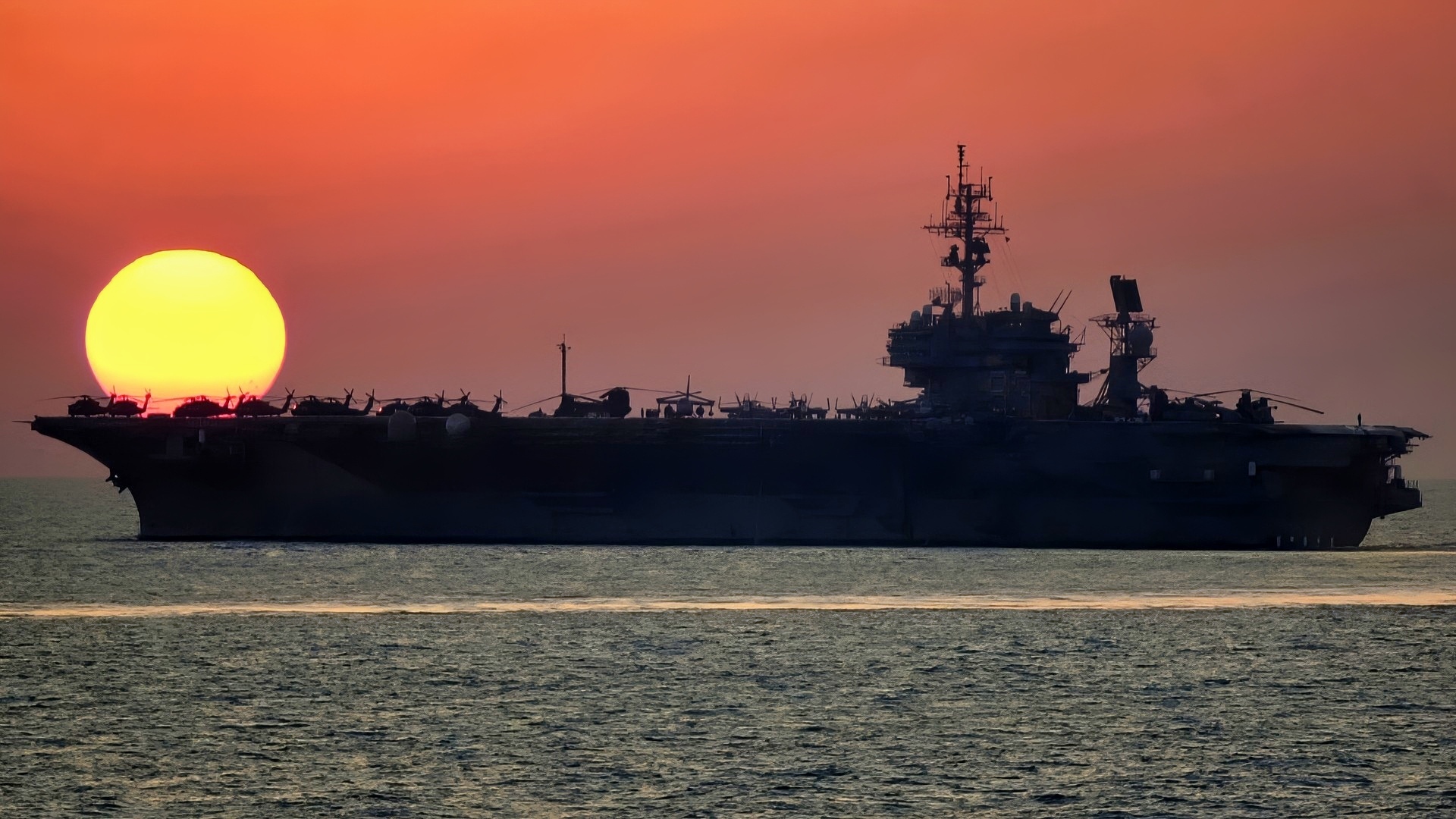
USS Kitty Hawk of Kitty-Hawk-Class. Image Credit: Creative Commons.
By 1972, peace talks were underway, but broke down, leading to a new North Vietnamese invasion of South Vietnam. That spring, the Constellation played a key role in Operation Freedom Train and later Operation Freedom Porch.
That nine-month deployment ended July 1, 1972. The Constellation returned to the Pacific in January of 1973, with the ceasefire taking effect later that month. Sorties continued to be conducted in Laos, however. The Constellation headed back to San Diego that October.
After the War
The Constellation’s next deployments to Asia were considered peacetime, with the next one beginning in June of 1974 and ending that December. In early 1975, it headed to the Puget Sound Naval Shipyard for what USCarriers called “one of the most extensive carrier overhauls ever undertaken,” to enable it to carry the F-14A Tomcat and the S-3A Viking.
The carrier’s next deployment was to Thailand, and then, in late 1978, it headed towards Singapore, in response to “the internal crisis in Iran.” On its next deployment, in 1980, the carrier went to the Arabian Sea, where it was to assist in the failed rescue attempt of the U.S. hostages in Iran in the spring of 1980.
In the 1980s and ‘90s
In August of 1981, when it was docked, President Ronald Reagan visited the ship, called it “America’s flagship,” and declared, “Let friend and foe alike know that America has the muscle to back up its words, and ships like this and men like you are that muscle.”
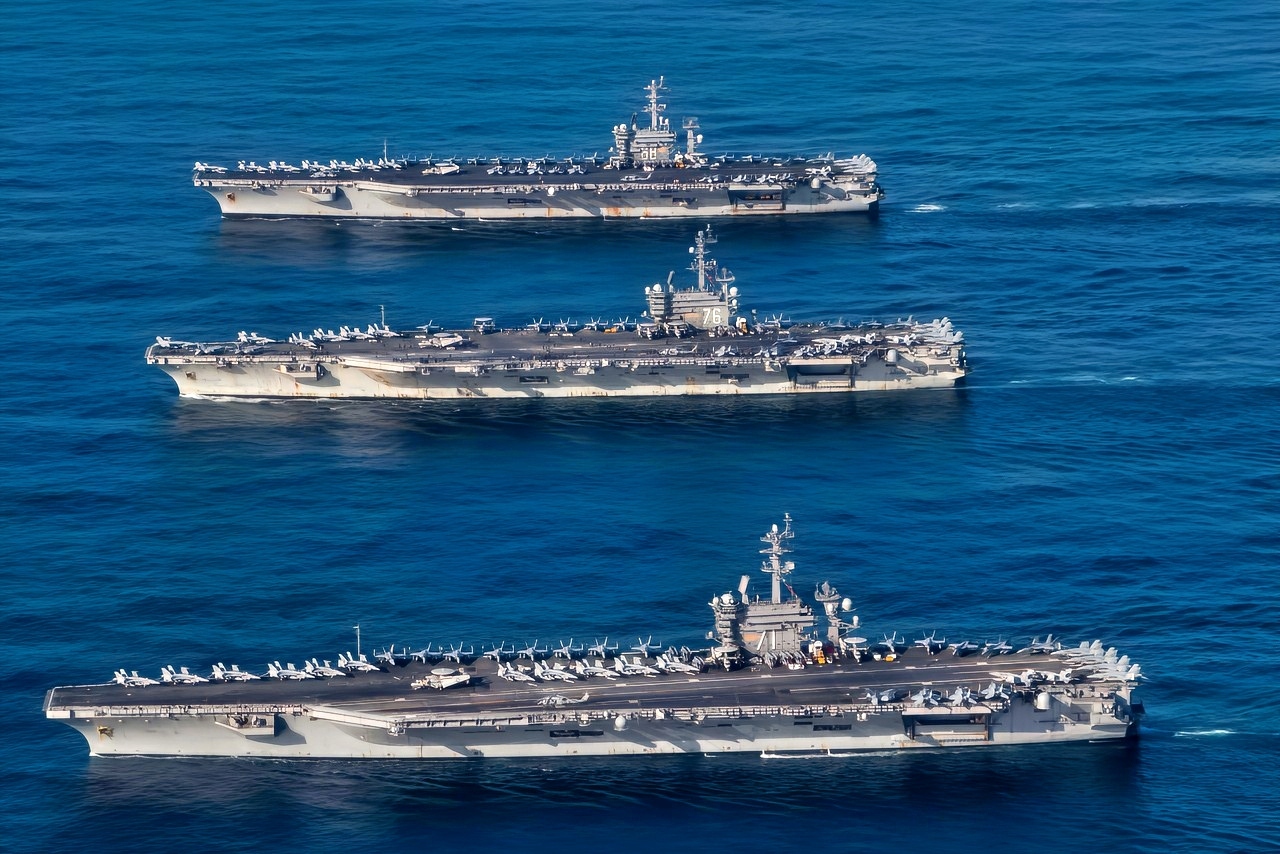
The U.S. Navy aircraft carriers USS Nimitz (CVN-68), USS Theodore Roosevelt (CVN-71) and USS Ronald Reagan (CVN-76) underway in the Western Pacific on 12 November 2017. The strike groups were underway and conducting operations in international waters as part of a three-carrier strike force exercise. This was the first time since August 2007 that three U.S. Navy carriers operated together. In 2007, USS Kitty Hawk (CV-63), USS Nimitz (CVN-68) and USS John C. Stennis (CVN-74) participated in exercise “Valiant Shield”.
The carrier was deployed again to the Pacific in 1985, then conducted a Northern Pacific Cruise in 1986. In 1987, it participated in Operation Earnest Will, another mission that involved escorting ships against Iran’s wishes, with echoes in today’s headlines.
In 1990, the carrier began a three-year overhaul, described in the USCarriers account as an 800-million-dollar Service Life Extension Program (SLEP). This kept it out of the Persian Gulf War. However, a few years later, it did take part in Operation Southern Watch in 1995 and again in 1999.
The End
When the 9/11 attacks took place in 2001, the Constellation was on its way from Pearl Harbor to San Diego, a voyage depicted in the Disney movie Tiger Cruise. About a year later, the carrier departed for what would be its final deployment.
The Constellation was decommissioned in August 2003 after 41 years in service and was stricken later that year.
It was scrapped in Brownsville in 2015, with the process completed two years later.
About the Author: Stephen Silver
Stephen Silver is an award-winning journalist, essayist, and film critic, and contributor to the Philadelphia Inquirer, the Jewish Telegraphic Agency, Broad Street Review, and Splice Today. The co-founder of the Philadelphia Film Critics Circle, Stephen lives in suburban Philadelphia with his wife and two sons. For over a decade, Stephen has authored thousands of articles that focus on politics, national security, technology, and the economy. Follow him on X (formerly Twitter) at @StephenSilver, and subscribe to his Substack newsletter.


Capt Peace
March 30, 2026 at 6:20 pm
This kind of carrier would be considered 100% wholly stupid if launched now, in 2026.
Why.
Any carrier worth its salt today must carry group 5 drones like the wing loong-X, which is a long-range semi-autonomous sub hunter.
Thus the USS Constellation would be simply useless for today’s use.