

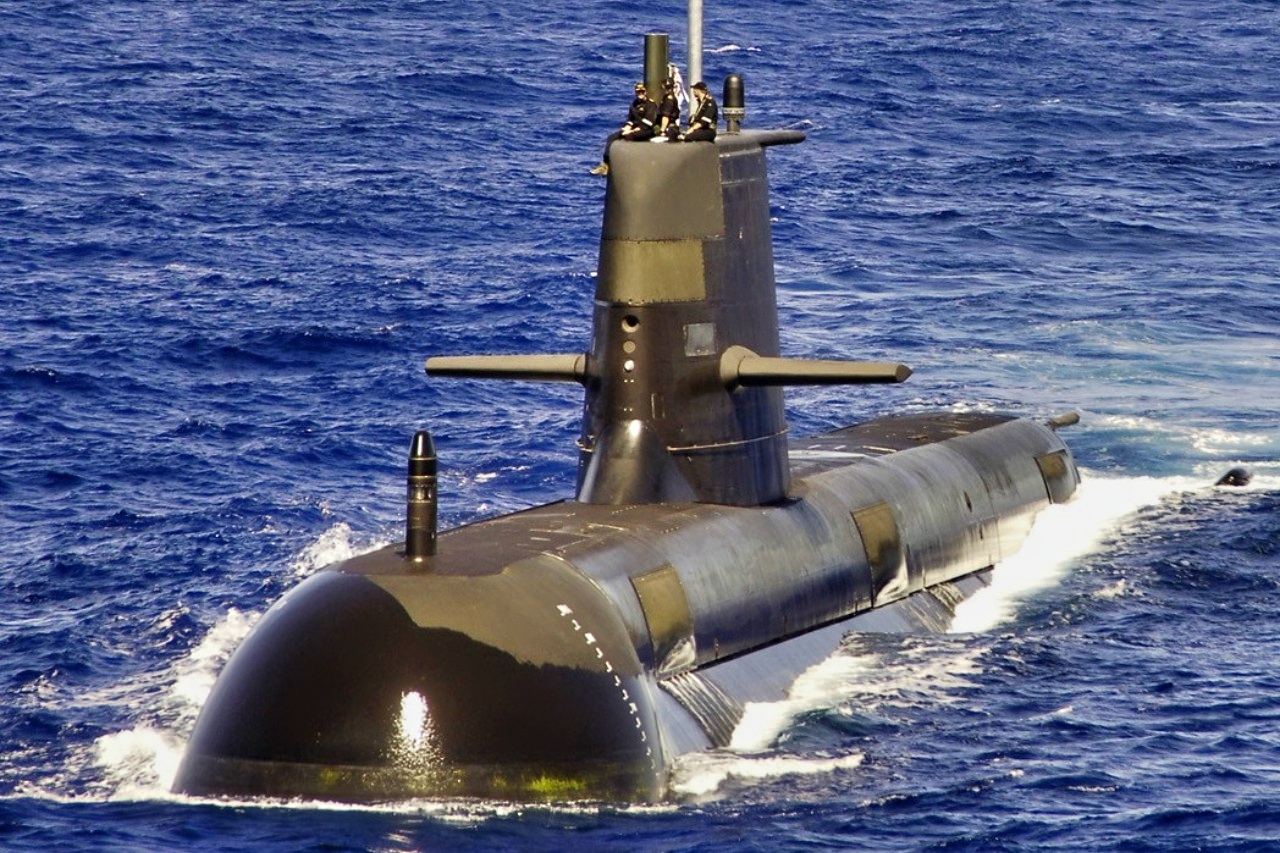
Key Points and Summary – The Australian Collins-class submarine HMAS Dechaineux narrowly averted a catastrophic disaster in February 2003 when a seawater hose burst while it was operating at its maximum depth.
-The rapid flooding of the engine room left the 55-person crew with only “20 seconds” to prevent the submarine from imploding and sinking.
-This near-fatal incident highlighted the significant design flaws and maintenance issues that plagued the Collins-class, a program already known for being unreliable and over-budget, and forced the Australian Navy to restrict the operational depth of the entire fleet.
Australian Submarine Disaster Averted: Only 20 Seconds Until Sinking
A close call with one of Australia’s submarines deeply scared the sailors when a flood nearly sank the HMAS Dechaineux in February 2003.
Personnel on board said they had only 20 seconds left until the diesel-electric guided missile sub would have imploded and killed everyone on board.
All Hands Could Have Been Lost
The Dechaineux was operating off the coast of Perth in Western Australia in the Indian Ocean when the near-death experience happened.
Fifty-five sailors were on board, and they considered themselves lucky to be able to recount the tale.
An after-action report released two years later determined that a hose in the lower engine room had burst, sending tons of high-pressure seawater that quickly flooded the compartment.
The hose was part of the auxiliary seawater system.
It provided cooling water for the engineering aspects of the boat.
This failure was scary. The Dechaineux was sailing at its deepest depth, and the water wouldn’t stop coming onboard.
Sailor Thrown Around Like Being in a ‘Washing Machine’
AFP had the following interview with one of the sailors to recount what happened.
“There was a loud bang and something hard flew past my head,” said Able Seaman Geordie Bunting, who nearly died when the room rapidly filled with water. “Then the water flooded in and I got tossed around like in a washing machine. Another five seconds and we would have been in big trouble … another 10 and you have got to question whether we could have surfaced.”
Quick Reaction Saved the Sub
Bunting and his mates must have been petrified. No submarine is completely safe, and sailors are trained for floods, but this one was serious.
The officer of the deck would have been forced to react quickly to take action on the bridge and get the sailors moving toward the flooded area.
The captain probably ordered additional personnel to the room to free Bunting before he drowned and this rescue party was able to stop the water coming in. Bunting was close to being a goner as the seawater moved higher and higher. Thankfully, the crew sprang to action and took “appropriate measures,” the Navy said in 2003.
In the report, a naval commander in charge of the entire submarine fleet said the flooding was very serious and significant. “We were talking seconds, not minutes,” until the sub would have been sent to Davy Jones’ Locker.
The Sub Could Have Been Crushed Like a Soda Can
“It would have been like crushing an empty Coke can in your hand,” Bunting said. “We were too deep to hit the bottom alive.”
The propulsion system could have been incapacitated, and the weight of the seawater entering the sub would have kept the boat from surfacing. All hands would have been lost as the vessel would have quickly gone to the bottom of the sea.
Meet the Collins-Class Submarine
The Dechaineux is a Collins-class sub, and the Australian navy decided to change the maximum depth on the boat,s keeping them from diving so deep. The type of hoses that failed are still on Collins-class boats.
Collins-Class Subs Were Problematic
The Australian Navy was not initially confident in the Collins-class submarines.
These six subs were expensive to maintain in the water and required considerable time in port for upkeep.
The Collins-class is made up of large conventionally-powered submarines that have replaced the earlier Oberon-class.
The Collins-class boats were not popular.
They were seen as having design flaws that kept the Australian silent service from reaching its full potential.
“Those problems included unreliable engines, excessive noise and a computer combat system which failed to meet specifications. The navy has made significant efforts to remedy the shortcomings and appeared to have fixed most of problems, although at significant cost,” according to The Age media outlet in 2003.
Australia did a thorough inspection of the Dechaineux after all Collins-class boats were ordered back to port.
They couldn’t find anything wrong with the hoses. They figured that to be on the safe side, the Collins-class should not dive as deep to relieve pressure on the hoses. This probably did not give much reassurance to the undersea warfare officers and enlisted men. The navy needs these sailors to be fully confident in the safety of the subs, or morale will suffer, and the crew may not perform their jobs to the best of their ability.
This was a fraught incident that shocked the Australian Navy. Commanders knew they had a problem with the Collins-class, and sailor poise was likely affected. The crew who served on the Dechaineux is aware of the risks associated with serving on submarines, but they never signed up for nearly drowning.
The sailors who saved Seaman Bunting should be considered heroes, and the Australian Navy likely used the example of this near-tragedy to train submarine crews more thoroughly.
About the Author: Dr. Brent M. Eastwood
Brent M. Eastwood, PhD is the author of Don’t Turn Your Back On the World: a Conservative Foreign Policy and Humans, Machines, and Data: Future Trends in Warfare plus two other books. Brent was the founder and CEO of a tech firm that predicted world events using artificial intelligence. He served as a legislative fellow for U.S. Senator Tim Scott and advised the senator on defense and foreign policy issues. He has taught at American University, George Washington University, and George Mason University. Brent is a former U.S. Army Infantry officer. He can be followed on X @BMEastwood.
More Military
Russia’s Su-57 Felon Stealth Fighter Is a Waste of Rubles


