


AUKUS with no submarines? All is not well down under. With the Trump administration leveling harsh, defiant, and increasingly unhinged accusations at some of their oldest allies — even raising the almost unimaginable specter of leaving the NATO alliance, the bedrock of the transatlantic relationship for nearly eight decades — officials in Canberra are scrambling to make sure their relationship with Washington is Trump-proof.
Australia’s big fear: No AUKUS nuclear attack submarine to deter China. Are such fears justified? Would Trump be forced to cancel the deal?
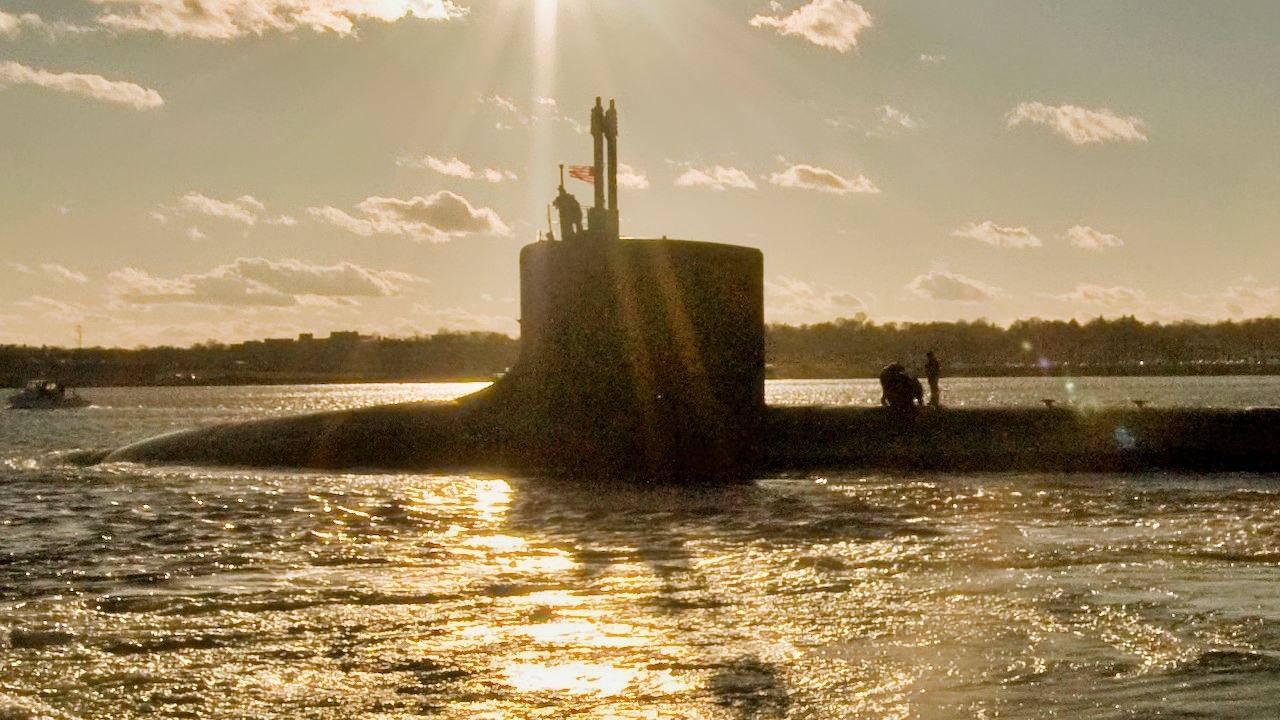
The Virginia-class attack submarine USS Virginia departs for a six-week underway. During this deployment, Virginia will undergo an Operational Reactor Safeguard Examination and a Tactical Readiness Evaluation to assess the submarine’s reactor along with its capacity to combat casualties through damage control.
No AUKUS Submarines for Australia?
Though Aussies can point to their favorable trade balance with the United States, which has favored the United States since Harry Truman was in office, there are fears that America’s atrophied shipbuilding base might short Australia in the short term.
That might- and the key word is might- make new nuclear attack submarines for Australia not an easy task.
The crux of the issue is a lack of building capacity that prioritizes American submarine building would come at the expense of the submarines to be built for Australia.
Under the auspices of the AUKUS agreement, the tripartite deal signed between the United States, the United Kingdom, and Australia in 202, Australia will receive underwater nuclear propulsion technology and, ultimately, a fleet of nuclear submarines.
Crucially, the agreement does not include nuclear weapons.
And it is not just policy wonks in Australia that see danger — analysts in the United States recognize the risk as well.
What If America Just Can’t Build the Subs?
A recent paper published by the Congressional Research Service, a non-partisan think tank that reports to Congress, largely concurred.
“Although Virginia-class SSNs have been procured at a rate of two boats per year from FY2011 through FY2024, the actual Virginia-class production rate has never reached 2.0 boats per year, and since 2022 has been limited by shipyard and supplier firm workforce and supply chain challenges to about 1.2 boats per year, resulting in a growing backlog of boats procured but not yet built,” the document explains.

101210-N-5538K-056 PHILIPPINE SEA (Dec. 10, 2010) The Los Angeles-class attack submarine USS Houston (SSN 713) takes part in a photo exercise as part of Keen Sword 2011. Keen Sword is a joint, bilateral exercise designed to strengthen Japan-U.S. military operations. (U.S. Navy photo by Mass Communication Specialist 3rd Class Casey H. Kyhl)
Furthermore, the “Navy and industry are working to enhance the submarine construction industrial base with a goal of increasing the Virginia-class production rate to 2.0 boats per year by 2028, and subsequently to 2.33 boats per year, the rate the Navy states will be needed to not only execute the two-per-year procurement rate, but also build replacement SSNs for the three to five Virginia-class boats that are to be sold to Australia under the AUKUS submarine (Pillar 1) project discussed later in this report, and to reduce the accumulated Virginia-class production backlog.”
Australia Makes A Downpayment On AUKUS Submarines
Still, Australia is taking steps to ensure the AUKUS submarine deal doesn’t sink below the waves. Early last month, Canberra signed a $500 million cheque, the first installment of $3 billion to bolster the United States submarine building industry. Ultimately, the AUKUS price tag will run up to $228 billion.
The Trump administration’s transactional nature favors the AUKUS agreement, but the United States’ own naval needs risk trumping those of Australia. Would Trump cancel a deal that America simply can’t deliver on, especially if it harms replacing older Los Angeles-class attack submarines?
What if America just can’t build the subs it has promised?
Trump Makes Clear There Is a Problem
In Trump’s recent address to Congress, he acknowledged that America’s shipbuilders are, if not in dire straits, facing stiff headwinds. However, the President said his administration would “resurrect the American shipbuilding industry” by setting up a new “office of shipbuilding” in the White House. “We’re going to make them very fast, very soon.”

APRA HARBOR, Guam (Jan. 17, 2023) – The Los Angeles-class fast-attack submarine USS Key West (SSN 722) departs Apra Harbor, Guam, Jan. 17. Key West is one of five submarines assigned to Commander, Submarine Squadron 15. Commander, Submarine Squadron 15 is responsible for providing training, material and personnel readiness support to multiple Los Angeles-class fast attack submarines and is located at Polaris Point, Naval Base Guam. (U.S. Navy photo by Lt. Eric Uhden)
It will take some time and a stiff shot of cash before America’s shipbuilders are moving along full steam ahead. But for now, a needed tailwind is picking up.
But, as Trump likes to say: We will see what happens.
About the Author: Caleb Larson
Caleb Larson is an American multiformat journalist based in Berlin, Germany. His work covers the intersection of conflict and society, focusing on American foreign policy and European security. He has reported from Germany, Russia, and the United States. Most recently, he covered the war in Ukraine, reporting extensively on the war’s shifting battle lines from Donbas and writing on the war’s civilian and humanitarian toll. Previously, he worked as a Defense Reporter for POLITICO Europe. You can follow his latest work on X.


Pingback: SSN-AUKUS: The Royal Navy Has Big Plans for New Nuclear Attack Submarines - National Security Journal