

Key Points and Summary – A leaked New York Times account of the Pentagon’s classified “Overmatch Brief” paints a grim picture of a U.S.–China clash over Taiwan. In repeated simulations, People’s Liberation Army forces were able to destroy U.S. advanced systems—including the USS Gerald R. Ford aircraft carrier—before they reached the fight, using hypersonic missiles and anti-satellite strikes to blind and overwhelm American forces.
-The report blasts Washington’s reliance on expensive, vulnerable platforms and warns that U.S. defense spending—just 3.4 percent of GDP—is dangerously low.
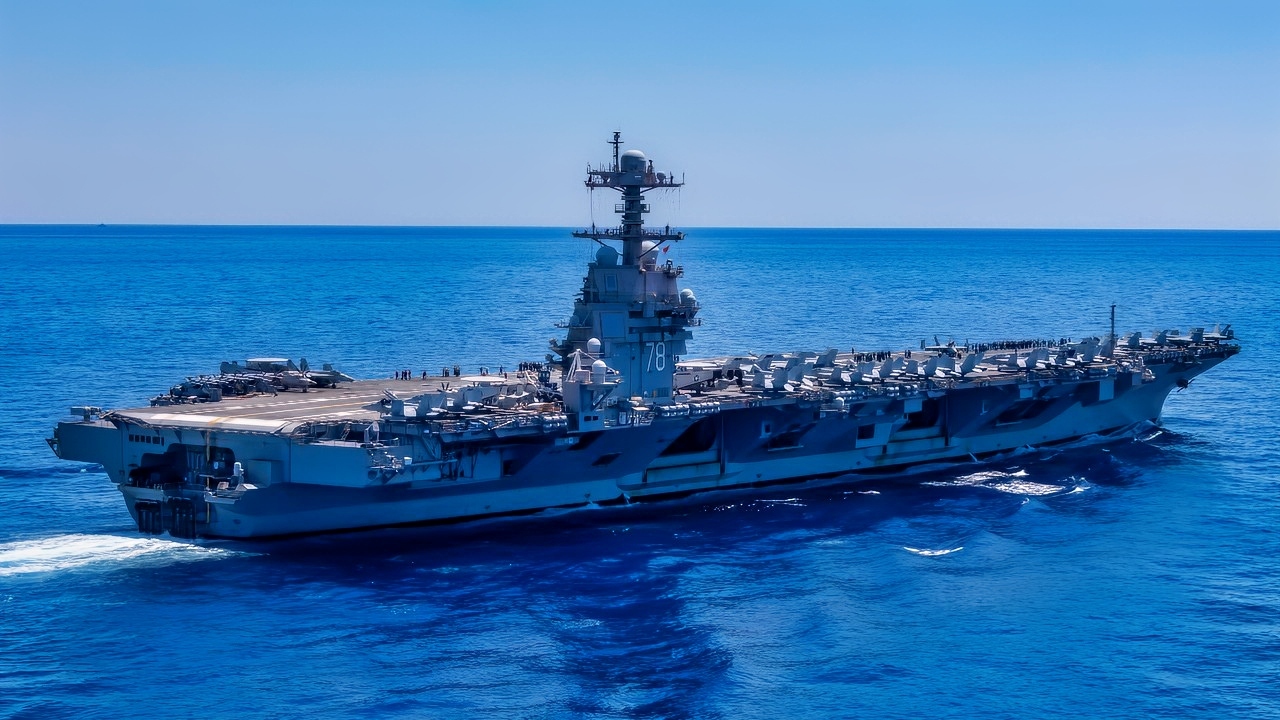
The world’s largest aircraft carrier, USS Gerald R. Ford (CVN 78) transits the Mediterranean Sea, August 1, 2025. Gerald R. Ford, a first-in-class nuclear aircraft carrier and deployed flagship of Carrier Strike Group Twelve, is on a scheduled deployment in the U.S. 6th Fleet area of operations to support the warfighting effectiveness, lethality, and readiness of U.S. Naval Forces Europe-Africa, and defend U.S., Allied, and partner interests in the region. (U.S. Navy photo by Mass Communication Specialist Seaman Brianna Barnett)
-It concludes that America is now at real risk of losing a Taiwan war unless it rapidly retools and rearms.
USS Gerald R. Ford Aircraft Carrier, Other Systems Vulnerable in a Taiwan Conflict, Says Pentagon Report
Fort Lauderdale, Florida – A December 8 New York Times (NYT) story reveals the US Department of Defense has concluded that the US Navy’s most modern weapons would likely not prevail in military engagements with the Chinese People’s Liberation Army (PLA).
The story reports the key findings of the “Overmatch Brief”, a classified Pentagon report that presented outcomes from simulated scenarios of a US military-PLA conflict.
The same Pentagon document also predicts that, even if Washington were to intervene in a Beijing invasion of the self-ruling island Republic of China (ROC), US forces could suffer a military defeat.
The US Navy’s most modern and sophisticated aircraft carrier, the CVN-78 USS Gerald R. Ford, could even be lost in such engagements.
This finding confirms 20 simulation runs conducted by a group of war-gaming exercises in the People’s Republic of China (PRC) more than two years ago.
The document was prepared by the Office of Operational Evaluations (OOE), which sits under the Office of the Secretary of Defense (OSD). The brief is an annually produced classified report that summarizes critical military issues for senior White House staff.

The Ford-class aircraft carrier USS Gerald R. Ford (CVN 78) and the Italian aircraft carrier ITS Cavour (CVH 550) transit the Atlantic Ocean March 20, 2021, marking the first time a Ford-class and Italian carrier have operated together underway. As part of the Italian Navy’s Ready for Operations (RFO) campaign for its flagship, Cavour is conducting sea trials in coordination with the F-35 Lightning II Joint Program Office’s Patuxent River Integrated Test Force to obtain official certification to safely operate the F-35B. Gerald R. Ford is conducting integrated carrier strike group operations during independent steaming event 17 as part of her post-delivery test and trials phase of operations. (U.S. Navy photo by Mass Communication Specialist 3rd Class Riley McDowell)
According to the NYT, this year’s document projected outcomes from a scenario in which the US attempts to prevent the PLA from attacking and invading the ROC.
Quoting directly from the classified document, the US daily reports the overall conclusion was “China has the capability to destroy US advanced weapons before they even reach Taiwan.”
Taiwan is Not Venezuela
The report points out that the PLA and the PRC’s ability to deploy some of the world’s most modern weaponry is of prime concern to the briefing’s authors.
The war-gaming scenarios run by the OOE predict that even the Gerald R. Ford-class carrier strike group would not survive Chinese attacks.
Other sections of the document make a point of contrasting the deployment of the Ford carrier strike group in the Caribbean to target military sites of Venezuelan President Nicolás Maduro with how it might perform in the Taiwan Strait against the PLA.
The new-age carrier is lauded for its formidable complement of aircraft and other weaponry, which can be highly effective against the far less capable military of a nation like Venezuela.

ATLANTIC OCEAN (Oct. 29, 2019) USS Gerald R. Ford (CVN 78) conducts high-speed turns in the Atlantic Ocean. Ford is at sea conducting sea trials following the in port portion of its 15 month post-shakedown availability. (U.S. Navy photo by Mass Communication Specialist 3rd Class Connor Loessin)
But even the Ford would be potentially highly vulnerable to some of the latest PRC-developed weaponry.
Specifically, the Pentagon document pointed to hypersonic weapons.
The PLA has reportedly stockpiled up to 600 units of this class of weapon, which are singled out as a prime example of one of the “new forms of attack” that Beijing would employ in such a conflict.
These weapons travel at five times the speed of sound and would be difficult to intercept even by the most modern US missile defense systems.
The report also concluded that US forces could additionally lose the ability to monitor PLA deployments and deprive them of situational awareness as “China can destroy US reconnaissance and communication satellites.”
Aircraft Carriers Falling Behind
The report criticizes current US war planning for an inordinate reliance on “expensive and vulnerable weapons.” The US has been falling behind the PRC and Russia in keeping pace with the rapid developments of its own advanced weapon systems.

Ford-Class. Image Credit: Creative Commons
Another point of criticism is the report’s view of US defense spending as dangerously low. Pentagon outlays currently sit at only 3.4 per cent of GDP, the lowest level in 80 years, and compromise the strength and resilience of the US military.
Emerging and high-technology domains in warfare, such as artificial intelligence, cyber warfare, and biological threats, were listed as areas where the US military needs to develop adequate responses and strategies.
The NYT stated that its correspondents found the report’s findings to be “consistent and shocking.” The Pentagon needs to develop more efficient responses to its challenges that strengthen US military capabilities, but do so in a way that deters future conflicts rather than initiating them.
All in all, the OOE briefing is groundbreaking in that it is the first time the US military’s inferiority to the PLA has been spelled out in an official report rather than in sound bites delivered by anonymous sources. The impact following these revelations is likely to be immediate. It may well result in the US Donald Trump Administration’s now demanding that Washington’s NATO partners and allied nations increase defense spending even further.
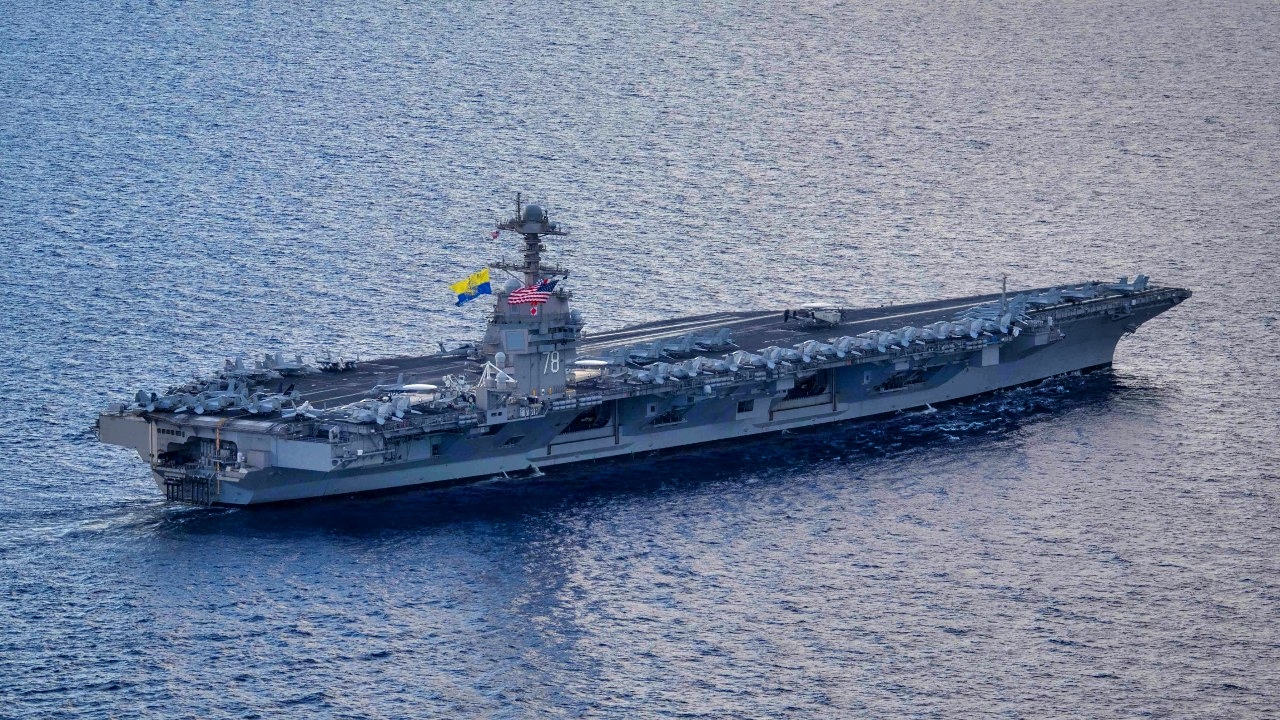
The world’s largest aircraft carrier USS Gerald R. Ford (CVN 78) sails in the Mediterranean Sea, Dec. 31, 2023. The U.S. maintains forward deployed, ready, and postured forces to deter aggression and support security and stability around the world. (U.S. Navy photo by Mass Communication Specialist 2nd Class Jacob Mattingly)
About the Author: Reuben F. Johnson
Reuben F. Johnson has thirty-six years of experience analyzing and reporting on foreign weapons systems, defense technologies, and international arms export policy. Johnson is the Director of Research at the Casimir Pulaski Foundation. He is also a survivor of the Russian invasion of Ukraine in February 2022. He worked for years in the American defense industry as a foreign technology analyst and later as a consultant for the U.S. Department of Defense, the Departments of the Navy and Air Force, and the governments of the United Kingdom and Australia. In 2022-2023, he won two awards in a row for his defense reporting. He holds a bachelor’s degree from DePauw University and a master’s degree from Miami University in Ohio, specializing in Soviet and Russian studies. He lives in Warsaw.


