


The Virginia-Class Submarine, Explained
With a Virginia-class Block VI under development and continued exploration of a much-discussed SSN(X) future generation attack submarine, some might be inclined to wonder just how much upgrading the Virginia-class boats can take on before a new hull is necessary.
Each new Virginia-class submarine “Block” of boats has advanced undersea attack and detection technology to new levels, to the point where Block III and Block V Virginia boats are entirely different from the earlier Blocks.
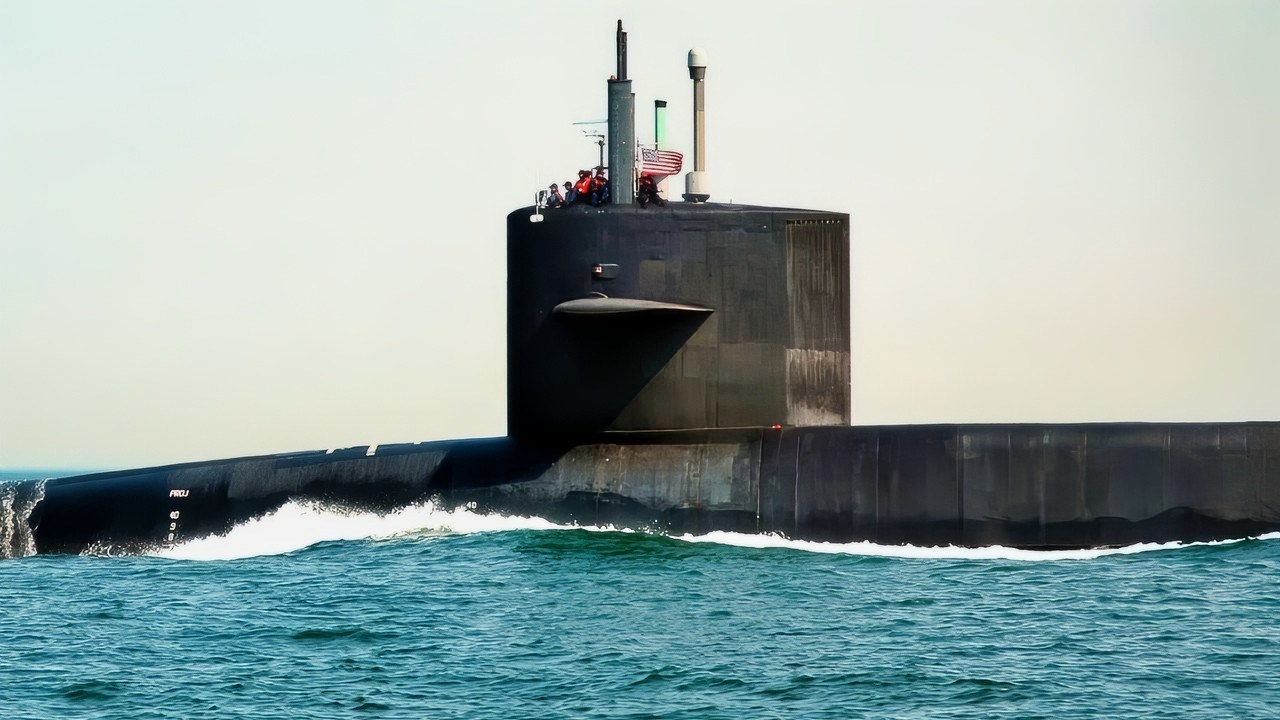
(March 31, 2006) – The guided missile submarine USS Florida (SSGN 728) conducts sea trials off the coast of Virginia. Florida will be delivered to the Fleet in April, and a Return To Service ceremony is scheduled for May 25 in Mayport, Fla. As the second of four SSBN submarines to be converted to SSGN, this nuclear-powered submarine will have the capability to: launch up to 154 Tomahawk cruise missiles; conduct sustained special warfare operations with up to 102 Special Operations Forces (SOF) personnel for short durations or 66 SOF personnel for sustained operations; and provide approximately 70 percent operational availability forward deployed in support of combatant mission requirements. U.S. Navy photo by Chief Journalist (SW/AW) Dave Fliesen.
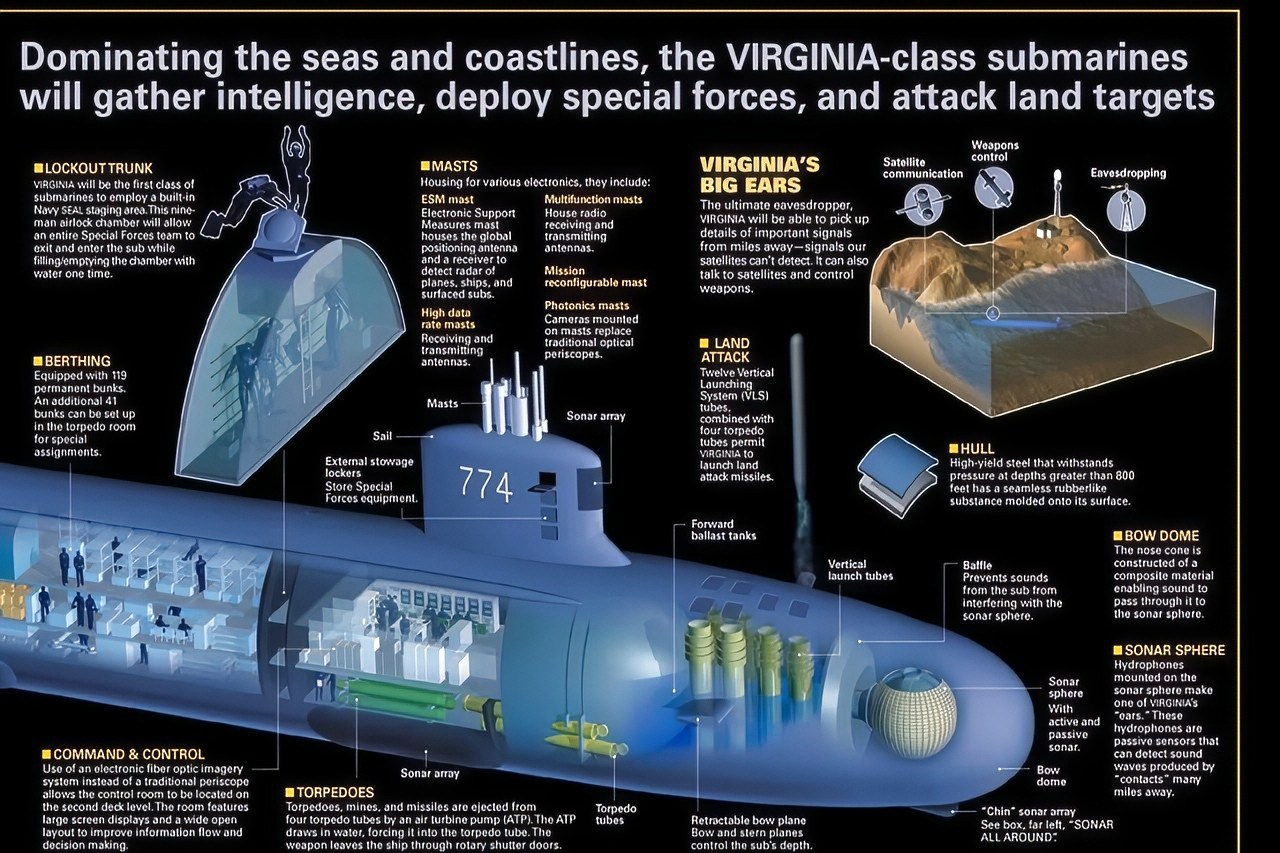
Virginia-Class Submarine Cut Out. Image Credit: Creative Commons.
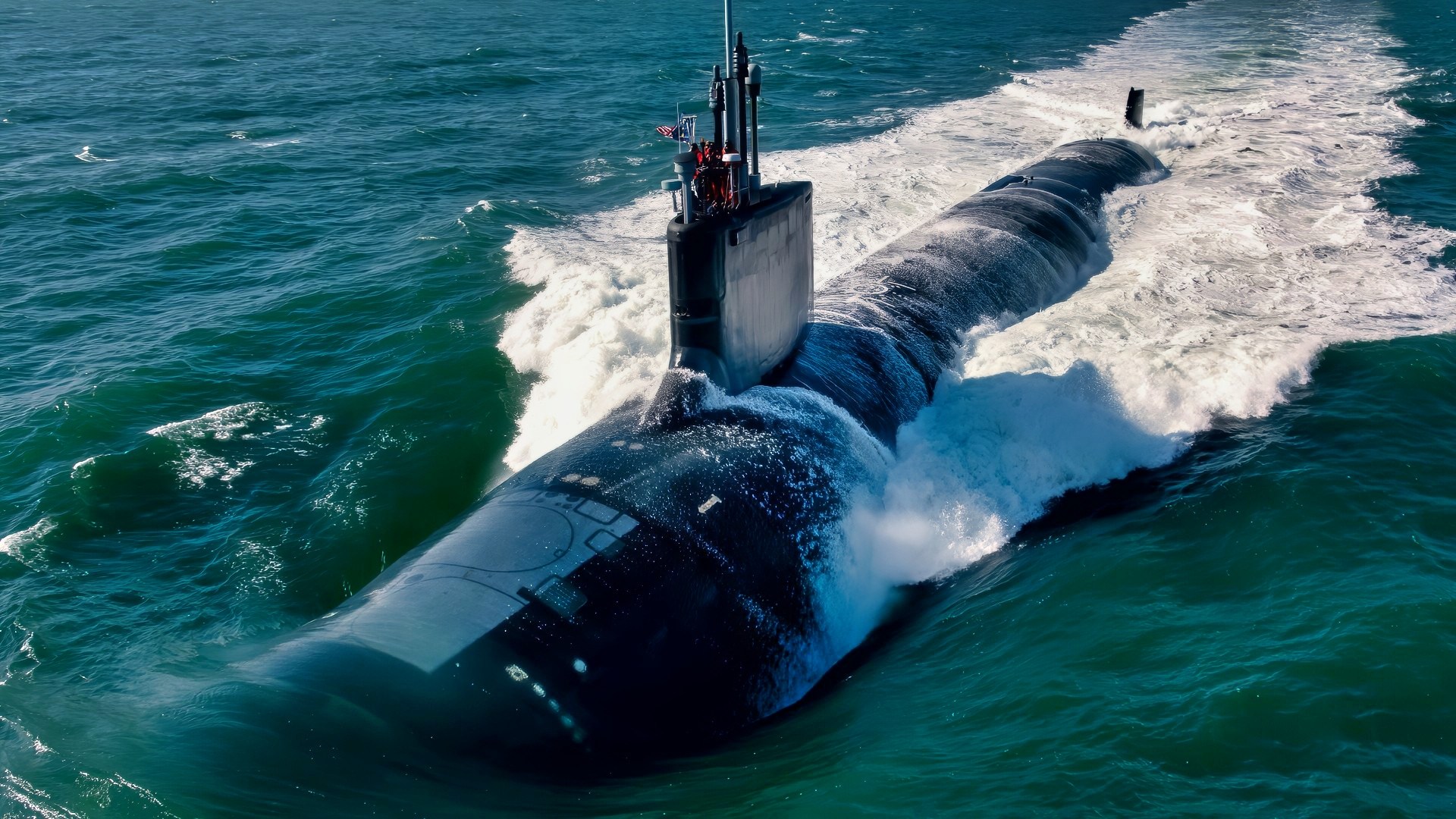
ATLANTIC OCEAN (Feb. 1, 2022) The future Virginia-class attack submarine Montana (SSN 794) conducts initial sea trials Feb. 1, 2022 in the Atlantic Ocean. Montana is the 10th Virginia-class submarine. (U.S. Navy photo courtesy of HII by Ashley Cowan) Montana SSN 794 Alpha Sea Trials
There appear to be few limitations concerning the extent to which Virginia-class submarines can be upgraded. Block III Virginia-class submarines and beyond are all engineered with a “fly-by-wire” automated computer navigation system that enables humans to set depth and speed.
Once parameters are set, the computer maintains the boat’s movements. This system replaced the legacy hydraulic mechanical navigation systems.
Block III Virginias also feature a redesigned Large Aperture Bow sonar system that delivers new levels of range and sensitivity for undersea acoustic detection.
Block III boats also leverage fiber-optic communications technology to enable commanders to view periscope sensor input from numerous locations inside the boat.
In recent years, Block III boats have also received new antennas, coating materials, and quieting technologies, greatly improving their ability to conduct clandestine undersea reconnaissance missions.
Block III also makes use of a “lock-out-trunk” area where Special Operations Forces can exit a submarine for clandestine missions without having to surface.
Block V FirePower Breakthrough
Block V boats add massive firepower through the integration of Virginia Payload Modules, a roughly 80-ft missile-tube section added to the center of the boat to increase its Tomahawk missile firing capacity from 12 missiles up to 40.
Alongside these innovations, breakthroughs continue with undersea drones able to launch from missile tubes and conduct high-risk, forward-operating sensing and reconnaissance missions.
Virginia-Class submarines’ “Fly-by-Wire” capability allows the ship to quietly linger in shallow waters without having to surface or have each small move controlled by a human operator.
With this technology, a human operator will order depth and speed, allowing software to direct the movement of the planes and rudder to maintain course and depth. The ships can be driven primarily through software and electronics, freeing up time and energy for the operator, who no longer needs to manually control each small maneuver.
Computer Automation = More Maneuverable Virginias
This technology, using upgradeable software and rapidly advancing AI applications, widens the mission envelope for attack submarines by vastly expanding their ISR capabilities.
Using real-time analytics and the ability to draw on and organize vast databases of information and sensor input, computer algorithms can now perform a range of procedural functions historically performed by humans.
This can increase the speed and maneuverability of an attack submarine and its ability to quickly shift course, change speed, or alter depth when under attack.
“The most important feature for maneuvering in littoral waters is the fly-by-wire control system, whereby computers in the control center electronically adjust the submarine’s control surfaces, a significant improvement from the hydraulic systems used in the Los Angeles-class,” a 2016 Stanford University “The Future of Nuclear Submarines” paper by Alexander Yachanin writes.
Attack Submarines for Reconnaissance
The U.S. Navy’s 2018 “Commander’s Intent for the United States Submarine Force,” writes, “We are uniquely capable of, and often best employed in, stealthy, clandestine and independent operations … we exploit the advantages of undersea concealment which allow us to: Conduct undetected operations such as strategic deterrent patrols, intelligence collection, Special Operations Forces support, non-provocative transits, and repositioning,” the Navy strategy document writes.
Virginia-class subs are armed with Tomahawk missiles, torpedoes, and other weapons able to perform a range of missions; these include anti-submarine warfare, strike warfare, covert mine warfare, ISR (Intelligence, Surveillance, Reconnaissance), anti-surface/ship warfare, and naval special warfare, something described as having the ability to carry and insert Special Operations Forces.
Future Virginia-Class submarines provide improved littoral (coastal waters) capabilities, sensors, special operations force employment, and strike warfare capabilities.
UnderSea Communications
The largest area of progress in the coming years may be in undersea communications, and these are the kinds of breakthroughs that can massively improve and change submarine operations without requiring a new boat.
The Navy and its industry partners have made great progress with wireless undersea data transmission, as seen in Raytheon’s Barracuda mine-destroying undersea drone.
Since RF does not transmit beneath the surface, except for some mostly ineffective low-frequency signals, the Navy and its industry partners, such as BAE Systems and Raytheon, have been working to pioneer undersea non-electromagnetic connectivity that can function like GPS on land.
A key tactical advantage here is the use of undersea drones, as the Navy is still largely unable to transmit data in real time between unmanned underwater vehicles and host ship submarines.
Progress is being made, yet by and large, forward-operating undersea drones have had to gather, collect, and organize sensor data, then “download” it upon return. However, this is changing as innovators not only launch UUVs from missile tubes but also develop real-time methods for transmitting critical information.
Drones, Gateways & Tethering
One promising effort uses a series of transport layers integrated through gateways. Undersea drones can reach great depths while remaining “tethered” to a fiber-optic cable that sends key threat data to the surface.
Perhaps an undersea drone uses forward acoustic “pings” to analyze a return signal and detect the presence of an enemy submarine? In this instance, the drone can instantly send threat details to the surface through a high-speed cable.
Once the information is on the surface of the ocean, gateway technologies can use advanced computer technology and IP protocol to essentially “translate” data from one transport layer to another.
A surface gateway can attach to an antenna or an above-water sensing and transmission device in a position to send an RF or GPS signal to air, land, and surface nodes.
Moving beyond this, emerging technologies can increasingly approach or achieve the ability to transmit real-time data wirelessly underwater.
There would seem to be few limits to this kind of technological advancement, and it could introduce new concepts of operation and support a new generation of undersea combat without requiring a redesign of the Virginia-class hull.
About the Author: Kris Osborn
Kris Osborn is the President of Warrior Maven – Center for Military Modernization. Osborn previously served at the Pentagon as a highly qualified expert in the Office of the Assistant Secretary of the Army—Acquisition, Logistics & Technology. Osborn has also worked as an anchor and on-air military specialist at national TV networks. He has appeared as a guest military expert on Fox News, MSNBC, The Military Channel, and The History Channel. He also has a Masters Degree in Comparative Literature from Columbia University.


