

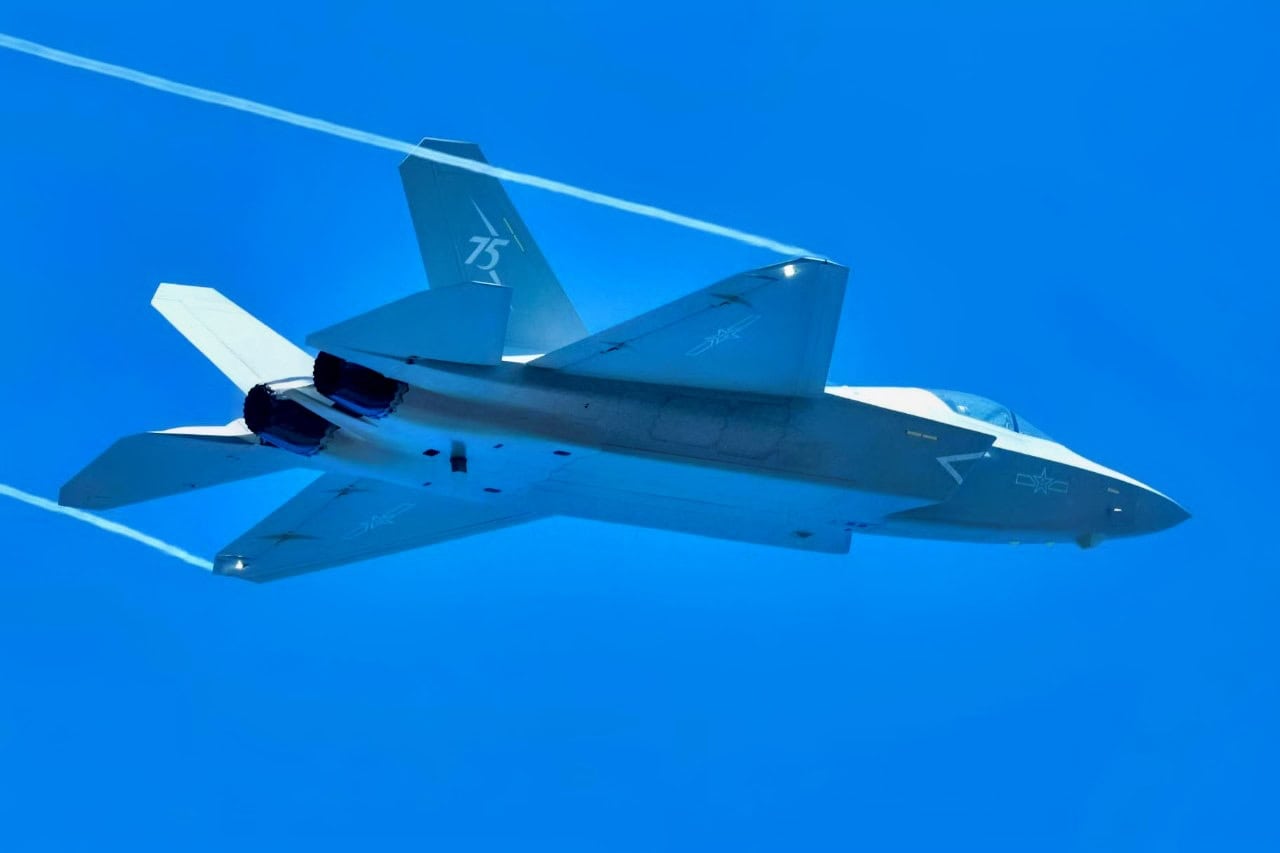
Key Points – China’s J-35A stealth fighter, which debuted at the 2024 Airshow China, is reportedly entering production in large numbers for both its air force and navy, and is slated to appear at the upcoming Paris Air Show.
-A designer described the jet as a “point guard” in future combat, capable of both engaging targets and coordinating other assets in a networked environment.
-The J-35A’s development is significant as it makes China only the second country, after the US, to operate two distinct stealth fighters.
-Furthermore, China is fast-tracking the jet’s first export sale to Pakistan, a move expected to shift the regional air power balance with India.
China’s J-35A Stealth Jet: A New ‘Point Guard’ for Air Combat?
China’s J-35A fighter jet made its debut at the 2024 Airshow China last November, where The Aviationist described it as “the definitive highlight of this year’s show.”
“Marketed as a medium-sized multirole stealth fighter by the Aviation Industry Corporation of China (AVIC), the fighter’s short flight over the show center consisted of a single flyby with afterburner, followed by an unrestricted climb to exit,” The Aviationist said of the unveiling.
With the J-35A, China joins the U.S. as a country with two different operational stealth fighters.
Meanwhile, per Global Times, the jet is headed for the Paris Air Show, starting on June 16. And one air design believes that China will be able to produce the J-35A in large numbers.
The Global Times reported that at the China air show, the J-35A “captivated audiences with its stunning performance, and the Mach diamonds produced by its afterburners over Zhuhai’s skies became one of the most breathtaking highlights of the event.”
China’s New “Point Guard”
Wang Yongqing, described by Global Times as the “chief expert” at the Shenyang Aircraft Design and Research Institute of the state-owned Aviation Industry Corporation of China (AVIC), described the jet in an interview with Global Times.
The jet, he said, will serve as the “point guard” in China’s combat operations in the future, utilizing what he calls an “air-sea twin configuration” approach and a “one aircraft, multiple variants” concept.
“‘Air-sea twin configuration’ and ‘one aircraft, multiple variants’ of the J-35 series is a development program we’ve undertaken in response to the country’s needs. We are steadily advancing this project in strict accordance with the planned roadmap,” Wang said in the interview with Global Times.
While it has impressed at air shows, the new jet is meant for combat, Wang said in the interview.
“During the design phase, combat effectiveness was one of our primary objectives. The J-35‘s distinctive features include enhanced stealth performance and exceptional combat capabilities for coordinated operations,” Wang said of the jet.
Wang also used the “point guard” analogy to refer to the jet’s ability to both “score” itself, while it also “effectively coordinates other battlefield assets.”
A Deal With Pakistan
Meanwhile, China is “fast-tracking” the delivery of J-35A jets to Pakistan, to encourage that country’s deterrence against India. Per a Newsweek report in May, the first batch of jets is expected to be delivered to Pakistan in 2026, possibly earlier than originally planned.
This follows a series of “high-level diplomatic and military exchanges” between China and India.
According to Newsweek’s analysis, “the expedited delivery of China’s next-generation stealth fighters could shift the airpower balance in South Asia. India continues to modernize its air force with platforms like the Russian Su-30MKI and French Rafale jets, but neither possesses the stealth capabilities of the J-35A. This deal also marks China’s first known export of a fifth-generation fighter jet, reflecting its ambitions as a global arms supplier.”
“A Generational Leap”
Army Recognition looked more at what the delivery might mean for that region.
“Though originally tailored for China’s aircraft carriers, its versatility has allowed it to evolve into a land-based platform suitable for export,” the analysis said.
“As a fifth-generation aircraft, it combines reduced radar cross-section with internal weapons bays, advanced electronic warfare systems, supercruise capability, and next-generation avionics. It is equipped with a Chinese-made active electronically scanned array (AESA) radar, advanced infrared search and track (IRST), and a modern data fusion architecture that enables full integration in network-centric operations.”
The arrival of the J-35A could mean a big step up for Pakistan, Army Recognition said.
“From an operational standpoint, the arrival of the J-35A could mark a generational leap for the Pakistan Air Force. Currently, Pakistan’s frontline aircraft include JF-17 Block III fighters and a limited number of F-16s.”
About the Author:
Stephen Silver is an award-winning journalist, essayist and film critic, and contributor to the Philadelphia Inquirer, the Jewish Telegraphic Agency, Broad Street Review and Splice Today. The co-founder of the Philadelphia Film Critics Circle, Stephen lives in suburban Philadelphia with his wife and two sons. For over a decade, Stephen has authored thousands of articles that focus on politics, technology, and the economy. Follow him on X (formerly Twitter) at @StephenSilver, and subscribe to his Substack newsletter.
Iran War
B-2 Bomber: How America Would Strike Iran


Pingback: Su-57E: Why India Might Buy Russia's New Stealth Fighter - National Security Journal