


Key Points and Summary – China’s long-rumored H-20 stealth bomber is still years from debut, but the more important question may be scale.
-One way to size the requirement is internal: China operates roughly 239 H-6 bombers across the PLAAF and PLANAF, implying a one-for-one replacement baseline.

H-20 Bomber from China. Image Credit: Creative Commons.
-A second yardstick is the adversary: the United States fields about 140 bombers today and plans at least 100 B-21 Raiders.
-A third is Russia’s roughly 120-bomber force. In a U.S. conflict, numbers, readiness, and industrial capacity could ultimately eclipse stealth in strategic impact.
-The unknown is how fast Xi’an can build and sustain that fleet in wartime.
How Many H-20 Bombers Would China Need to Fight the USA?
China’s sixth-generation stealth bomber, the Xi’an H-20, has yet to make its official operational debut, and the U.S. intelligence community estimates the bomber is unlikely to do so until sometime in the 2030s. Nonetheless, pundits and prognosticators have already been asking: How many H-20 bombers will China need?
Of course, “need” is a subjective term. Accordingly, this writer and former U.S. Air Force officer will employ three different yardsticks for determining how many H-20s Beijing might need for a nightmare WWIII scenario against the United States.
Yardstick #1: The Internal One
We will start with the simplest and most basic measure to determine Beijing’s H-20 needs: the quality of China’s current strategic bomber fleet. Right now, China has concentrated all of its metaphorical eggs into one basket: the H-6 Zhanshen (“War God”).
According to the World Directory of Modern Military Aircraft, the People’s Liberation Army Air Force (PLAAF) has a total of 209 H-6s, while the People’s Liberation Army Naval Air Force (PLANAF) has 30 such airframes. If Beijing’s military production planners sought a mere one-for-one replacement of H-6s with H-20s, Xi’an would need to build 239 airframes.
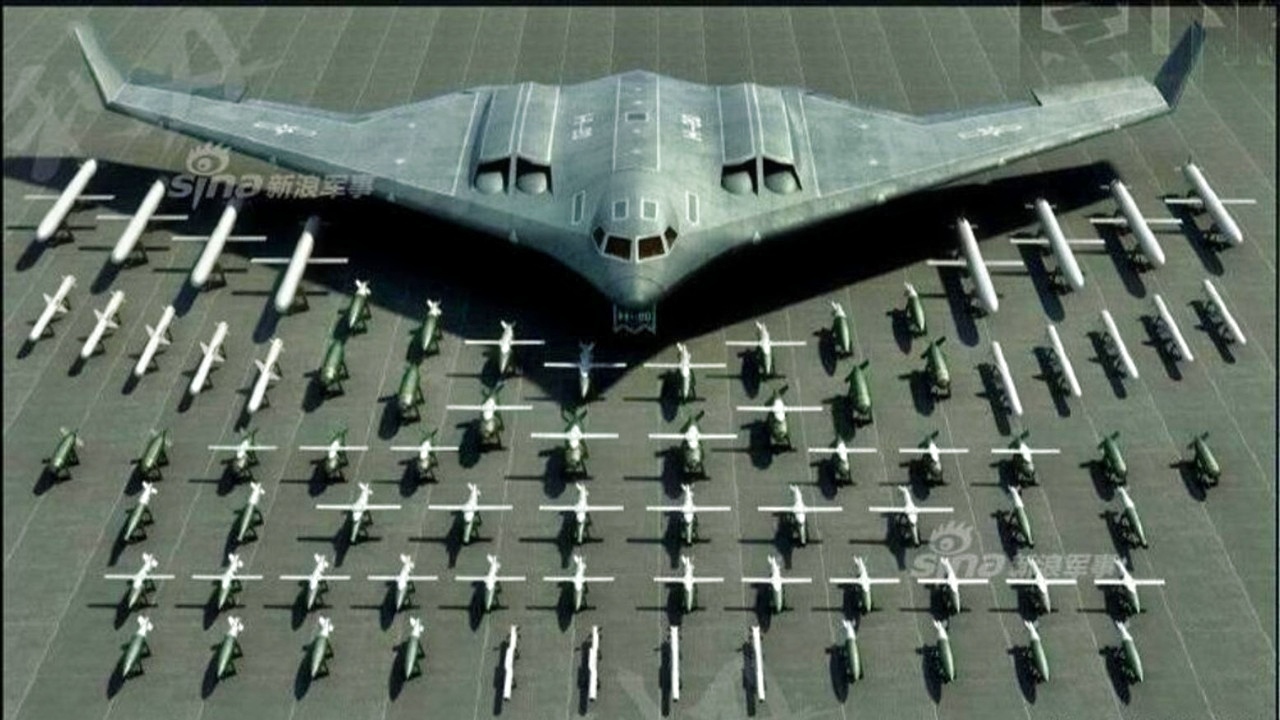
H-20 Bomber. Chinese Internet Social Media Screenshot.
The Zhanshen is still very deadly—especially considering its nuclear strike capabilities and its KD-21 ship-killing missile—but it is getting old. The bomber made its maiden flight on December 24, 1968, as a license-built version of the Soviet-designed Tupolev Tu-16, which debuted operationally in April 1952.
Given the age of its “War Gods,” the PLAAF is probably feeling a strong sense of urgency to augment and eventually replace them outright with the H-20.
Yardstick #2: The External Adversary
Since we are using a hypothetical war with the United States as the key criterion for determining how many H-20s China will need, it only makes sense to look at the numbers of the U.S. strategic bomber force.
The U.S. Air Force currently has an estimated 19 airframes of its fourth-generation B-2 Spirit. Based on artists’ renderings of the H-20, the Chinese warbird appears to be a copycat of the B-2—very much in keeping with Beijing’s knack for ripping off U.S. technology.
But what about America’s direct successor to the B-2, the sixth-generation B-21 Raider? The Air Force is not content with a mere one-for-one exchange of B-21s for B-2s, as Air Force brass remains committed to a production goal of at least 100 Raider airframes.

PLAAF Xian H-6M makes a turn over central Changzhou.
Moreover, unlike China, the U.S. isn’t a one-trick pony when it comes to strategic bombers. It also has two such warbirds that are non-stealth but still extremely deadly and, unlike the PLAAF and PLANAF bombers, highly battle-tested: the Boeing B-52 Stratofortress and the B-1B Lancer. The Air Force has 76 of the former and 45 of the latter, bringing its strategic bomber fleet strength to 140 units.
Given that the H-20 is not expected to be operational until the next decade, one has to wonder how quickly the Xi’an production facilities would be able to build 140 of them.
Yardstick #3: The External Ally
It also makes sense to use China’s great power-era ally Russia as a yardstick. After all, Moscow is using its own strategic bombing force in its seemingly never-ending war on Ukraine—and that war is seen by many as a potential inspiration and catalyst for a future Chinese invasion of Taiwan.
The Russian Air Force currently has an estimated 120 strategic bombers in its fleet: 58 Tupolev Tu-22M “Backfires,” 47 Tu-95 “Bears,” and 15 of the aforementioned Tu-160 “Badgers.”

Russian Air Force Bomber Tu-160. Image Credit: Creative Commons.
(Unlike their PLANAF counterparts, neither Russia’s nor the United States’ naval aviation components have strategic bombers.)
To pull off a successful attack against Taiwan, then, China would presumably need at least 120 H-20s—and possibly more, since Taiwan is much farther from mainland China than Ukraine is from Russia.
Taiwanese air-defense systems would have far more advance warning of an incoming Chinese invasion force, which would likely lead to higher bomber-force attrition for the Chinese than the Russians have already suffered in Ukraine.
About the Author: Christian D. Orr, Defense Expert
Christian D. Orr is a Senior Defense Editor. He is a former Air Force Security Forces officer, Federal law enforcement officer, and private military contractor (with assignments worked in Iraq, the United Arab Emirates, Kosovo, Japan, Germany, and the Pentagon). Chris holds a B.A. in International Relations from the University of Southern California (USC) and an M.A. in Intelligence Studies (concentration in Terrorism Studies) from American Military University (AMU). He is also the author of the newly published book “Five Decades of a Fabulous Firearm: Celebrating the 50th Anniversary of the Beretta 92 Pistol Series.”


Ted
December 18, 2025 at 8:25 pm
Tangential question, but why does the US publicize the number of our strategic bombers?