


The H-20 in One Word: Invisible – China announced a stealth bomber in 2016. Ten years later, no photograph of it has been confirmed, no flight acknowledged, and no airframe shown in public. The word fits, but not for the reason Beijing wanted.
Meet the H-20
Invisible. Not in the way the engineers intended. The Xi’an H-20 is meant to be a low-observable flying-wing bomber, so invisibility is the entire design brief. But a decade after Beijing announced the program, the aircraft is invisible in a much more basic sense. Nobody outside China has ever confirmed seeing one. There is no verified photograph, no acknowledged first flight, no airshow appearance, not even a shaky phone video anyone has been able to authenticate.
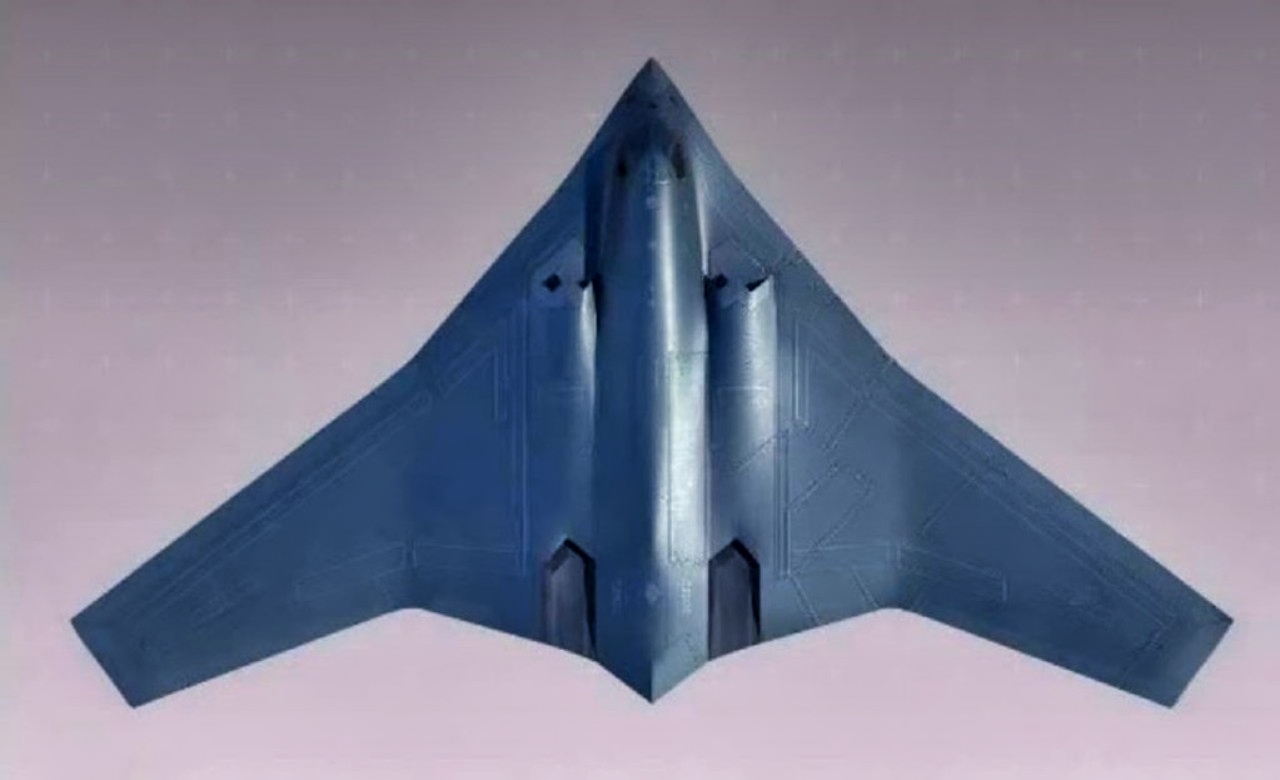
H-20 Bomber from China Artist Rendition. Creative Commons.

China’s H-20 Stealth Bomber. Image Credit: Creative Commons.
That absence is the story, and it is strange on its own terms. China does not generally hide its new aircraft. The J-20 has been paraded for years. The J-35 has gone into mass production with state coverage. And the tailless Chengdu design the world calls the J-36 was filmed by civilians standing outside a factory the day it first flew, then photographed repeatedly by enthusiasts for eighteen months afterward. Chinese aviation secrecy has not stopped any of that. It has stopped this.
A Decade of Almosts
The public record of the H-20 program is essentially a list of dates that passed.
In 2016, PLAAF commander General Ma Xiaotian announced at an air force open day that China was developing a new long-range strategic bomber. In 2018, a spokesman said development was progressing well, and the state aviation conglomerate released a video featuring a shrouded silhouette. A widely expected unveiling at the People’s Republic’s 70th-anniversary celebrations in 2019 came and went with nothing. A 2021 recruitment video ended with a brief glimpse of a covered shape and no explanation.
In July 2022, Chinese state media reported the bomber was close to its maiden flight. No confirmation followed. In March 2024, PLAAF deputy commander Wang Wei told reporters at the National People’s Congress that the aircraft would be revealed very soon and that the program had encountered no technological bottlenecks. Later that year, the Zhuhai Air Show came and went with the J-35A and the two-seat J-20S on display and no bomber. By December 2024, assessments had shifted to say the aircraft might not be fully operational until the 2030s.
Then, in January 2025, images appeared on Chinese social media, appearing to show a large flying-wing aircraft with a chase plane. It was never officially confirmed, and analysts noted the shape closely matched a wind-tunnel photograph published years earlier. Since then, there has been near silence.
What It Is Supposed to Be
The Pentagon’s annual report on Chinese military power describes a new generation of long-range bombers, likely designated H-20, that may debut sometime in the next decade with a range beyond 10,000 kilometers, enough to cover the Second Island Chain and reach into the western Pacific. In plainer terms, that means Guam. The design is understood to be subsonic, nuclear-capable, and closely modeled on the American B-2.
None of that has been demonstrated. All of it is projection.
What the Silence Probably Means
There are two honest readings, and the evidence leans toward one.
The first is trouble. American assessments point to difficulty with broadband low-observability, the coatings and shaping that make a flying wing genuinely hard to see across radar bands, and to engines that run hotter than Western equivalents and are therefore easier to spot on infrared. General Stephen Davis, who commands US Air Force Global Strike Command, told The War Zone that on long-range strike, the Chinese are just not there yet, calling China a regional bomber force at best. A US defense official told Breaking Defense the H-20’s system design is probably nowhere near as good as American low-observable platforms.
The second reading is that the silence is deliberate, because a strategic nuclear bomber is a different category of disclosure than a fighter, and Beijing may simply be choosing not to show it.
That is possible, but it sits awkwardly against the record. Every missed date came from a Chinese prediction, not a Western one. It was Beijing’s own deputy air force commander who said, very soon, in public, in 2024. Programs that are running smoothly rarely need ten years of reassurance.
The Bomber China Actually Flies
Lost beneath a decade of anticipation is what the PLAAF operates today: the H-6, a licensed derivative of the Soviet Tu-16, a design dating to the 1950s. It is not stealthy, and its combat radius is regional rather than global. But the H-6N variant that debuted in 2019 can be refueled in flight and carries a very large air-launched ballistic missile beneath its fuselage, thereby re-establishing China’s nuclear triad.
That is the real Chinese bomber capability in 2026, and it is a seventy-year-old airframe with a modern nuclear mission bolted underneath.
Meanwhile, the aircraft the H-20 was meant to answer has flown, entered production, and put a second test aircraft on the ramp at Edwards Air Force Base. Ten years of announcements have produced a silhouette in a recruitment video and one unverified photograph. Whatever the H-20 eventually turns out to be, it is not yet something anyone outside China can prove exists.
About the Author: Harry J. Kazianis
Harry J. Kazianis (@Grecianformula) was the former Senior Director of National Security Affairs at the Center for the National Interest (CFTNI), a foreign policy think tank founded by Richard Nixon based in Washington, DC. Harry has over a decade of experience in think tanks and national security publishing. His ideas have been published in the NY Times, The Washington Post, The Wall Street Journal, CNN, and many other outlets worldwide. He has held positions at CSIS, the Heritage Foundation, the University of Nottingham, and several other institutions related to national security research and studies. He is the former Executive Editor of the National Interest and the Diplomat. He holds a Master’s degree focusing on international affairs from Harvard University.


