

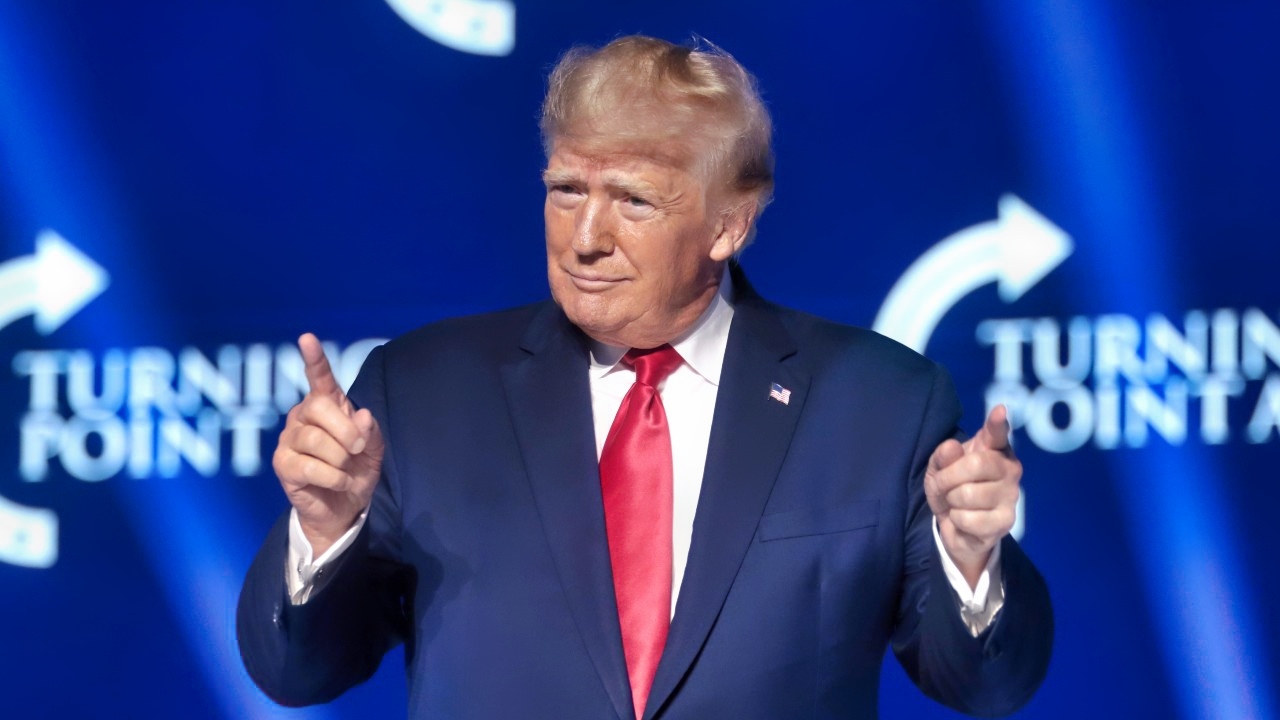
Last month, at the midterm convention in Dallas, President Donald Trump made a surprising proposal: he would distribute $5,000 checks to all Americans if Republicans won both houses of Congress in the midterms.
The offer immediately drew skepticism for a few reasons. Trump has offered similar things before, including during the “DOGE Dividend” days and a later proposal to return money from tariff revenue, but none came to pass.

President Donald J. Trump welcomes Russian President Vladimir Putin to Joint Base Elmendorf-Richardson, Anchorage, Alaska, August 15, 2025 (DoD photo by Benjamin Applebaum)

President Donald J. Trump and President Zelenskyy in the Oval Office. White House Photo.
Also, a $5,000 check for every American would make little economic sense right now and would almost certainly worsen inflation.
An AP story this week found that even staunch Trump supporters don’t expect the $5,000 checks ever to become a reality.
“I mean, I guess it’s good for some people. I really don’t care,” one man who attended a recent Trump rally in Alaska told the AP.
And while free money is usually popular, polling shows Trump’s latest rebate-check proposal isn’t especially well-liked.
A Wall Street Journal poll found that 64 percent of voters consider the $5,000 checks a bad idea.
But a new analysis shows that a big part of Trump’s midterm election strategy relies on carefully targeted bailouts and handouts.
Trump Cash
According to The Wall Street Journal, Trump has been “promising an array of financial benefits to Americans” on the campaign trail. However, some would be delivered only if Republicans keep control of Congress.
Beyond the $5,000 check proposal, Trump has pushed through payments, including $500 checks to nearly a million people for Obamacare “overcharges” and $90 to some Medicare recipients.
Trump also recently announced he will send $8 billion to farmers and launch a $25 billion program that will reward people up to $3,000 for reporting government fraud.
“And when the Republicans win, we will pass even more funding for our farmers,” Trump said at a rally this week.
Trump has also vowed to fast-track claims that veterans have made over contaminated water at the Marine Corps base at Camp Lejeune, another promise that will only be followed through on if Republicans win the midterms.
And this week, in Kansas, Trump agreed to sign a law allowing year-round sales of blended ethanol gasoline, but made it conditional on the results of a certain Senate race: the one in Kansas between Republican Sen. Roger Marshall and Democrat Adam Hamilton.
“If Adam Hamilton is in, I’m not doing it,” Trump said at the Kansas rally.
“If we win the House and the Senate, I am directing the Department of Justice to settle all remaining legitimate claims as soon as possible,” Trump said at a rally this week. However, it’s unclear how that would relate to who controls the next Congress, or why he couldn’t fast-track those claims right away.
Most of the other recent actions haven’t involved acts of Congress, but if Trump tried to pass the $5,000 check gambit, which could cost around $1 trillion, it would require legislation.
The newspaper said that Trump’s promises tend to earn applause at his rallies, although “it is unclear if they will turn out the voters that Republicans need.” Those are voters who are supporters of Trump but aren’t as quick to turn out for Republican candidates
Other Moves Coming?
The Journal also reported that the Trump Administration is considering other moves before the midterm elections via executive orders, including actions to address high prices, including one focused on housing costs.
However, the hour is getting late, and it’s unclear how much such actions could help with inflation, especially in a midterm election in which the cost of living is among the most salient issues.
Trump’s shocking deal, announced last month, to suspend sanctions and allow the purchase of diesel from Russia was meant to deal with the high cost of energy ahead of the midterms.
Still, with that deal, as well, there are doubts from experts as to whether it will help do anything to bring down costs in the near term.
“It’s kind of shuffling deck chairs on the Titanic,” Michael Lynch, distinguished fellow at the think tank Energy Policy Research Foundation, told ABC News this week.
About the Author: Stephen Silver
Stephen Silver is an award-winning journalist, essayist, and film critic, and contributor to the Philadelphia Inquirer, the Jewish Telegraphic Agency, Broad Street Review, and Splice Today. The co-founder of the Philadelphia Film Critics Circle, Stephen lives in suburban Philadelphia with his wife and two sons. For over a decade, Stephen has written thousands of articles on politics, national security, technology, and the economy. Follow him on X (formerly Twitter) at @StephenSilver, and subscribe to his Substack newsletter.


