

Iran continues to manufacture dozens of ballistic missiles every single month as the United States and Israel hesitate to launch new strikes against its military infrastructure, according to new intelligence assessments.
The findings, reported by Bloomberg on November 10, demonstrate that Iran still possesses military capabilities that could cause significant damage to U.S. military assets in the Middle East and potentially further afield.
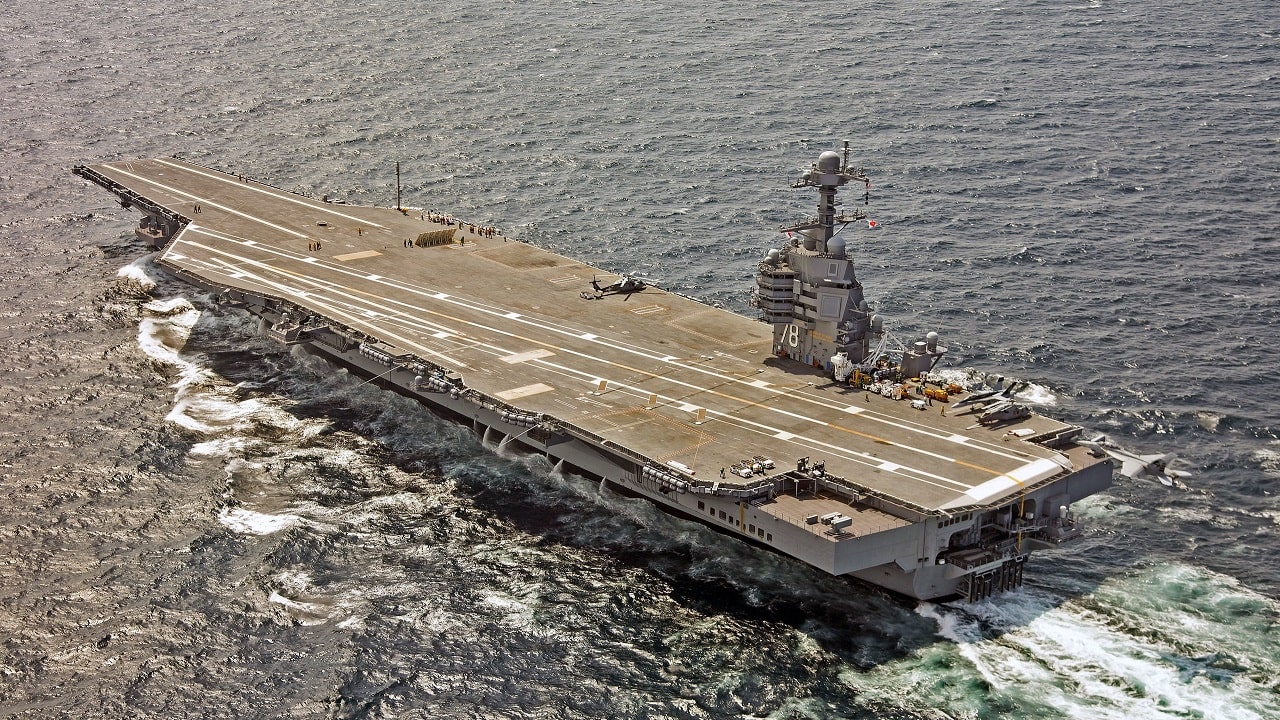
Ford-Class Aircraft Carrier in Test Run. Image Credit: Creative Commons.

U.S. Navy Aircraft Carrier Sailing. Image Credit: Creative Commons.
According to the report, Iran is capable of producing as many as 50 ballistic missiles every month. Though it is roughly half the number it was producing before the war began in February, it is still a substantial figure.
A Western official familiar with Western military intelligence assessments told Bloomberg that Tehran retains as many as 1,700 ballistic missiles, despite much of its conventional military infrastructure having been destroyed.
The findings come as the Islamic Revolutionary Guard Corps (IRGC) also unveils a new underground missile facility intended to protect its remaining weapons and production capabilities from future American and Israeli strikes.
Thousands of Missiles and Drones
According to Bloomberg, Iran’s missile manufacturing industry is still operational despite successive U.S. strikes.
The estimate of 50 missiles produced per month is a significant reduction in overall capacity, but it still means Iran could theoretically manufacture another 600 ballistic missiles over the next year if production continues at the same rate.
The report also suggested that Tehran possesses thousands of Shahed-type attack drones, although the exact number remaining in its arsenal is unclear.
The figures are a problem for the Trump administration, which continues to insist that Iran’s military capabilities have been effectively destroyed.
Iran has also launched more than 4,900 Shahed drones and at least 2,200 ballistic missiles since the war began.
The scale of those attacks has put enormous pressure on U.S. air defense capabilities and inventories, with at least 1,000 Patriot interceptor missiles reportedly expended defending U.S. forces and regional allies against Iranian attacks.
The U.S. produces approximately 650 of those interceptors per year.
The intelligence has not been independently verified, and it’s entirely possible that Iran’s missile stockpile includes some that are not operational, but it’s clear that its manufacturing capacity will ensure that the country remains capable of fighting, or at least wreaking havoc in the Middle East, for some time yet.
Underground “Missile City”
The news comes as the IRGC unveiled a new underground military installation, described as a “missile city.” The IRGC revealed the installation on November 10, and it is said to contain ballistic missiles, cruise missiles, and mobile launch systems.
The facility was presented during the Aerospace Force Week in Iran, with Armed Forces Chief of Staff Major General Ali Abdollahi and IRGC Aerospace Force Commander Brigadier General Majid Mousavi attending the unveiling.
Footage showing senior military commanders inspecting missiles and launch vehicles stored inside the underground complex was released by Iranian state media.
Naturally, the location of the facility was not disclosed, and Iranian authorities have not officially confirmed how many weapons are stored there, so it remains unclear how much the installation contributes to Iran’s remaining missile capabilities.
IRGC spokesman Brigadier General Hossein Mohebbi, however, recently claimed that Iran had moved missile and drone manufacturing operations from aboveground facilities to underground installations instead.
Operating an underground missile storage facility would protect Iran’s remaining missile stockpile from future attacks, but if it is also building an underground missile manufacturing facility, that could fundamentally change calculations for Washington.
Maintaining underground manufacturing capabilities would, in theory, allow Iran to continue building its military capabilities and therefore its ability to threaten U.S.-linked infrastructure in the Middle East and potentially as far as Europe.
Hegseth Says Iran’s Military Is Destroyed
The new intelligence comes after Defense Secretary Pete Hegseth insisted that the Trump administration’s military campaigns have successfully destroyed Iran’s military capabilities. He made the claim again during a Pentagon press conference on Tuesday, November 10.
Hegseth insisted that Operation Epic Fury had achieved its objectives, claiming that U.S. forces struck more than 13,000 targets during the most intensive phase of the war.
“By every measure, we achieved a historic military victory,” he said.
“Under 40 days of sustained combat, more than 13,000 targets struck, their Navy sunk, their Air Force grounded, their defense industrial base gone, more than 80 percent of their nuclear industrial base gone, their military in ruin, the ironclad blockade unbroken. We control the Strait of Hormuz. Crazy Islamists in Tehran will never, ever have a nuclear weapon, a historic effort only made possible by a courageous Commander-in-Chief,” he continued.
However, the reality is this: the United States destroyed Iran’s naval capabilities and its aging air force. It has not destroyed its missile stockpile, which was and long has been Iran’s biggest strength.
About the Author: Jack Buckby
Jack Buckby is a British researcher and analyst specializing in defense and national security, based in New York. His work focuses on military capability, procurement, and strategic competition, and he produces and edits analysis for policy and defense audiences. He brings extensive editorial experience, with a career output spanning over 1,000 articles at National Security Journal, and has previously authored books and papers on extremism and deradicalization.


