

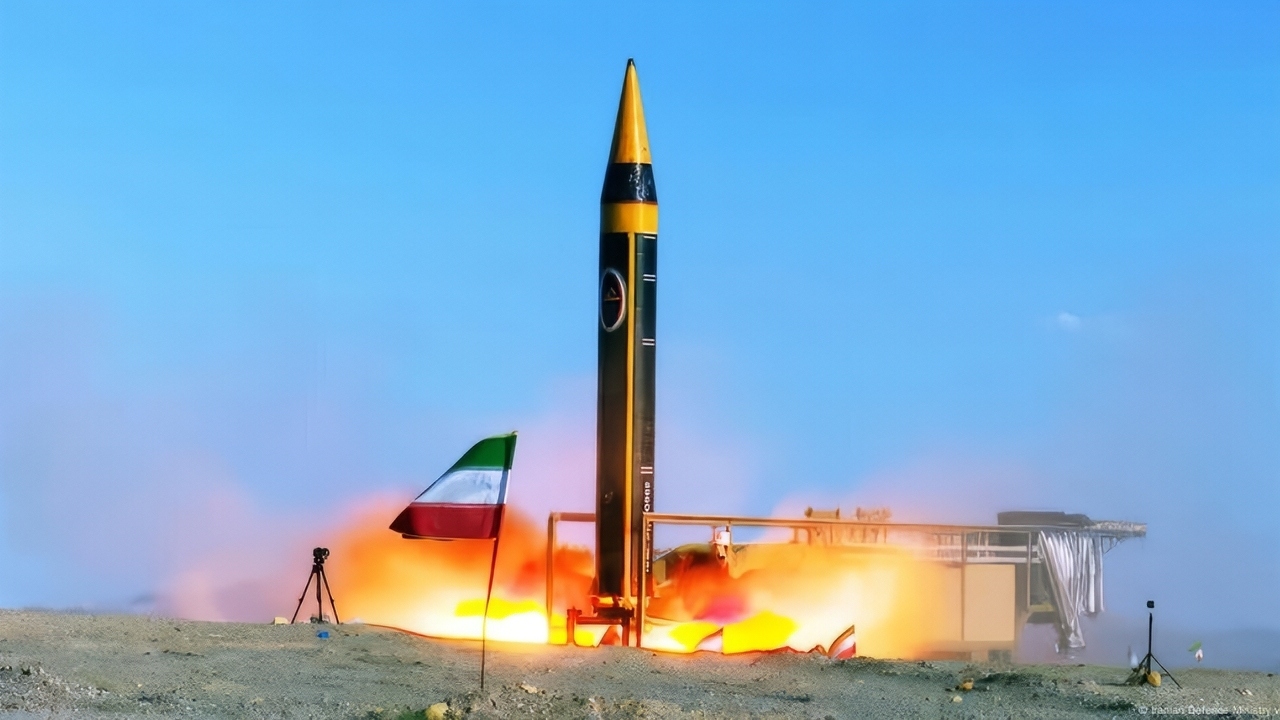
Iran’s missile industry went underground. That’s the conclusion drawn from a Times of Israel report this week which, citing a Western intelligence estimate first reported by Bloomberg, says Tehran is building about 50 ballistic missiles a month.
That’s about half its prewar production. The same estimate puts Iran’s remaining inventory at a minimum of 1,700 ballistic missiles, after US and Israeli airstrikes that began on February 28.

Ford-Class. Image Credit: Creative Commons

The Ford-class aircraft carrier USS Gerald R. Ford (CVN 78) and the Italian aircraft carrier ITS Cavour (CVH 550) transit the Atlantic Ocean March 20, 2021, marking the first time a Ford-class and Italian carrier have operated together underway. As part of the Italian Navy’s Ready for Operations (RFO) campaign for its flagship, Cavour is conducting sea trials in coordination with the F-35 Lightning II Joint Program Office’s Patuxent River Integrated Test Force to obtain official certification to safely operate the F-35B. Gerald R. Ford is conducting integrated carrier strike group operations during independent steaming event 17 as part of her post-delivery test and trials phase of operations. (U.S. Navy photo by Mass Communication Specialist 3rd Class Riley McDowell)
Then, almost on cue, the IRGC Aerospace Force rolled out a brand-new underground “missile city” for the cameras.
The Numbers Are The Story
If the numbers are correct, fifty missiles a month is 600 a year. Bloomberg estimates Iran has launched at least 2,200 ballistic missiles and more than 4,900 Shahed drones since the war started.
Those launches against US forces and regional partners burned through at least 1,000 Patriot interceptors. Industry turns out roughly 650 of those per year, at about $4 million apiece.
That’s an Iranian production line, running at half speed, keeping pace with the annual output of the interceptor built to stop it. And every Patriot costs far more than the missile it’s chasing. That’s the cost-exchange problem in one paragraph.
However, Washington is telling a different story. Defense Secretary Pete Hegseth said this week that 80 percent of Iran’s industrial base has been destroyed.
President Trump told reporters Monday the war “militarily is effectively over.” Both can be true at once. Iran’s conventional military has been largely wrecked. Its missile force is another matter.
Why Underground Changes The Math
On November 7, IRGC spokesman Brig. Gen. Hossein Mohebbi announced that the Guard had moved its missile and drone production lines from surface plants into underground facilities.
He called them “missile production cities.” Three days later, Armed Forces Chief of Staff Maj. Gen. Ali Abdollahi and IRGC Aerospace Force commander Brig. Gen. Majid Mousavi toured a new complex that Tasnim said holds ballistic and cruise missiles along with their launchers. No location was given to protect them from future air strikes.
Say what you will about IRGC press events.
They exaggerate, and this one can’t be independently verified. That’s beside the point. The trend underneath it is real.
The Wall Street Journal reported in September that Iran had resumed assembling missiles underground using stockpiled components, and satellite analysis has flagged fresh excavation at Garmdareh near Tehran and at Shahroud in the north.
Former CIA analyst Jim Lamson believes the Shahroud dig is likely tied to moving production below ground.
This isn’t new behavior. Iran has been tunneling into mountains for two decades. During the June 2025 airstrikes, the Israelis hit a site near Khorramabad with launch shafts and dozens of missiles stored in tunnels.
And as 19FortyFive reported in April, US intelligence undercounted the arsenal by more than 1,000 missiles, largely because so much of it was buried.
What’s new is moving the factory floor itself underground. Storage tunnels protect the inventory that is in place. Production tunnels protect your ability to replace it.
The Underground Facilities Are Complex And Expensive
Building missiles inside a mountain isn’t free. Tunnel complexes are slower, more cramped, and harder to supply than a surface plant.
Casting solid-fuel motors, mixing propellant, and curing it all demand space, ventilation, and reliable power, and Iran’s grid is already failing homes and factories. The 50-a-month figure is half the prewar rate for a reason.
However, survivability beats efficiency in wartime. A slow plant you can’t hit is worth more than a fast one that’s rubble.
Lamson’s other point is the key one: Iran built up a reserve of components, so it can keep assembling missiles even while mass production is crippled.
Add Western reports that Russia is supplying strike weapons, type and quantity unknown, in addition to satellite imagery and electronic signals intelligence to help Iran target assets in the Persian Gulf region, and you get the idea.
One lesson to note is that in wartime, the enemy you think you are beating is usually the one quietly rebuilding where you can’t see him. Air power is outstanding at destroying what it can find.
Hardened, deeply buried targets are a different problem entirely.
Each one requires exact intelligence, the right penetrating munition, and often repeated strikes. Some demand people on the ground.
Nobody in Washington wants to have that conversation, and it won’t happen.
So What Happens Next?
Israel’s Foreign Ministry is urging the world to take the threats seriously. Abdollahi told troops inside the new complex that surprises in a future war would be revealed one after another.
Iranian security chief Mohsen Rezaei warned that any new US strikes would be answered by hitting American bases far from Iran.
Meanwhile, IDF Chief of Staff Eyal Zamir is reportedly again warning Netanyahu against ill-advised action against Tehran.
An Israeli security source put the arsenal at more than 1,700 missiles as of early November, equaling the Western figure.
In looking at the situation, the 50-a-month number matters more than the stockpile.
Inventory estimates are snapshots.
Production rate is the trend.
At 50 a month, Iran climbs back to the roughly 2,500 missiles Israel estimated it held before the June 2025 war in about 16 months.
That’s before counting a single crate from Moscow.
The war may be effectively over above ground.
Below it, the assembly lines are still running.
About the Author: Steve Balestrieri
Steve Balestrieri is a National Security Columnist. He served as a US Army Special Forces NCO and Warrant Officer. In addition to writing on defense, he covers the NFL for PatsFans.com and is a member of the Pro Football Writers of America (PFWA). His work was regularly featured in many military publications.


