

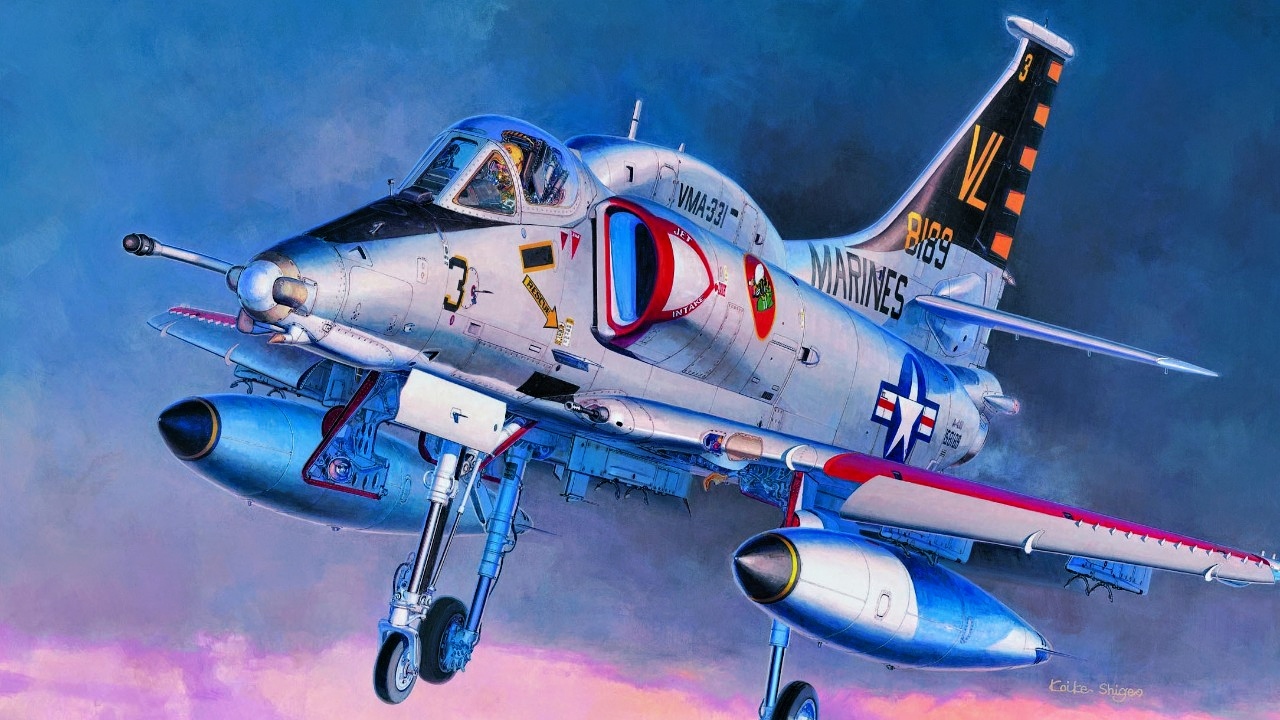
Key Points and Summary – This piece explains how the Essex-class carriers became the backbone of U.S. naval airpower from World War II through Vietnam and beyond.
-Designed for sortie generation and survivability, they brought industrial-scale flight decks to the Pacific war, absorbed kamikaze punishment, and kept flying.
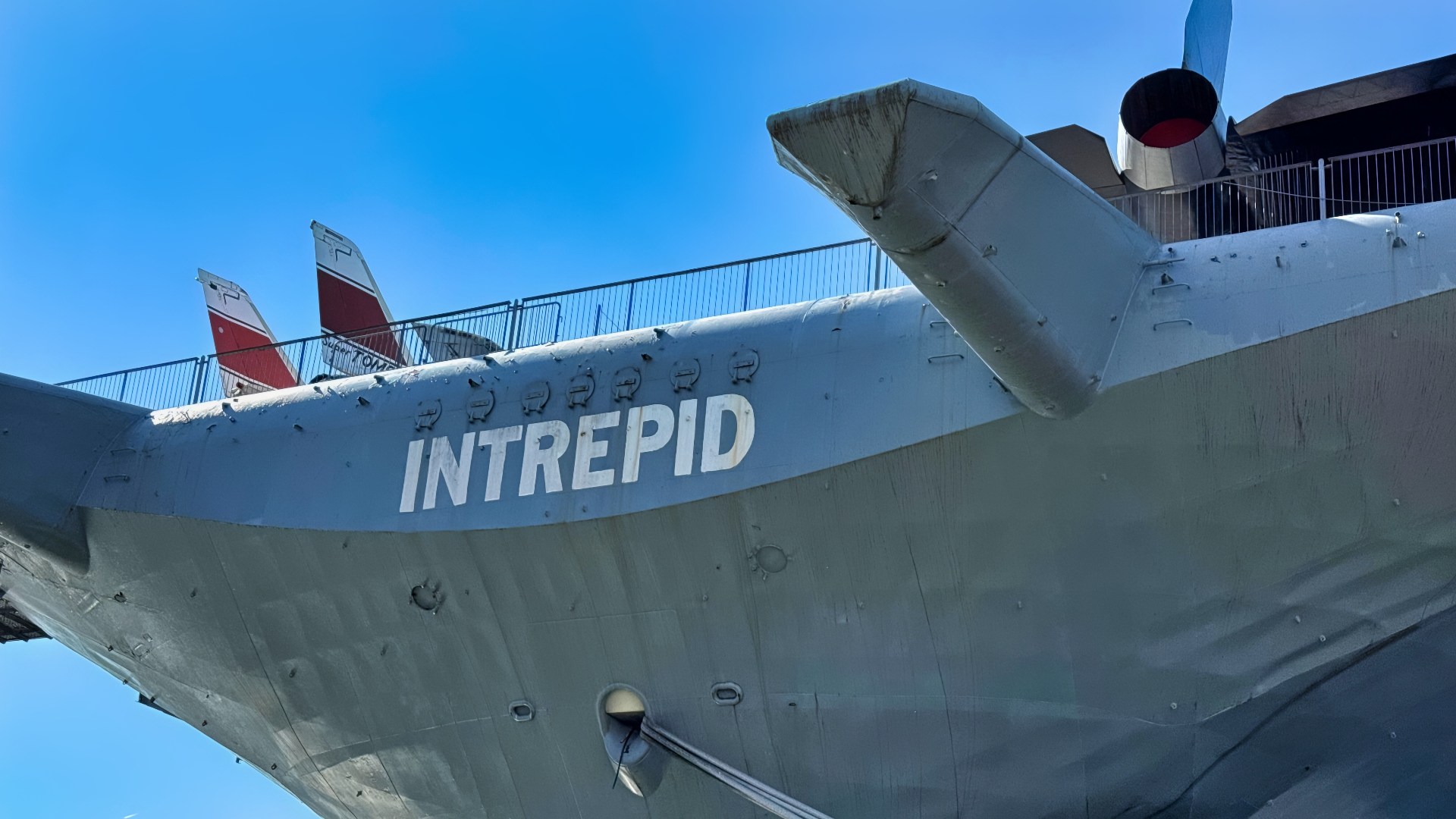
Essex-Class Carrier USS Intrepid NSJ Photo.
-Postwar, the Navy reinvented surviving hulls for the jet age with SCB-27/125 upgrades, angled decks, and new roles in Korea, Vietnam, anti-submarine warfare, amphibious operations, and even space-capsule recovery.
-The article argues that their scale, upgrade capacity, longevity, and role as a “schoolhouse” for generations of aviators make Essex arguably the most successful carrier class ever built.
The Essex-Class Aircrart Carriers May Be the Best Warships America Ever Built
On the eve of World War II, U.S. carrier aviation was proving itself but still felt constrained by treaty-era ships.
The Navy needed more flight deck, more aircraft, and more resilience to support sustained offensive operations across the Pacific. Early war experience—particularly the pace and punishment of carrier battles—underscored a requirement for a hull that could launch, recover, arm, and repair aircraft at scale, shrug off damage, and return to flight ops quickly. The Navy also wanted a design that could be built in numbers, not ones and twos.
The answer became the Essex-class—larger than Yorktowns, optimized for throughput, and engineered to take growth. The design broadened the flight deck, raised hangar volume, improved magazines and aviation fuel protection, and embraced innovations like the deck-edge elevator (pioneered just before the war and adopted widely here) to keep the flight deck clear. In short: the Navy asked for a carrier that could fight every day, not just win a single set-piece battle—and one that shipyards could reproduce like a product, not a prototype.
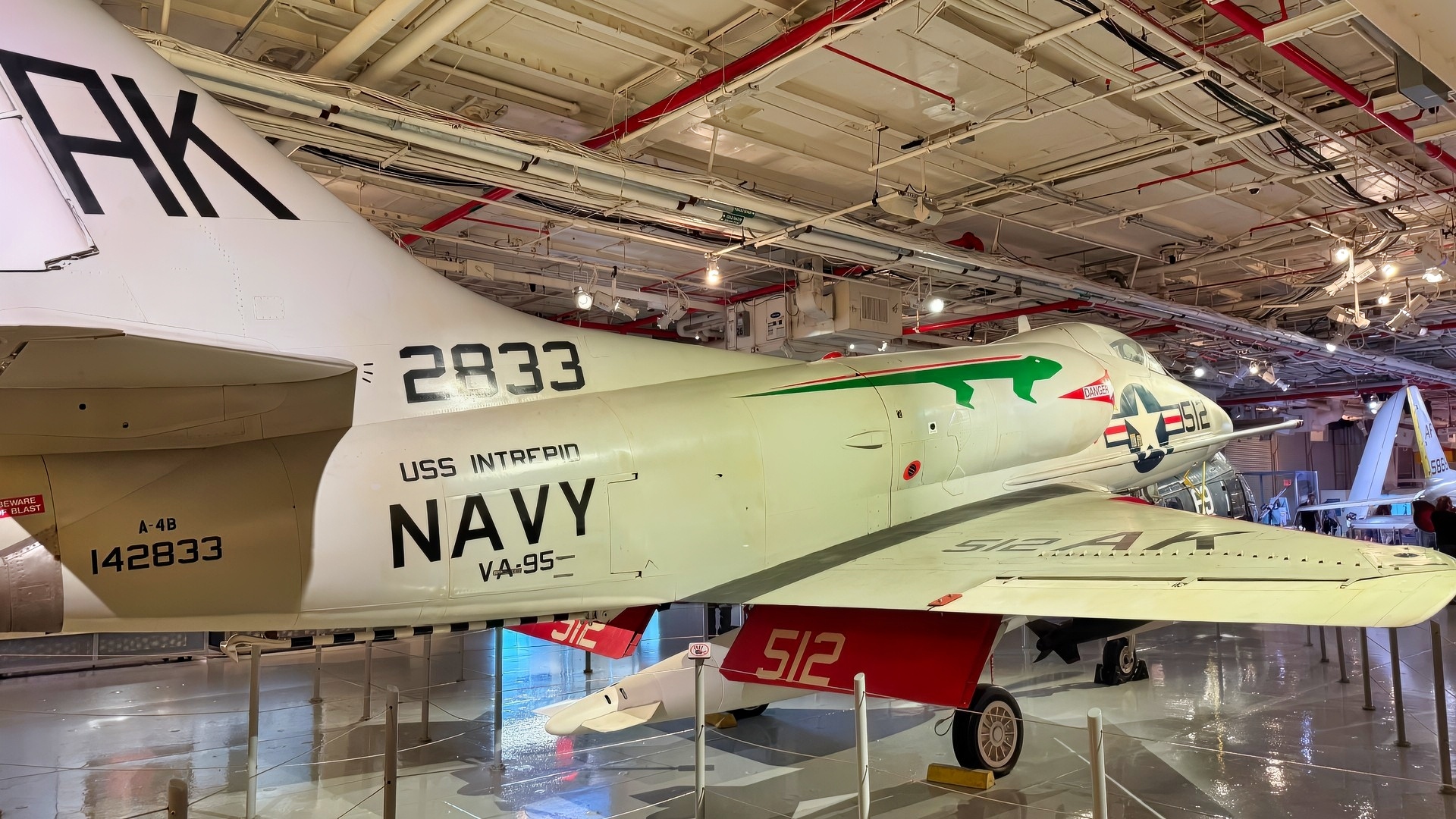
A-4 Skyhawk Sideview. Image by Jack Buckby for National Security Journal. Taken on 9/18/2025.
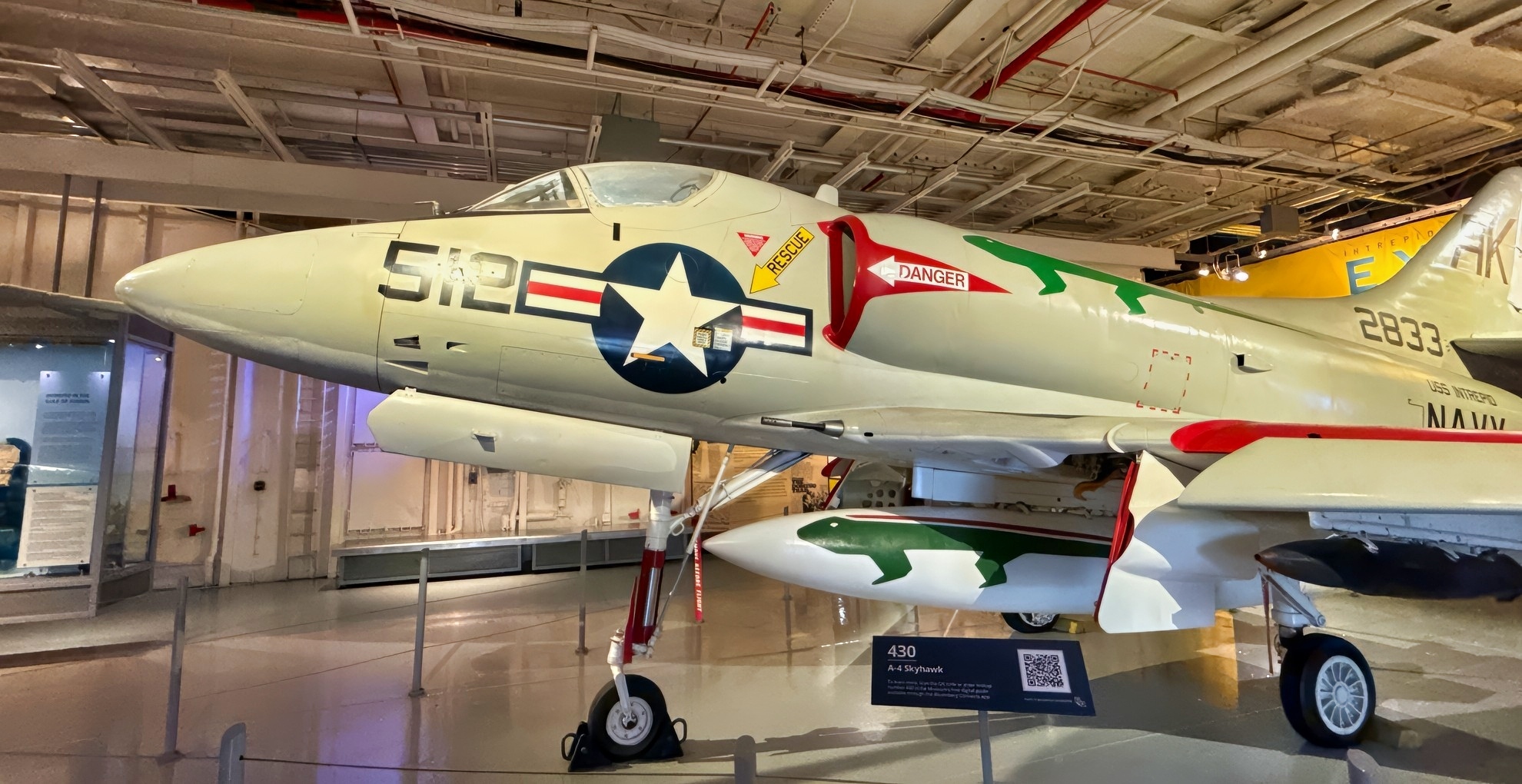
A-4 Skyhawk National Security Journal Museum Visit. Image Taken by Jack Buckby on September 18, 2025.
How The Essex Was Built To Fight And To Survive
Two ideas governed the plan: sortie generation and staying power. Essex carriers used a strong, open hangar concept with the principal strength deck below the flight deck, broad galleries for weapons handling, and aircraft elevators positioned to minimize traffic jams. Aviation fuel systems were protected and segregated; magazines were better armored and better arranged. The island grew to support more radar and better air-traffic control, and the anti-aircraft battery emphasized layered 5-inch, 40 mm, and later 20 mm weapons—a hedge against the torpedo and dive-bomber threats of the day.
Power came from four shafts and a machinery plant sized for 30+ knots, letting the ships keep up with the fast battleships and stay inside the wind envelope carriers crave. Crucially, the hull form and internal layout left weight and space margins—an accountant’s phrase that, decades later, would become the class’s superpower.
War At Industrial Scale: Bringing Flight Decks To The Pacific
The Essex wasn’t merely a ship; it was a production run. U.S. shipyards delivered these carriers in a wartime rhythm that put new decks on the map as fast as the air wing and escorts could be readied. Between 1942 and the end of the decade, two dozen Essex-class carriers entered commission. They arrived in time to change how the Navy fought: from early, anxious raids to sustained, rolling fast-carrier task force operations that smashed island defenses, struck Japanese naval bases, and denied the enemy the initiative.
Because the ships shared parts and procedures, the Navy could move crews, spare equipment, and experience across hulls. Pilots trained on one Essex could trap on another. Ordnancemen who learned a magazine on Yorktown (CV-10) could work efficiently on Intrepid (CV-11) or Lexington (CV-16). Scale bred competence.
Combat Service In World War II: The Tip Of The Spear
Operationally, the class wrote the air-sea playbook of the Pacific War. Essex carriers and their air groups led the Central Pacific drive: Gilberts and Marshalls, then the Marianas, the Philippine Sea, Leyte Gulf, and the relentless pounding of the Ryukyus and home islands.
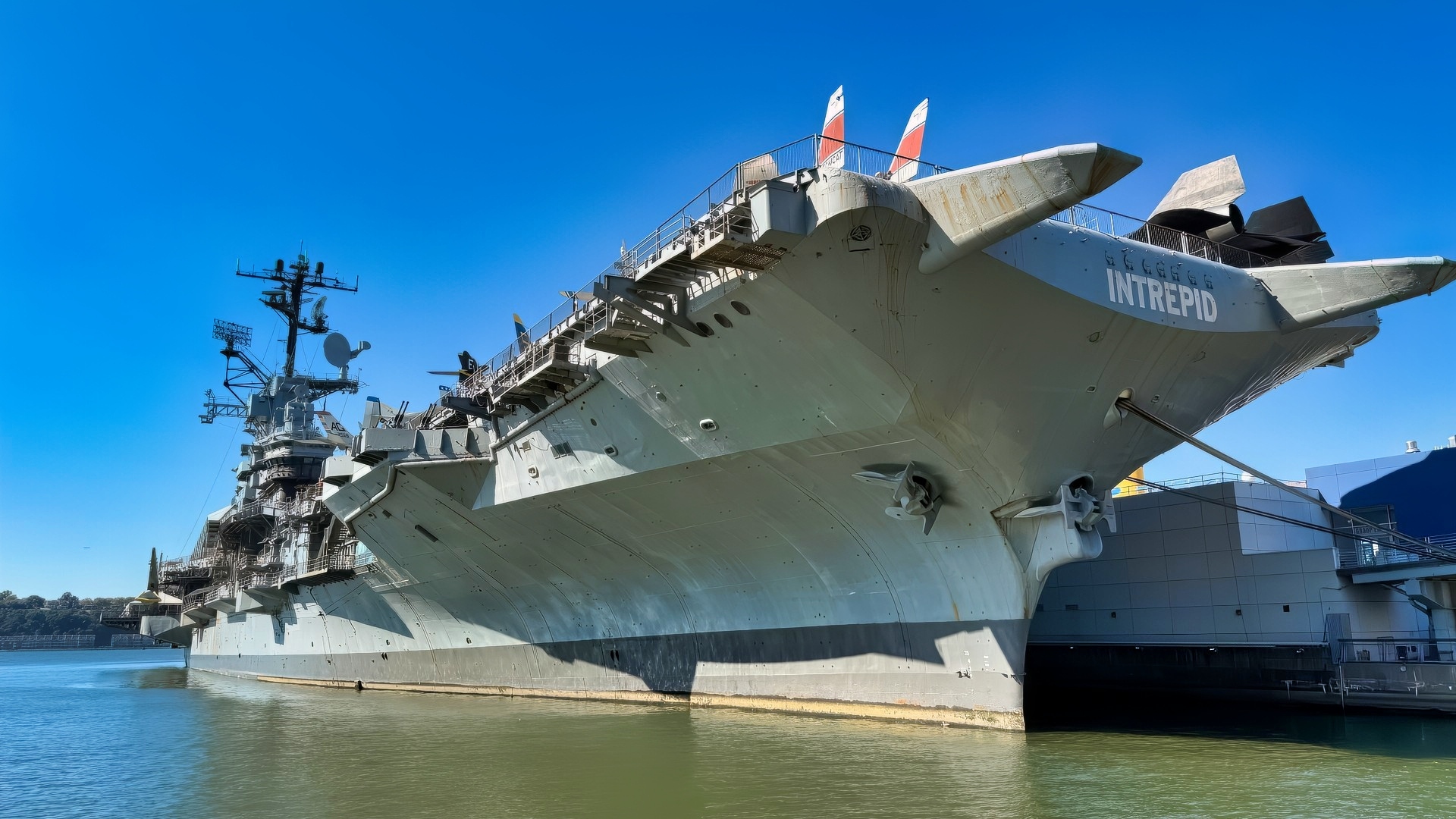
USS Intrepid Essex-Class National Security Journal Original Image. Taken by Jack Buckby on 9/18/2025.
Their aircraft sank shipping, shattered airfields, and guarded the surface fleet. When kamikazes arrived late in the war, the Essex carriers took terrible blows—Franklin (CV-13)’s near-death, Bunker Hill (CV-17)’s inferno, Intrepid’s repeated hits—and still returned to flight when damage control and destiny allowed. The design’s compartmentation, firefighting improvements, and practiced crew drills turned potential sinkings into survivable crises.
By 1945, the class had become the backbone of the Fast Carrier Task Force—the most potent naval striking arm of the war. The ships and their air groups absorbed losses, rotated squadrons, and simply kept coming, day after day, until Japanese resistance at sea collapsed.
Demobilization And The Big Question: What Now?
Peace posed a different challenge: what to do with a large, battle-proven class as aviation leapt forward? Jets were arriving; aircraft weights and approach speeds were increasing; electronics were multiplying. The Navy faced a fork in the road: build entirely new “supercarriers,” or rebuild proven hulls to buy time and capability. It did both.
While new larger carriers were designed, the Navy launched a set of modernization programs for Essex-class survivors. The goal wasn’t nostalgia. It was utility: fold modern aviation into platforms the Navy already owned, staffed, and understood—so the fleet wouldn’t fall off a cliff while it waited for the future.
Reinventing For The Jet Age: SCB-27 And SCB-125
The postwar refits came in two big waves. Under SCB-27, Essex hulls received heavier flight-deck structures, stronger arresting gear, more aviation fuel protection, redesigned weapons stowage, and upgraded catapults—first hydraulic on some ships, then steam catapults on later conversions—to throw early jets off the bow with authority. The islands and electronics were rebuilt around radar-directed air operations, and the ships gained new workshops and power generation to feed a rising tide of avionics.
Then came SCB-125, the transformation everyone notices in photos: the angled flight deck, the enclosed “hurricane” bow, relocated deck-edge elevators, better lighting, and the optical landing system. These changes weren’t cosmetic. The angled deck let aircraft go around without tangling with parked jets and allowed simultaneous launch and recovery cycles that kept sorties flowing. The hurricane bow kept green water off the flight deck and reduced corrosion and downtime. Together, SCB-27 and SCB-125 gave a World War II hull a new life as a jet carrier.
One ship, Oriskany (CV-34), even served as a prototype—completed postwar already embodying many SCB-27 features—proof that smart modernization could wring serious combat power from an existing hull.Korea: Back To War—And A Proof Of Concept
When North Korea invaded the South in 1950, the Navy’s rebuilt Essex carriers returned to combat with a mixed bag of aircraft: prop-driven Skyraiders and Corsairs alongside early jets like the Panther. The ships flew close air support, interdiction, reconnaissance, and combat air patrols—essentially the same mission set as in 1945, now against a new enemy and a more dangerous air-defense environment.
Korea validated the upgrades. The strengthened decks and improved gear handled jet operations; the ships’ speed and endurance kept them on station; and the new maintenance and ordnance arrangements supported a sustained sortie tempo far from home bases. The Essex had bridged its first technological chasm.
Cold War Utility: ASW Guardians, Spacecraft Recovery, And Amphibious Tricks
Not every Essex stayed a frontline strike carrier. As supercarriers arrived and air wings grew heavier, many Essexes became CVS—anti-submarine carriers—embarking S-2 Trackers and Sea King helicopters to guard sea lanes against Soviet submarines. The class also proved handy at roles no one had imagined in 1942: several ships served as spacecraft recovery platforms during the Mercury, Gemini, and Apollo eras, turning the middle of the Pacific into a carefully choreographed splash-down airport.
A subset swapped fixed-wing air wings for helicopter assault loads, becoming LPHs that moved Marines, gear, and rotary-wing strike packages—an early taste of today’s amphibious ready groups. And one Essex spent decades as a training carrier, putting Navy and Marine pilots aboard ship for their first arrested landings long after her sisters retired. Versatility wasn’t a talking point; it was a lived reality.
Vietnam: The Essex-Class Goes To War One Last Time
If Korea was proof of concept, Vietnam was the late-career stress test. Modernized Essex carriers deployed as attack carriers in the early and mid-1960s, launching A-4 Skyhawks, A-1 Skyraiders, and F-8 Crusaders on long, punishing strike cycles. Others, in the CVS role, hunted submarines and provided plane-guard and search-and-rescue support that kept the fast carriers operating hard in the Gulf of Tonkin. The ships endured tropical weather, high sortie rates, and the human grind of a long war. They were no longer the biggest or most modern carriers in the fleet—but they were useful, and in war, useful is enough.
Systems March Forward: Electronics, Safety, And Human Factors
Beyond the headline changes, the Essex class benefited from a steady creep of electronics and human-systems improvements. Air-traffic control got better tools; navigation improved; tactical air navigation (TACAN) replaced older aids; radios multiplied and hardened. Firefighting gear, damage control training, and protective plating improved after hard-learned lessons—on these ships and others—which meant that when mishaps and deck fires did occur, crews had both the equipment and the muscle memory to respond quickly.
Habitability, long a sore point, saw measured gains as refits modernized berthing, galleys, and air-conditioning for tropical duty. None of these shifts made headlines, but together they translated into more time on the line and fewer days lost to things that once routinely hobbled a ship.
Retirement: A Long Sunset For An Enduring Class
By the 1970s the Navy’s center of gravity had shifted decisively to supercarriers—Forrestal, Kitty Hawk, Enterprise, and later Nimitz—whose larger decks and deeper magazines fit the heavy jet age. Essex-class carriers faded by role: some decommissioned outright; others shifted to training and reserve duties; a few lingered as CVS ships as long as their air wings made sense. One preserved veteran served as a training carrier into the early 1990s, an extraordinary coda for a World War II hull.
Several became museum ships, telling their stories from New York Harbor to Charleston to the San Francisco Bay—flight decks now topped with static aircraft instead of dripping arresting gear. One was sunk as an artificial reef, a fitting return to the sea for a ship that had lived there longer than many of her crews.
Why So Many Experts Consider Essex Among The Best—Ever
“Best” is a loaded word, but the Essex-class makes a compelling case on five counts:
1) They Delivered Strategic Effect At Scale. The class didn’t just win battles; it sustained an operational tempo across months and oceans that made the Pacific offensive possible. Logistics loved them; commanders trusted them.
2) They Took Upgrades Without Losing The Plot. Few warship designs accept transformation as gracefully. From piston props to early jets, from straight decks to angled decks, from attack to ASW and amphibious roles—the hull kept absorbing change without becoming a Frankenstein.
3) They Balanced Protection And Capacity. The Americans bet on larger air groups and high sortie rates with smart internal protection rather than an armored flight deck that would have constrained operations. In practice, that meant more planes in the fight and faster recovery from damage—exactly what a long campaign demanded.
4) They Stayed Useful For Half A Century. A design commissioned in 1942 was still earning its keep in Vietnam and beyond. That longevity isn’t luck; it’s the product of margin—space, weight, power, and crew architecture that invited modernization instead of resisting it.
5) They Trained Generations. Even after the last strike cruises, the class poured value into the fleet by qualifying aviators, testing gear, and serving as dependable platforms for missions that didn’t need a nuclear giant. That’s institutional gold.
Add it up, and the Essex-class looks less like a “type” and more like a carrier ecosystem that matured with naval aviation itself—from deck handling to C2 to damage control, from the culture of air wings to the choreography of the flight deck. Most classes define a moment. Essex defined an era.
The Final Word
If you built a carrier to fight one war, you’d build it differently: thicker armor here, a bigger radar there, perhaps different aviation fuels or magazines. But if you wanted a carrier that could fight many wars, teach many crews, adopt many technologies, and still earn its keep a lifetime later, you would want something very much like an Essex. They were not perfect—no ship is—but they were exactly what the Navy needed when it mattered most, and exactly adaptable enough to matter again and again.
That is why, decades after their first launches, the Essex-class still draws respect from engineers, aviators, and historians alike. They were the fleet’s workhorses, the schoolhouse, the bridge to modern carrier aviation—and, in the judgment that counts, one of the best classes of carriers ever to go to sea.
About the Author: Harry J. Kazianis
Harry J. Kazianis (@Grecianformula) is Editor-In-Chief and President of National Security Journal. He was the former Senior Director of National Security Affairs at the Center for the National Interest (CFTNI), a foreign policy think tank founded by Richard Nixon based in Washington, DC. Harry has over a decade of experience in think tanks and national security publishing. His ideas have been published in the NY Times, The Washington Post, The Wall Street Journal, CNN, and many other outlets worldwide. He has held positions at CSIS, the Heritage Foundation, the University of Nottingham, and several other institutions related to national security research and studies. He is the former Executive Editor of the National Interest and the Diplomat. He holds a Master’s degree focusing on international affairs from Harvard University.


Mark Tercssk
September 22, 2025 at 7:57 am
just one mistake Super Carriers , the first to enter service was the U.S.S. Midway Class tail end of WW2.
Brandon Graff
September 25, 2025 at 11:02 pm
PLEASE stop using the “has a message” headlines. I’m sick of seeing it and don’t want to unsubscribe from your journal. Hire someone with some creative ability and come up with a new headline.