

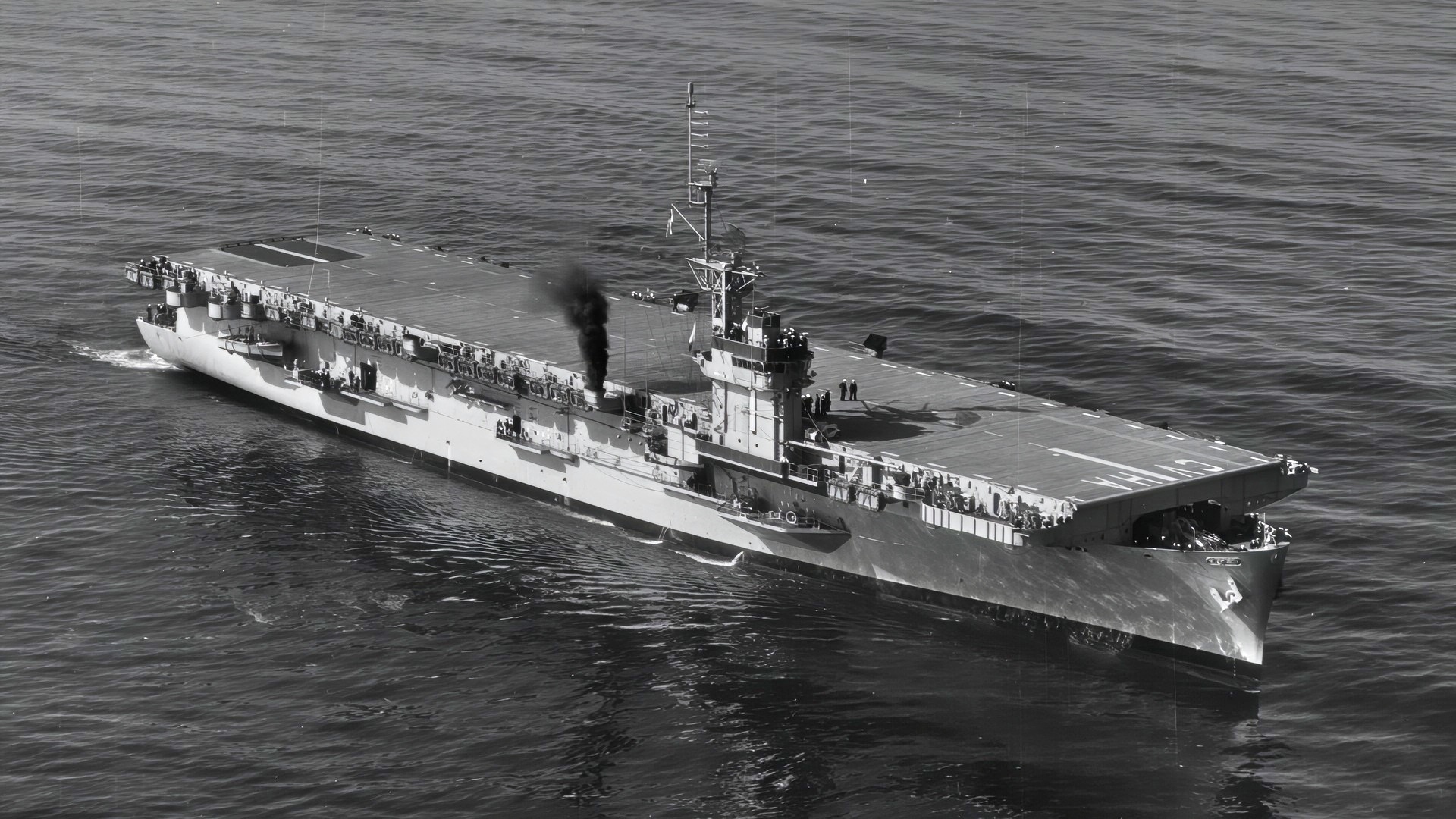
Key Points and Summary – America’s Casablanca-class escort aircraft carriers were WWII’s most numerous flattops: 55 “Jeep” carriers mass-produced by Henry Kaiser’s yards to a Gibbs & Cox design after FDR pushed an all-US program in 1942.
-The Mission: Help win World War II.

Casablanca-Class Aircraft Carrier WWII. Image Credit: Creative Commons.
-Faster than earlier CVEs, they proved vital across both oceans—escorting convoys, flying ASW and CAS, and starring at the Battle off Samar, where Taffy 3’s CVEs and destroyers blunted a superior Japanese force. The class paid dearly—USS Liscome Bay and Bismarck Sea were lost—and crews dubbed them “Kaiser coffins.”
-Decommissioned postwar, none survive, but recent wreck IDs (e.g., Ommaney Bay) keep their service and sacrifice in view.
The Story of the Casablanca-Class Aircraft Carrier
No aircraft carrier in history has been as numerous as the Casablanca-class escort carrier, more than 50 of which were built by the US Navy during World War II.
The idea of escort carriers goes back to the 1920s, when British Lieutenant Commander Bruce G. Leighton wrote “Light Aircraft Carriers, A Study of their Possible Uses in So-Called ‘Cruiser Operations,’ Comparison with Light Cruisers as Fleet Units.” Another early advocate for the idea was Captain John S. McCain, the grandfather of the war hero and later senator and presidential candidate.
According to the US Naval Institute’s website, President Franklin Delano Roosevelt first recommended a “Jeep” carrier program to the Navy as early as 1940, before the US joined the war. The Navy started by developing such ships and transferring them to the UK under the Lend-Lease program.
By August 1942, following Pearl Harbor and the US entry into the war, FDR sought to establish his own fleet of carriers.
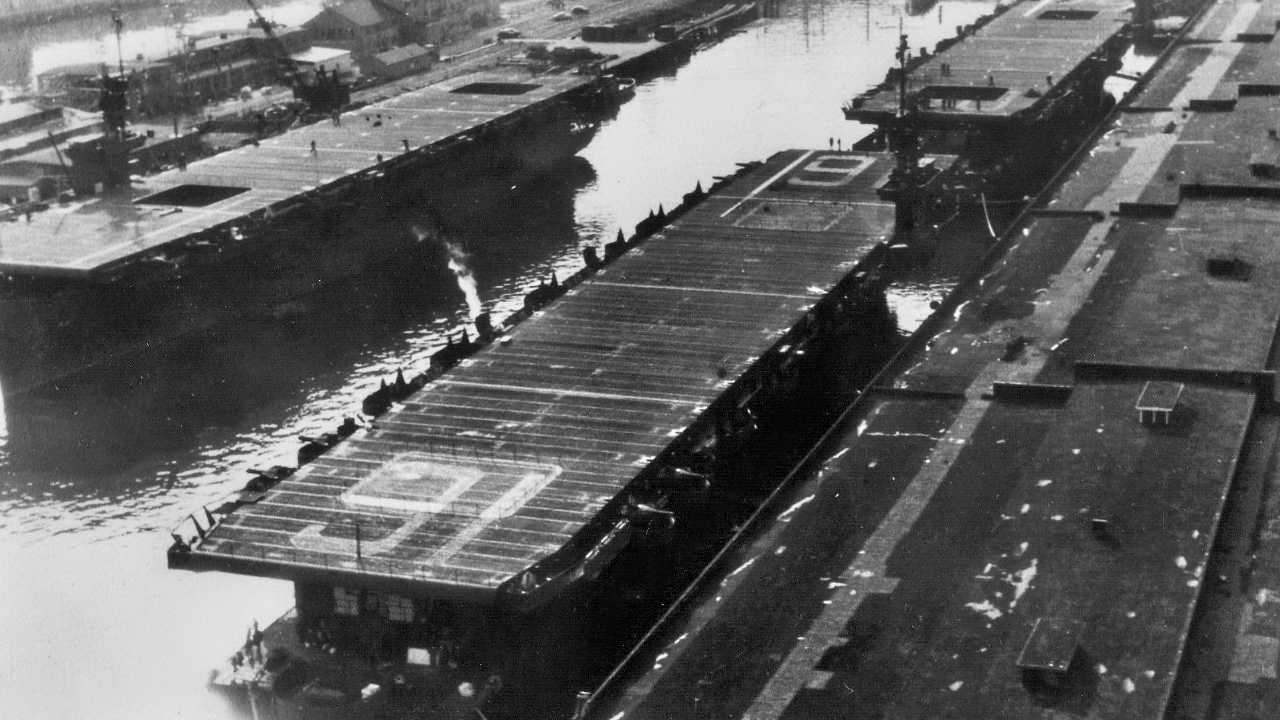
Image Credit: Creative Commons.
Birth of the Casablanca-Class
Meeting with Navy leaders, the president “requested an additional 50 escort carriers be built exclusively for U.S. Navy use to a design specifically intended for the purpose under the management of the Maritime Commission,” per USNI’s history.
The ships were designed by Gibbs & Cox and built at the shipyard owned by industrialist Henry J. Kaiser, who would go on to found Kaiser Permanente, in Vancouver, Wash.
An NPS historical article credits Kaiser with “revolutionizing shipbuilding,” since he “recognized the urgency of the situation and the limitations of traditional shipbuilding methods.” The industrialist applied assembly line tactics to shipbuilding and is credited with reducing building times, “from months to mere days.”
Expedited Production
The first of the fleet was laid down in November 1942 and launched in April of the following year, while the final one was laid down in March 1944 and launched that June.
The carriers were distinguished by an improvement in speed, which USNI described as “an improvement in sustained speed of 2 knots to a nominal 20.3 knots.”
There were 55 Casablanca-class carriers, which were deployed in both the Atlantic and Pacific theaters, out of the 130 escort carriers that were built throughout US involvement in the war. All but five survived the war, but in the years afterward, they were decommissioned.

Casablanca-Class. Image Credit: Creative Commons.
After the war, there was an attempt by the Jewish Agency to acquire one of the ships, the USS Attu (CVE-102), and take it to Israel, around the time of its War of Independence. But the plans ultimately failed.
“While they were too small and too slow to operate postwar Navy and Marine Corps fixed-wing combat aircraft, the Casablanca-class carriers provided a remarkably successful and rapidly built force that proved vitally useful in service,” USNI said of the carriers.
The Casablanca case holds the Guinness World Record for “most numerous class of aircraft carrier.”
“Risky for Crews”
Indeed, according to a 2023 article by We Are the Mighty, the Casablanca class was “the most popular carrier class in Naval history.” And while buyers and planners were thrilled with the ships, they were risky and sometimes even dangerous for their crews. Some even called them “Kaiser coffins.” Others joked that “CVE” should have stood for “combustible, vulnerable, and expendable.”
Indeed, the greatest tragedy involving the Casablanca class was the sinking, in 1943, of the USS Liscome Bay.
Torpedo Junction and Casablanca-Class
It happened on November 24, 1943, when, per the Navy’s official website’s history, “one of a spread of torpedoes fired from the Japanese submarine I-175, slammed into the escort carrier’s starboard side.” It struck near the bomb magazine, described by the Navy as “ the worst possible location, and 644 men were killed as the ship sank in just 23 minutes.
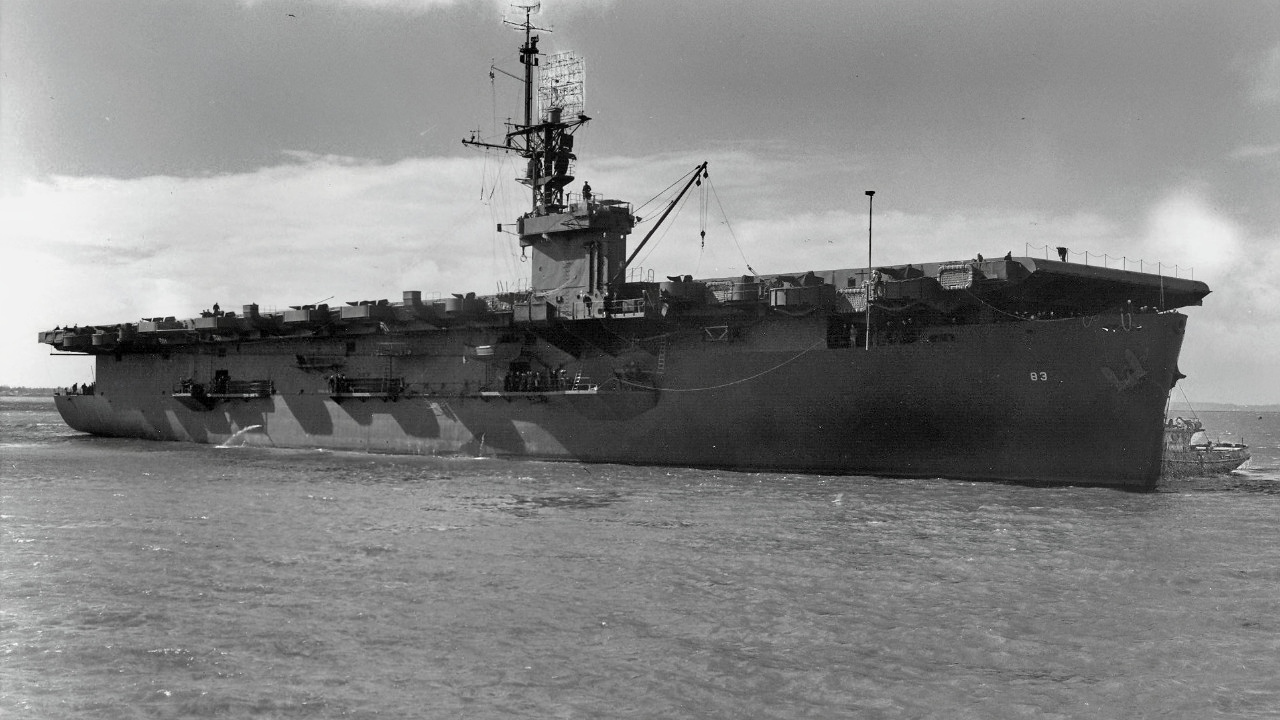
Casablanca-Class Aircraft Carrier. Image Credit: Creative Commons.
The Battle Off Samar
Several of the Casablanca-class carriers took part in the crucial Battle Off Samar, in the Philippine Sea on October 25, 1944, a battle that has been called the Casablanca class’ “finest hour.” Those escort carriers included the Fanshaw Bay (CVE-70), Gambier Bay (CVE-73), Kalinin Bay (CVE-68), Kitkun Bay (CVE-71), St. Lo (CVE-63), and White Plains (CVE-66).
According to an article published in 2019 at George Mason University by CSPS Fellow Tyler Stone, that battle was an example of the “ascendancy of the aircraft carrier.”
“The Japanese fleet encountered American Task Unit 77.4.3, Taffy 3, which was comprised of six escort carriers, three destroyers, and four destroyer escorts. The escort carriers’ aircraft lacked anti-ship weapons, since they were armed for close air support and anti-submarine missions,” Stone wrote.
“Although outnumbered and outgunned, the American destroyers engaged the Japanese fleet long enough for the five of the six escort carriers to retreat to safety. The carriers also deployed their fighters to harass the Japanese ships and break their formations. After two hours of combat, the Japanese admiral decided to retreat to Japan, where most of the fleet would remain until the end of the war.”
Another carrier from the class, the USS Bismarck Sea, was sunk during the Battle of Iwo Jima in 1945, costing more than 300 men their lives. It would be the final Naval aircraft carrier to be lost during the war.
After the War
Once again, most of the Casablanca-class carriers were sold for scrap once the war was over, and none of them survives to this day. Some, such as the USS Sitkoh Bay, later saw action in the Korean War.
In 2023, the resting place of the USS Ommaney Bay, which sank in January 1945 after a kamikaze pilot struck it, was finally identified, 78 years after the sinking.
Per Historynet, the wreckage was identified by the Naval History and Heritage Command’s Underwater Archaeology branch.
“Ommaney Bay is the final resting place of American Sailors who made the ultimate sacrifice in defense of their country,” retired admiral and NHHC Director Samuel J. Cox said at the time of the discovery.
“This discovery allows the families of those lost some amount of closure and gives us all another chance to remember and honor their service to our nation.”
About the Author: Stephen Silver
Stephen Silver is an award-winning journalist, essayist, and film critic, and contributor to the Philadelphia Inquirer, the Jewish Telegraphic Agency, Broad Street Review, and Splice Today. The co-founder of the Philadelphia Film Critics Circle, Stephen lives in suburban Philadelphia with his wife and two sons. For over a decade, Stephen has authored thousands of articles that focus on politics, national security, technology, and the economy. Follow him on X (formerly Twitter) at @StephenSilver, and subscribe to his Substack newsletter.
More Military
Japan’s ‘Big Whale’ Taigei-Class Submarine Is One of the Best on Earth
World War III: 5 Places It Could Start Right Now
The Challenger 3 Tank Is A Powerhouse with a Number Problem
SR-72 Darkstar Like in Top Gun: Maverick Could Hit 4,000 Miles Per Hour
China’s J-20 Mighty Dragon Stealth Fighter Summed Up in 3 Words


