

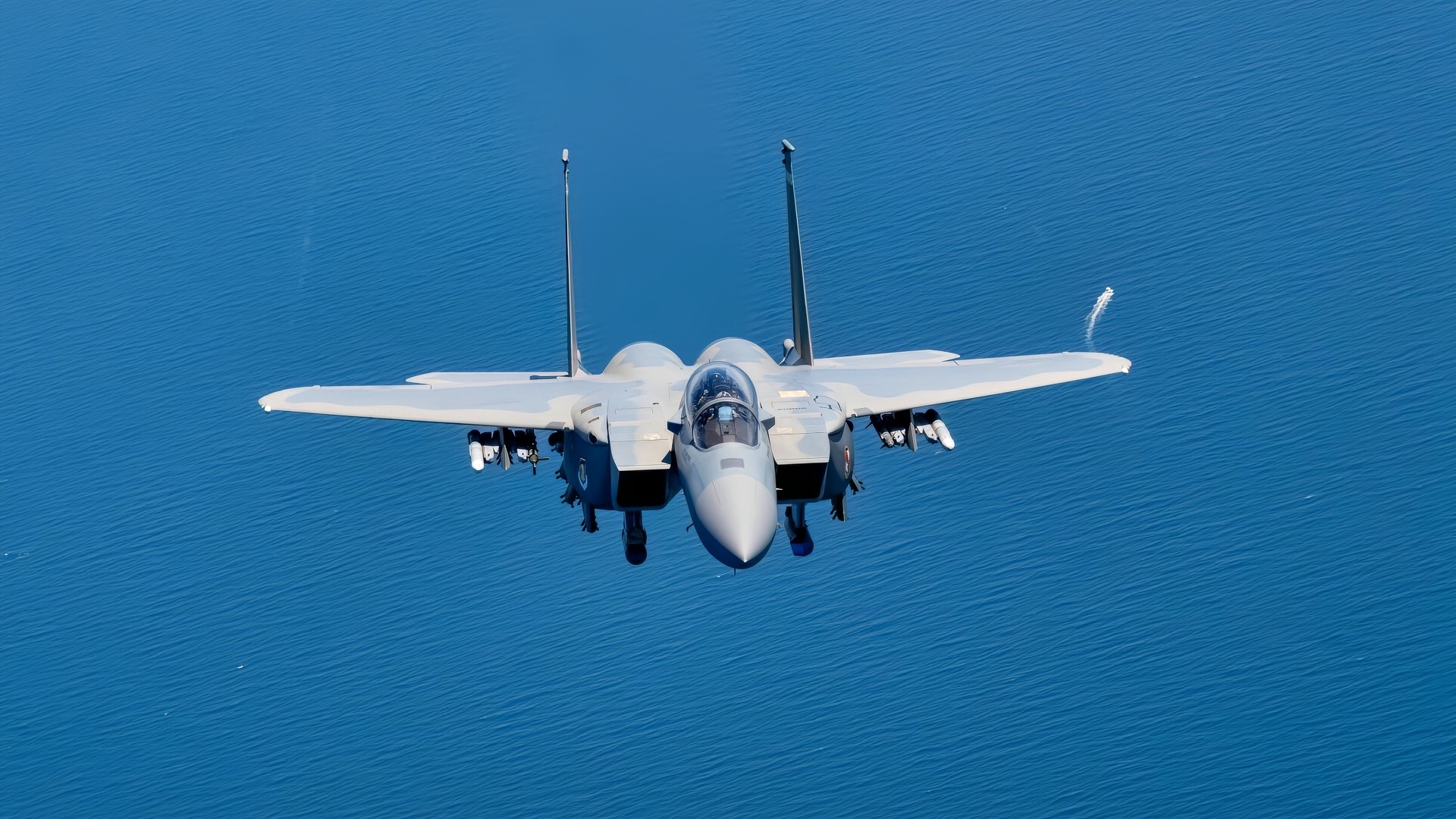
Key Points and Summary – America’s F-15EX and Sweden’s JAS 39 Gripen E are elite 4th-gen fighters built for different playbooks.
-The twin-engine Eagle II brings brute speed, range, and unmatched missile capacity plus EPAWSS electronic warfare.
-The smaller, road-base-friendly Gripen E counters with swashplate AESA coverage, potent EW, slick sensor fusion, and Meteor ramjet missiles with a large no-escape zone.
-In BVR, Gripen’s stealthier profile and Meteor can earn first shots, but the F-15EX’s radar, jamming, and magazine depth can absorb and reply.
-In WVR, Gripen’s agility bites; the Eagle’s energy lets it reset. Verdict: scenario, tactics, and pilot skill decide.
F-15EX vs Gripen E: BVR vs WVR—Who Wins?
The Saab JAS 39 Gripen is currently Sweden’s most advanced and prolific fighter.
With advanced avionics, high-performance engines, and a diverse array of armaments, the Gripen has achieved significant success on the international market, with air forces around the world.
On the other hand, the F-15EX is one of America’s most advanced fourth-generation fighters.
Built on the original F-15 platform, the F-15EX boasts advanced avionics, an impressive payload capacity, and a wide range of armaments that enable it to target air, land, and sea threats.
Both aircraft are capable, but which one would prevail in a hypothetical combat engagement?

Image Credit: US Air Force.
The F-15EX vs the Saab Gripen
The F-15EX is an evolution of the iconic F-15 platform, initially designed in the 1970s as an air superiority fighter.
The EX-variant incorporates modern avionics, electronic warfare systems, and open mission architecture, making it one of the most capable fourth-generation fighters in the world.
It is powered by two powerful engines that give it a top speed exceeding Mach 2.5 and a combat radius of over 1,000 kilometers.
Its payload capacity is unmatched among current fighters, capable of carrying up to 22 air-to-air missiles or a mix of air-to-ground munitions, including future hypersonic weapons. The aircraft is not stealthy in the traditional sense, but it compensates with brute force, speed, and advanced electronic warfare capabilities through the EPAWSS suite.
In contrast, the JAS 39 Gripen E is a product of Swedish defense doctrine, which emphasizes flexibility, cost-efficiency, and survivability in a contested environment.
The Gripen is smaller, lighter, and designed to operate from short runways and even road bases, allowing for dispersed operations that are harder to target.
It features the Raven ES-05 AESA radar mounted on a swashplate for a wider field of view, an advanced electronic warfare suite, and a high degree of sensor fusion.
The Gripen E is also built with network-centric warfare in mind, allowing it to share data seamlessly with other platforms and operate effectively in a connected battlespace.

JAS 39 Gripen Fighter From Sweden. Image Credit: Creative Commons.
Avionics and Armament
When comparing avionics and sensor capabilities, both aircraft are equipped with AESA radars and advanced electronic warfare systems.
The F-15EX’s radar is more potent in terms of raw detection range and tracking capability.
Still, the Gripen E’s sensor fusion and passive detection systems give it an edge in situational awareness and electronic stealth. The Gripen’s EW suite is designed to deceive and jam enemy sensors subtly, while the F-15EX’s EPAWSS is more focused on overpowering threats with high-output jamming and threat detection.
In terms of weapons, the F-15EX has a clear advantage in quantity. It can carry more missiles than any other fighter in the U.S. inventory, including a whole load of AIM-120 AMRAAMs and AIM-9X Sidewinders.
The Gripen E, while more limited in payload, carries the Meteor missile, which is widely regarded as one of the most advanced beyond-visual-range (BVR) air-to-air missiles in the world.
The Meteor’s ramjet propulsion gives it a more extended range and a larger no-escape zone than the AMRAAM, potentially allowing the Gripen to strike first in a BVR engagement.
Survivability and Engine Performance
Neither aircraft is stealthy in the way that fifth-generation fighters like the F-22 or F-35 are, but both employ electronic stealth techniques. The Gripen E has a slightly smaller radar cross-section due to its size and design, making it harder to detect and track.
Its electronic warfare suite enhances this stealthiness by jamming and spoofing enemy sensors.
The F-15EX, being larger and more visible, relies on its speed, altitude, and robust EW systems to survive in contested airspace.
The F-15EX is powered by two Pratt & Whitney F100-PW-229 engines, delivering a combined thrust of over 58,000 pounds, which gives it exceptional acceleration, high-speed performance, and the ability to sustain supersonic flight for extended periods.
This raw power allows the F-15EX to reach speeds above Mach 2.5 and carry heavy payloads without compromising maneuverability.
In contrast, the JAS 39 Gripen E uses a single General Electric F414-GE-39E engine, producing around 22,000 pounds of thrust. While not as powerful as the F-15EX, the Gripen’s lighter airframe and advanced aerodynamics make it highly agile and efficient, especially at lower speeds and altitudes.
Who In 4 Words: Maybe No Clear Winner?
In a hypothetical one-on-one engagement in neutral airspace with no external support, the outcome would depend heavily on the scenario.
In a beyond-visual-range fight, the Gripen E might have the advantage due to its Meteor missiles and stealthier profile.
It could detect and engage the F-15EX before being detected itself. However, the F-15EX’s powerful radar and electronic warfare systems could counter this advantage, allowing it to survive the initial volley and respond with a barrage of AMRAAMs.
In a within-visual-range dogfight, the Gripen E’s agility and smaller size would make it harder to hit, giving it a potential edge.
Both aircraft are equipped with helmet-mounted sights and high-off-boresight missiles, allowing them to engage targets at extreme angles. The F-15EX’s superior thrust and sustained maneuverability could help it stay in the fight, but the Gripen’s nimbleness might allow it to outmaneuver the larger jet.
Ultimately, there is no clear winner in this competition. Both aircraft are well-suited to their respective roles and are more than capable of taking on their opponents.
The victor in this scenario ultimately depends on which pilot possesses more skill and experience.
If the Gripen can lock onto the F-15EX and fire the first missile, then the battle is over, and vice versa. Real-life combat is rarely as simple as comparing metrics on paper.
About the Author: Isaac Seitz
Isaac Seitz, a Defense Columnist, graduated from Patrick Henry College’s Strategic Intelligence and National Security program. He has also studied Russian at Middlebury Language Schools and has worked as an intelligence Analyst in the private sector.
More Military
B-1B Lancer: The Bomber The Air Force Needs to Keep Flying
Su-37 ‘Terminator’: The Thrust-Vectoring Super Flanker Fighter That Never Was
Russia or China Would Love to Have the Aircraft Carrier USS Harry S. Truman
NATO’s Big Fear: Putin Drops a Tactical Nuclear Weapon on Ukraine
The U.S. Military’s Big F-22 Raptor Stealth Fighter Mistake Cuts Deep


