


Key Points and Summary – President Trump wants a new class of Trump-class “guided missile battleships,” but the case for them is unclear, and the timeline is, in one word, implausible.
-The proposed 35,000-ton BBGs would pack a headline-grabbing mix of railguns, hypersonic missiles, nuclear cruise missiles, lasers, and a large VLS battery—yet several of those systems are immature or difficult to integrate quickly.

Trump-Class Battleship. Image Credit: White House.
-The concept also dodges hard questions about survivability and how a big, prestigious surface ship would operate against submarines, missiles, drones, and aircraft.
-The likely risk is another boutique class; the upside is a shipbuilding and technology jumpstart.
Railguns, Hypersonics, Lasers: Why Trump’s BBG Battleship Plan Collides With Reality
United States President Trump wants battleships. It is not clear that the Navy and the American shipbuilding industry are capable of delivering them, and it is equally unclear how the United States would benefit from such vessels.
Battleships From a Foregone Era
The 20th-century battleships that President Trump, among others, admires so greatly were large, heavily armored warships that carried heavy guns designed to defeat enemy battleships’ armor.

USS Iowa Logo National Security Journal Photo. Taken August 15, 2025.

16-Inch Iowa-Class Guns. Image Credit: National Security Journal.

Iowa-Class 16-Inch Shell Menu. Image Credit: National Security Journal.
Technological change rendered those ships obsolete, with navies worldwide opting for smaller, less survivable ships with longer-ranged and more lethal weapons. Still, there has long been talk in maritime circles of the value that a large surface combatant might add to the fleet, and various projects to that effect were proposed and disposed of during and after the Cold War.
The Trump-class “battleships” (probably designated BBG, or “guided missile battleship”) would displace some 35,000 tons and carry a variety of advanced weapons.
The arsenal would include a rail gun, hypersonic missiles, nuclear cruise missiles, a 128-cell vertical launch system (VLS), 5″ guns, and defensive lasers.
A flight deck could carry helicopters or an MV-22 Osprey.
Several of these systems are still in development and are not expected to mature in the timeframe established by the President. While President Trump claimed that these would be the largest battleships in the history of the US Navy, a casual glance suggests they would be roughly 2/3 the size of the Iowa-class battleships built in the 1940s.
The President also mandated that the ships be visually attractive, suggesting that part of the logic of building what will be exceedingly expensive warships involves “showing the flag” and overawing locals in port visits around the world.
Expedited Shipbuilding in a Crunch
President Trump emphasized that he expects the first two hulls to hit the water in two and a half years, a timeline that is not plausible given current understanding of the constraints imposed by the laws of physics.
More plausible projections envision the first ships being laid down in the 2030s, a gap which would give industry time to develop shipyard capacity and the new technologies that are supposed to arm the BBGs. Trump’s announcement did involve one concession to reality, with Navy Secretary John Phelan claiming that the ships would source components from every state. This initiative will require a massive contracting effort, likely delaying construction of many of the ships’ components.
Survivability concerns have not been addressed as of this reading. The VLS system will offer some protection against conventional missiles, and, in theory, a laser system could protect against missiles and drones.
Nevertheless, these large, expensive, prestigious ships will prove a tempting target for any foe. As of yet, we lack a strong sense of the operating concept for the ships, although President Trump implied that they would be capable of operating alone. If this is so, the Navy will need to establish confidence that its defensive systems can defeat the array of submarines, missiles, drones, and aircraft that currently threaten surface vessels. One answer could involve using the vessels as “motherships” for uncrewed air and sea vehicles managed by advanced AI, which would presumably provide some defensive value.
Jumpstarting US naval shipbuilding appears to be part of the motivation for building the ships. Still, it is unclear how the shipbuilding industry will meet the massive requirements associated with designing and building the new vessels. New yards will have to be constructed, old yards opened, and a massive workforce recruited. None of these is necessarily a bad thing, but they are exceedingly expensive and will take a long time to implement.
Fitting New Battleships in the Fleet
Reasonable people think that the US Navy should build a large, multi-mission surface combatant, and the Trump class BBG program promises to deliver a large, multi-mission surface combatant.
It is not unreasonable to call these vessels “battleships,” as after all, the cruisers and destroyers of today have little physical resemblance to the cruisers and destroyers of World War II. But the Navy and the Trump Administration appear to have given little thought as to how these particular warships will fit into the fleet, how they will compete with other priorities, and what strategic purposes they will serve.
This is a mess … but the Navy asked for this mess.
The failure of the Littoral Combat Ship, the inability of the Zumwalt-class destroyer, and the failure of the Constellation-class frigate have left the service with few ideas and little to show for three decades of work.
Trump will not be President when the first Trump-class battleship hits the water, and it is by no means evident that his successor will want to pay for these vessels.

(July 28, 2022) U.S. Navy Zumwalt-class guided-missile destroyer USS Michael Monsoor (DDG 1001) sails in formation during Rim of the Pacific (RIMPAC) 2022, July 28. Twenty-six nations, 38 ships, three submarines, more than 30 unmanned systems, approximately 170 aircraft and 25,000 personnel are participating in RIMPAC from June 29 to Aug. 4 in and around the Hawaiian Islands and Southern California. The world’s largest international maritime exercise, RIMPAC provides a unique training opportunity while fostering and sustaining cooperative relationships among participants critical to ensuring the safety of sea lanes and security on the world’s oceans. RIMPAC 2022 is the 28th exercise in the series that began in 1971. (U.S. Navy photo by Mass Communication Specialist 3rd Class Aleksandr Freutel)
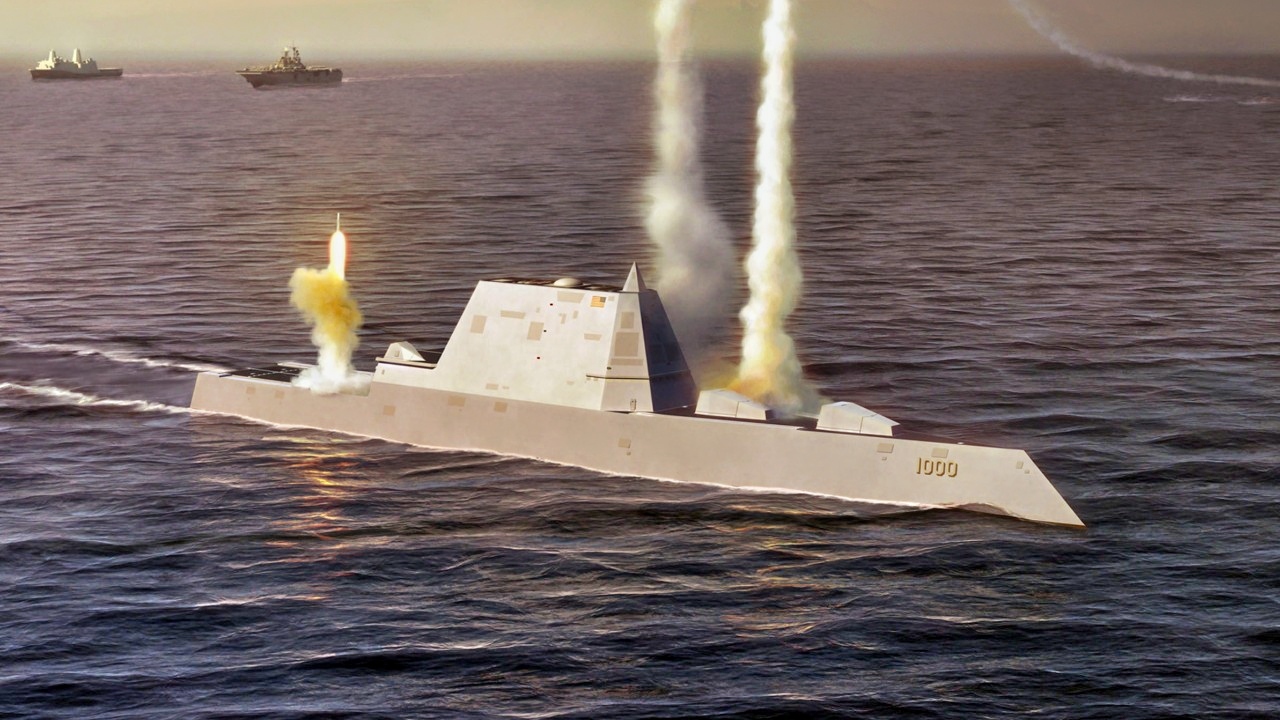
The US Navy’s troubled Zumwalt-class destroyers are being revitalized with the integration of Conventional Prompt Strike (CPS) hypersonic missiles, transforming them into powerful long-range strike platforms. The original class of 32 ships was cut to just three after its Advanced Gun System failed due to exorbitant costs. Now, these stealthy, $8 billion warships are having their defunct guns replaced with vertical launch tubes for hypersonic weapons. This upgrade will dramatically increase their strike range from a mere 63 miles to over 1,700 miles, making the Zumwalts relevant and formidable assets for deterring adversaries like China in the 21st century.
In the worst-case scenario, the Navy will actually acquire one or two Trump class BBGs, then cancel production for all the reasons it has cancelled the LCS, the DDG-1000, and the Connies. This would leave the fleet with yet another “unicorn,” a one- (or two-) of-a-kind ship that will strain maintenance and crew training while offering little strategic value.
As Tom Nichols, retired professor at the US Naval War College, writes, “the goal, apparently, was to give a childlike president a new toy, named after himself, in exchange for gobs of money that the Navy will figure out how to spend later.”
Trump-Class Battleship: What Happens Next?
The best-case scenario is that investment in these warships will help drive a revival of the US naval shipbuilding industry and spur technological development in components such as lasers and railguns.
This, rather than the prospect of modern, hyper-expensive battleships chasing drug-running “go fast” boats across the Caribbean, may represent the real and enduring value of yesterday’s announcement.
About the Author: Dr. Robert Farley, University of Kentucky
Dr. Robert Farley has taught security and diplomacy courses at the Patterson School since 2005. He received his BS from the University of Oregon in 1997, and his Ph. D. from the University of Washington in 2004. Dr. Farley is the author of Grounded: The Case for Abolishing the United States Air Force (University Press of Kentucky, 2014), the Battleship Book (Wildside, 2016), Patents for Power: Intellectual Property Law and the Diffusion of Military Technology (University of Chicago, 2020), and most recently Waging War with Gold: National Security and the Finance Domain Across the Ages (Lynne Rienner, 2023). He has contributed extensively to a number of journals and magazines, including the National Interest, the Diplomat: APAC, World Politics Review, and the American Prospect. Dr. Farley is also a founder and senior editor of Lawyers, Guns and Money.


JOSEY WALES
December 23, 2025 at 2:29 pm
YOU WANT BATTLESHIPS??? THEN BRING BACK THE IOWA CLASS BATTLESHIPS. THOSE THING WERE DESIGNED AND BUILT FOR KNOCK DOWN DRAG OUT TAKE NO NAMES TOTAL WAR NOT LIKE THE CRAP THEY HAVE NOWADAYS. THIN HULLED HULKING DESIGN WITH A TINY AMOUNT OF GUNS. YEAH THEY ARE FAST BUT ONE SURFACE TO SURFACE MISSILE CAN TAKE EM OUT LET ALONE A POWER BAOT LOADED WITH PLASTIQUE EXPLOSIVES THAT ALMOST BLEW ONE OF OUR DESTROYERS IN HALF A FEW YEAR BACK. IF IT HAD BEEN THE IOWA OR MISSOURI IT MIGHT HAVE SCRATCHED THE PAINT.
lars
December 23, 2025 at 4:14 pm
Actually, the idea of a new class of battleship has been in the works with navy strategist for years. Integrated into a carrier fleet group, it would have the fire power to decimate countries from a great distance. We are talking about a ship carrying hundreds of missiles. A cruise missile has a 500-kilometer range, and a hypersonic missile has 10,000-kilometer range. My experience with the military as far as advanced weapons go lasers, railguns, and things you have not thought of. Is that the military probably has had them operational and deployed for 10 years, when they tell you they are working on them. It is called national security. A ship with 10 times the capacity of a nuclear sub with advanced defensive weaponry integrated into say a carrier fleet with support ships. Connect all the systems with an AI system. We would have fleets with more air power and missile power than most countries in a single strike group. It would be an incredibly devastating amount of mobile firepower. Just because you hate Trump doesn’t mean that it’s not a very good plan.
GT Void
December 23, 2025 at 5:37 pm
We have a laughable and totally fraudulent Space Force, so why not a vaguely imagined and designed battleship?
Doyle
December 24, 2025 at 6:17 pm
Not implausible at all, maybe unlikely but not implausible. There is nothing about this ship that does not exist today in some form. Maybe cutting edge is too difficult for you to understand. The term battleship is very malleable but by all means let your interpretation feed your biases.