
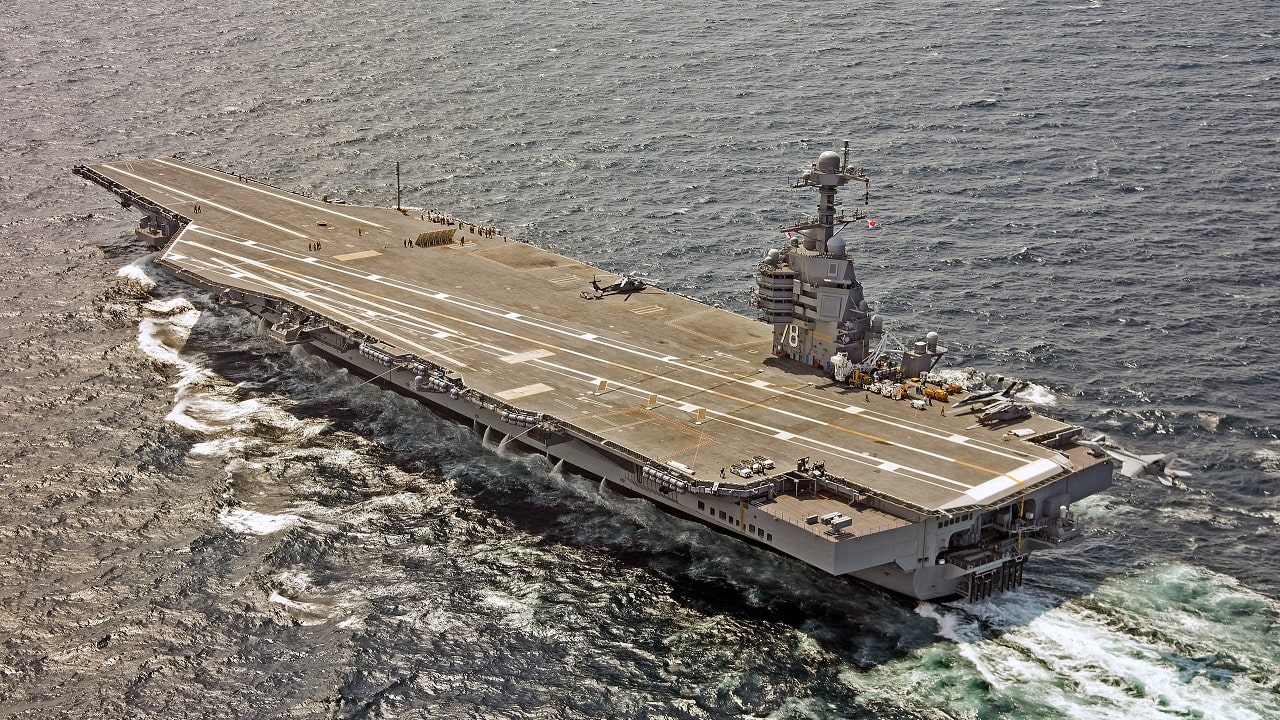
Key Points and Summary – China’s Type 003 Fujian has been commissioned, giving the PLAN its first CATOBAR aircraft carrier with electromagnetic catapults and a clear signal of intent.
-Now attention is shifting to the rumored Type 004: open-source indicators suggest China may be moving toward a nuclear-powered supercarrier designed for longer endurance and higher electrical margins.

China Aircraft Carrier. Image Credit: Creative Commons.

(September 24, 2021). The navy’s only forward deployed aircraft carrier USS Ronald Reagan (CVN 76) transits the South China Sea. Reagan is attached to Commander, Task Force 70/Carrier Strike Group 5 conducting underway operations in support of a free and open Indo-Pacific. (U.S. Navy Photo by Mass Communication Specialist 1st Class Rawad Madanat)
-Even if that proves true, the United States retains a major advantage in decades of Naval Reactors experience, carrier air wing integration, and global sustainment.
-Fujian’s real test is turning sea trials into routine, safe, high-tempo flight operations—especially as J-35 integration matures and regional missile threats keep rising steadily.
The U.S. Still Has One Big Carrier Advantage China Can’t Build Overnight
China’s newest aircraft carrier, the Type 003 Fujian, just officially entered service.
While it’s a conventionally-powered carrier, its larger cousin – the Type 004 – is not.
The upcoming nuclear-powered supercarrier, designed to compete with the United States’ Ford-class, marks an important inflection in the regional naval power balance.
It will allow China to project power over great distances – more than it will soon be capable of with the Fujian and a fleet of new, stealthy J-35s.
And, if carriers remain relevant into the future, they could quickly put Beijing on par with Washington if it continues to ramp up its industrial capacity at a pace the United States cannot match.
The United States Navy has operated nuclear-powered supercarriers for decades, giving it a deep understanding of these platforms and a significant operational advantage. But at the same time, America’s shipbuilding capacity is limited.
With the arrival of long-range missile technology that can counter even the biggest, most formidable carriers, it’s possible that China catching up on multiple threats could pose a significant threat to the U.S. Navy in the years to come.

A Sailor directs an F/A-18E Super Hornet from the “Kestrels” of Strike Fighter Squadron (VFA) 137 on the flight deck of the aircraft carrier USS Nimitz (CVN 68) in the South China Sea, May 12, 2025. Nimitz is underway in the U.S. 7th Fleet area of operations on a scheduled deployment, demonstrating the U.S. Navy’s unwavering commitment to a free and open Indo-Pacific. (U.S. Navy Photo by Mass Communication Specialist Seaman Apprentice Franklyn M. Guage)

(Feb. 25, 2019) The aircraft carrier USS John C. Stennis (CVN 74) transits the South China Sea at sunset, Feb. 25, 2019. The John C. Stennis Carrier Strike Group is deployed to the U.S. 7th Fleet area of operations in support of security and stability in the Indo-Pacific region. (U.S. Navy photo by Mass Communication Specialist 1st Class Ryan D. McLearnon/Released)

SOUTH CHINA SEA (Jan. 17, 2025) – The Nimitz-class aircraft carrier USS Carl Vinson (CVN 70) transits the South China Sea during a Maritime Cooperative Activity with the Philippine Navy, Jan. 17, 2025. The U.S. and Philippines work together as allies, enhancing the interoperability of maritime forces and supporting their shared goal of a free and open Indo-Pacific. Carrier Strike Group ONE, is underway conducting routine operations in the U.S. 7th Fleet area of operations. (U.S. Navy photo by Mass Communication Specialist 3rd Class Brianna Walker)
America Did It first
Since the launch of the USS Enterprise (CVN-65) in 1960, the U.S. Navy has built and operated nuclear-powered aircraft carriers as its core power-projection platform.
These platforms have long defined American global military presence, allowing its Navy and Air Force to dominate the seas and skies from thousands of miles away.
The current backbone comprises the Nimitz-class and Ford-class carriers, all of which are nuclear-powered and built at U.S. yards under the Naval Reactors program.
The Nimitz-class uses two A4W reactors, can travel at speeds of over 30 knots, and requires no refueling for more than 20 years.
Nuclear propulsion, in this sense, is truly remarkable: it means carriers can remain at sea for extremely long periods, docking only when necessary for maintenance.
It provides a virtually unlimited range, huge electrical power generation capacity, and speed. These are the ultimate global carriers – and that’s precisely why China wants and needs its own.
But while China is about to prove it is technically capable of building these machines, the United States has the institutional know-how and experience to ensure reactor safety.
And, in theory, the U.S. knows how to manage shipyard logistics – even if it is coming under strain as demand outstrips the country’s shipbuilding and maintenance capacity.
The United States also has decades of experience in carrier aviation operations – something that China will soon learn as it begins to deploy J-35s to its Type 003 Fujian carrier.

J-35 Fighter Chinese State Media Photo.
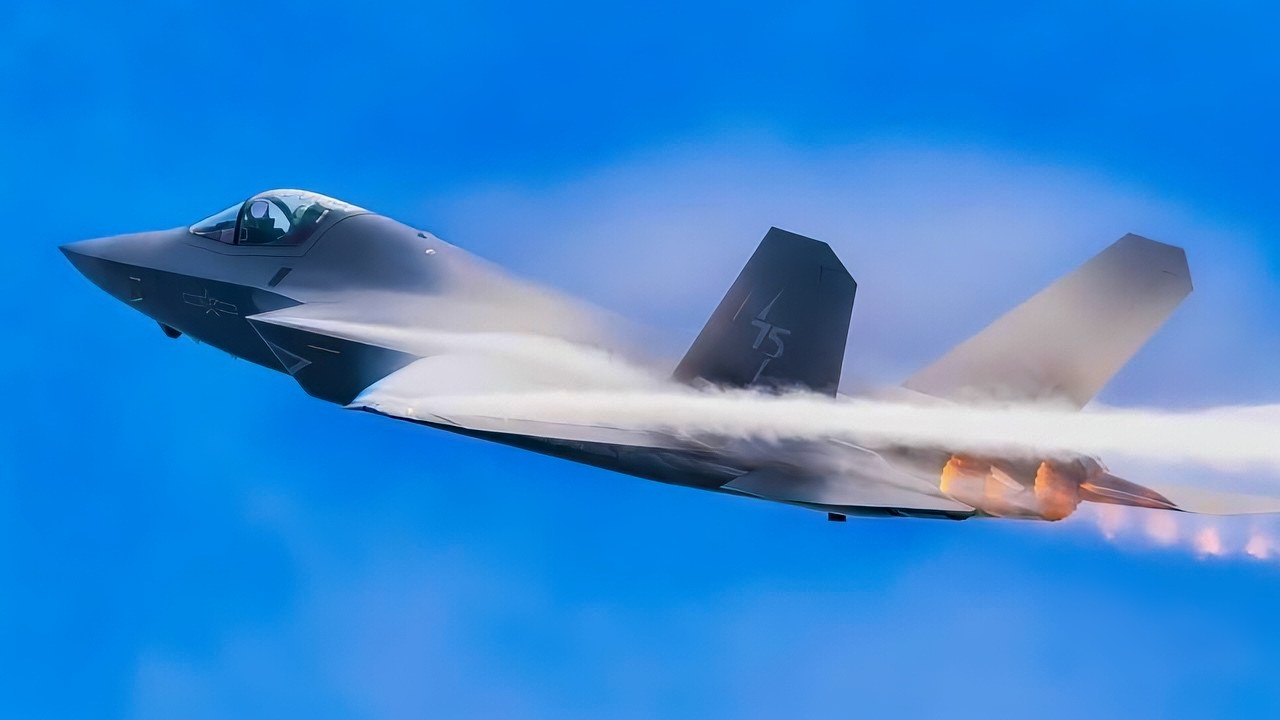
J-35A Fighter in the Clouds. Image Credit: Chinese Weibo.

J-35 China Weibo Screenshot.
Why Nuclear Matters
Nuclear propulsion is a massive edge for supercarriers.
Yes, it means that carriers don’t need to plan for refueling intervals like conventionally-powered carriers that are supported by tankers – but there’s still more to it than that.
First is the matter of operational flexibility.
These carriers can operate from global bases with minimal dependence on local infrastructure.
Then, there’s the fact that these carriers generate so much energy that they can support next-generation, advanced systems. For example, electromagnetic catapult launch systems (EMALS) require power to work, and nuclear power plants on board the carrier ensure that’s possible at all times.
Next-generation radars and future directed-energy weapons can be fueled by these onboard generators, too.
Nuclear won’t just power carriers into the future, but also a range of new weapons—including some that haven’t even matured yet.
China isn’t just betting on long-range missiles, but on a way to power future weapons.
In effect, nuclear propulsion turns these carriers into a completely sovereign mobile base. It’s independent, sustainable, and has global reach.
The U.S. Navy’s 1 Big Advantage: Experience
China’s momentum in this space is very real.
The Fujian has just been deployed, and the Type 004 could be operationally ready by 2027, giving China a brand-new, competent global carrier fleet.
But nuclear-carrier capability isn’t only measured in terms of the ships that are laid down.
China notably lags in terms of experience and operational integration.
The U.S. has problems, and few analysts would argue otherwise; shipbuilding capacity is a major concern that deserves far more attention than it currently gets.
But at the end of the day, the U.S. has decades of experience in reactor operations, along with carrier aviation experience that Chinese pilots don’t even come close to matching. And then there’s the matter of global logistics chains.
Conventional power may allow China to build large carriers like the Fujian quickly. The Type 004 will also prove that China can, in theory, catch up to the United States.
But a handful of carriers is no match for the United States’ large fleet and decades of experience in this field.
Beijing, even after eventually deploying the Type 004, will lag behind the United States for years and will remain on a learning curve for potentially a decade or more. And then there’s the matter of equipping these ships with vast fleets of next-generation aircraft.
That said, China’s arrival as a serious carrier power will dramatically shift calculations in the Indo-Pacific in the near term – and who knows how much could change over the coming decades?
About the Author:
Jack Buckby is a British author, counter-extremism researcher, and journalist based in New York. Reporting on the U.K., Europe, and the U.S., he works to analyze and understand left-wing and right-wing radicalization, and reports on Western governments’ approaches to the pressing issues of today. His books and research papers explore these themes and propose pragmatic solutions to our increasingly polarized society. His latest book is The Truth Teller: RFK Jr. and the Case for a Post-Partisan Presidency.


James Moore
November 11, 2025 at 3:32 pm
Yeah, the one thing is they’re better. Next question.
Ray
November 11, 2025 at 10:22 pm
Several issues. In this age, carriers cannot hide like they did in WW2. They are a projection of power, but America seems to assume China will project across the Pacific. They don’t have to in this modern age. They merely need to delay America from getting closer to the Asia mainland. Carriers are highly vulnerable to UWLV that will form a defensive fence mid Pacific. Seems military minds are projecting past engagements on the future with our taking into account technology.
Simon Wong
November 12, 2025 at 1:53 am
China is a Turtle and USA is the rabbit… But for the Turtle every steps count.