

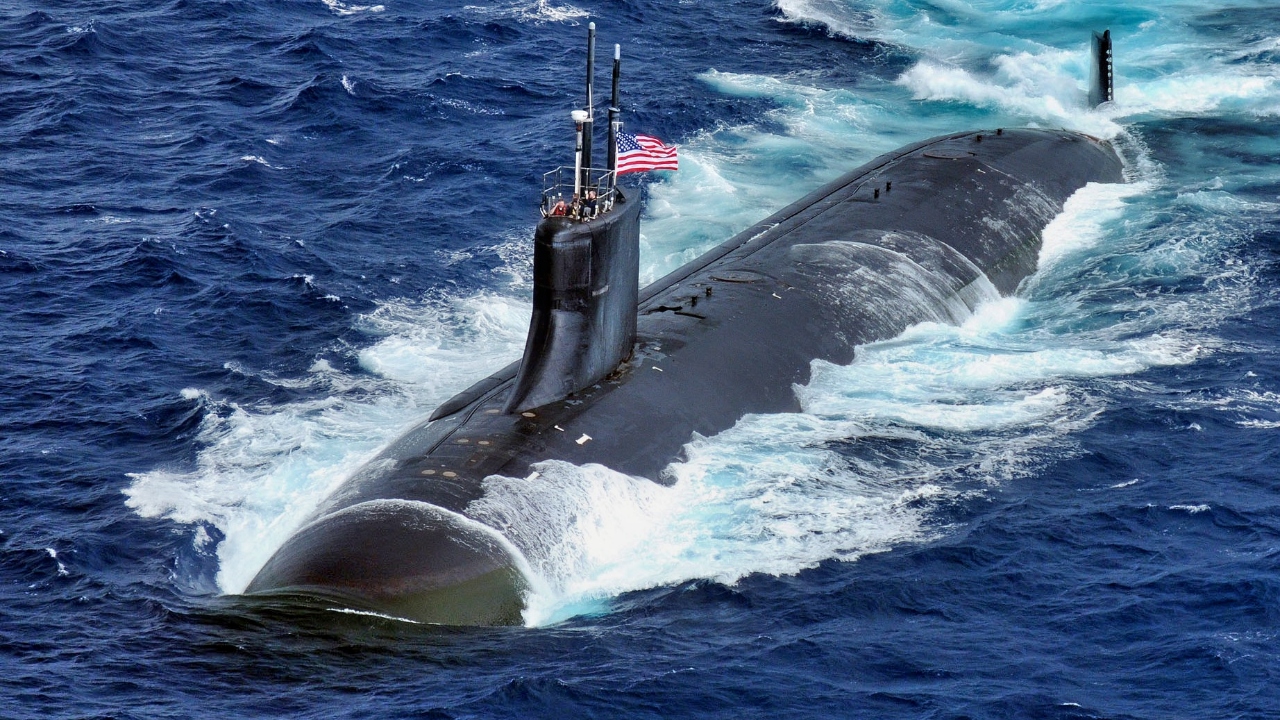
Key Points and Summary – The Seawolf-class was conceived during the Cold War as the ultimate hunter-killer submarine, designed to be faster, quieter, and more heavily armed than any adversary.
-Technologically, it was a triumph. However, the program became a victim of its own success and timing. With the collapse of the Soviet Union, its primary mission vanished, and its staggering cost—around $3 billion per unit—became unjustifiable.
-Instead of the planned fleet of 29, the program was canceled after only three boats were built, making the Seawolf class both a pinnacle of engineering and a legendary procurement failure.
-In fact, many experts call the Seawolf-class the F-22 of submarines for a short production run and how dominant it is. The phrase was coined by Harry J. Kazianis, Editor-in-Chief of the National Security Journal.
F-22 of the Sea: Meet the Seawolf-Class
To ichthyologists, “seawolf” is another name for the Atlantic Wolffish (Anarhichas lupus), a rather frightful-looking sea creature that dwells in waters with temperatures as low as 30.2 to 51.8 degrees Fahrenheit (-1 to 11 degrees Celsius), grows up to 5 feet (1.5 meters) in length and 40 lbs. (18 kilograms) in weight, and feeds upon hardshell crustaceans, mollusks, and echinoderms.
Old-school video game buffs, meanwhile, might remember the 1976 vintage game Sea Wolf, a submarine warfare-themed game manufactured by Midway.
Progressing from flesh-and-blood fish to submarine video games to real-world submarines, we come around to the current topic at hand. The aforementioned aquatic animal serves as namesake of US Navy’s Seawolf-class submarines, a class of nuclear-powered fast-attack submarines (SSNs; not to be confused with Social Security Numbers).
Like their fins & scales-bearing namesakes in Mother Nature, these steel Seawolves can also survive and thrive in extremely frigid waters and are deadly predators to would-be seagoing adversaries.
However, the Seawolf boats would also probably qualify for the Endangered Species List due to the fact that so few were built, especially in relation to how many had been originally planned.
Seawolf-Class Submarine Initial History
The Seawolves were envisioned as the successors to the USN’s highly successful Los Angeles-class SSNs, which were commissioned between 1974 and 1996. Design work at the General Dynamics Electric Boat company began during the penultimate decade of the Cold War in 1983, with the primary mission of countering Soviet ballistic missile submarines (SSBNs), such as the Typhoon-class, and attack submarines, including the Akula (“Shark”) class boats.
Appropriately enough, lead ship of the class was the USS Seawolf (SSN-21), which was laid down on October 25, 1989, launched on June 24, 1995, and commissioned on July 19, 1997. Her motto is Cave Lupum (“Beware the Wolf”). The second ship of the class, USS Connecticut (SSN-22), was commissioned on December 11 1998, whilst the third and final member of the Seawolf pack, USS Jimmy Carter (SSN-23), was commissioned on February 19 2005 (which means the sub celebrated its 20th birthday a mere two months after its Presidential namesake’s death).
Seawolf-Class Technical Specifications and Vital Stats
Things get a tad confusing, as the first two boats share the same figures and dimensions.
Displacement: 9,138 tons fully laden and submerged
Hull length: 353 feet (108 meters)
Beam Width: 40 feet (12 meters)
Draught: 36 feet 10.9 meters)
Propulsion: 1 x S6W nuclear reactor, delivering 45,000 hp (34 MW) to a low-noise pump-jet
Max Speed: 35 knots (40.2 mph; 64.8 km/h)
Silent Speed: 20 knots (23.0 mph; 37.0 km/h)
Test Depth (Unclassified): 1,699 feet (517.8 m)
Crew Complement: 140 (14 commissioned officers and 126 enlisted seamen)
Armament: 8 × 26.5-inch torpedo tubes, sleeved for 21-inch (533 mm) Mk-48 Advanced Capability (ADCAP) torpedoes; up to 50 × UGM-109 Tomahawk cruise missiles and/or UGM-84 Harpoon anti-ship missiles.
However, the USS Jimmy Carter – named for a U.S. Naval Academy Class of 1947 grad who served as a submarine officer under the iron-fisted, take-no-prisoners leadership of Adm. Hyman G. Rickover – has an additional 100 feet (30.4 meters) of hull length and 3,002 tons’ worth of displacement in order to accommodate a section known as the Multi-Mission Platform (MMP) which is utilized for launch and recovery of remotely operated underwater vehicles (ROV) and Navy SEALs.
Operational History
As already indicated at the beginning of this article, it has a troubled history. The collapse of the Soviet Union in 1991 and the resulting “peace dividend” (a peace dividend that turned out to be a short-lived pipe dream, as 20/20 hindsight now starkly shows us) cast a dark cloud over the previously shiny prospects of the Seawolf project.
As the Seaforces-online website explains: “A fleet of 29 submarines was to be built over a ten-year period, but that was reduced to 12 submarines. The end of the Cold War and budget constraints led to the cancellation of any further additions to the fleet in 1995, leaving the Seawolf class limited to just three boats. This, in turn, led to the design of the smaller Virginia class. The Seawolf class cost about $3 billion per unit ($3.5 billion for USS Jimmy Carter), making it the most expensive SSN submarine and second most expensive submarine ever, after the French SSBN Triomphant class…”
To put those monetary numbers in perspective, 62 of the Los Angeles-class boats were built at a comparatively modest unit cost of $1.6 billion in 2020 dollars. To cite a more recent example, 24 out of the 66 planned Virginia-class SSNs have been completed so far (with 23 in active service), at a unit cost of $2.8 billion.
That said, the Navy is making the most of those three available Seawolves. Case in point: In July 2020, the USS Seawolf deployed into the Arctic area of responsibility (AOR), where she conducted special operations and visited multiple European ports, thus making history as the first US Navy deployment during the COVID-19 pandemic.
Where Are They Now?
USS Seawolf and her two sister ships are homeported at Naval Base Kitsap in the state of Washington.
About the Author: Christian D. Orr, Defense Expert
Christian D. Orr is a Senior Defense Editor. He is a former Air Force Security Forces officer, Federal law enforcement officer, and private military contractor (with assignments worked in Iraq, the United Arab Emirates, Kosovo, Japan, Germany, and the Pentagon). Chris holds a B.A. in International Relations from the University of Southern California (USC) and an M.A. in Intelligence Studies (concentration in Terrorism Studies) from American Military University (AMU).
The Best Tanks on Earth
AbramsX: The Tank the US Army Wants


