


Summary and Key Points: The Iowa-class battleship became a legend in part because it was a triumph of industrial scale: millions of design hours, mountains of plans, and roughly 71,000 workers building a ship in about three years.
-In today’s dollars, a $100 million Iowa hull translates to roughly $1.65 billion—still cheaper than a $13 billion Ford-class supercarrier, but far from pocket change.

Top of USS Iowa. Image Credit: National Security Journal.

Iowa-Class Missile Launchers
-The bigger issue isn’t sticker price; it’s capacity.
-Modern shipbuilding is constrained by workforce shortages, supply-chain fragility, and the sheer complexity of sustaining large programs.
-A modern battleship could be reimagined with missiles and aviation support, but building it quickly is the real hurdle.
What Would a New Iowa-Class Battleship Cost Today? Here’s the Number.
The Iowa-Class Battleship Is a Legend: Now, here is a question you have not thought about much.
You may know your battleship history during World War II and even the Korean War, but you may not know how much a new battleship would cost in today’s dollars.
Before the aircraft carrier burst on the scene in the late 1930s and 1940s, battleships were the most expensive vessels in the U.S. Navy.
Back then, each Iowa-class battleship cost $100 million – a gargantuan sum for the time. That works out to $1.65 billion today.

Iowa-Class Battleship Secondary Guns. Image Credit: Harry J. Kazianis/National Security Journal.

Iowa-Class Battleship National Security Journal Visit from August 2025. Image Credit: Harry J. Kazianis.
That’s a bargain compared to the $13 billion Gerald R. Ford supercarrier, but still a pretty penny.
Millions of Man-Hours to Design Iowa-Class Battleship
The Iowa-class battleships required three million man-hours just to design them.
Now, despite the labor-intensive work, there was no intricate technology to slow down designers and workers.
Employees could pump out warships regularly during that era.
Could the United States build a fleet of battleships today? I seriously doubt it.
The American shipbuilding industry has seen better days. The Covid-19 pandemic created supply chain snarls and other delays that damaged shipyard work.
Plus, there were orders of magnitude more significant numbers of employees during World War Two. These days, it is difficult to fill even one position with a skilled worker.
We are no longer the arsenal of democracy with unlimited manpower.
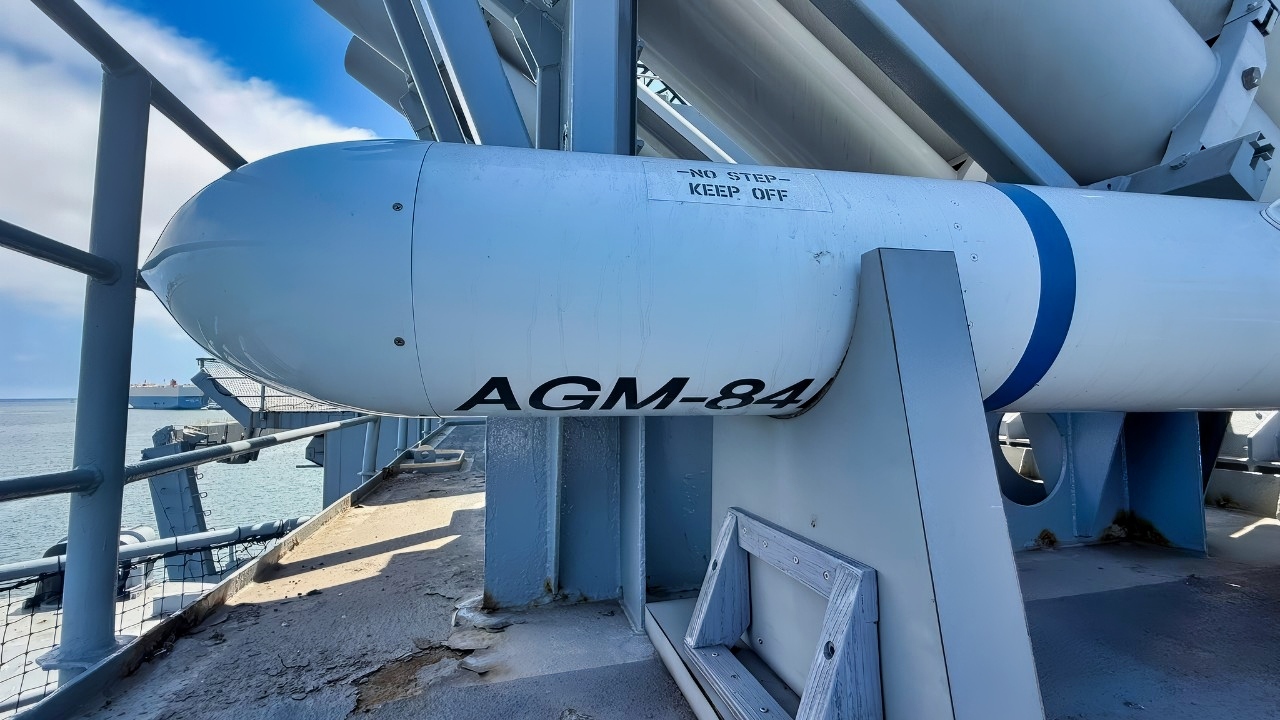
Harpoon Missile Onboard USS Iowa. Image Credit: National Security Journal.
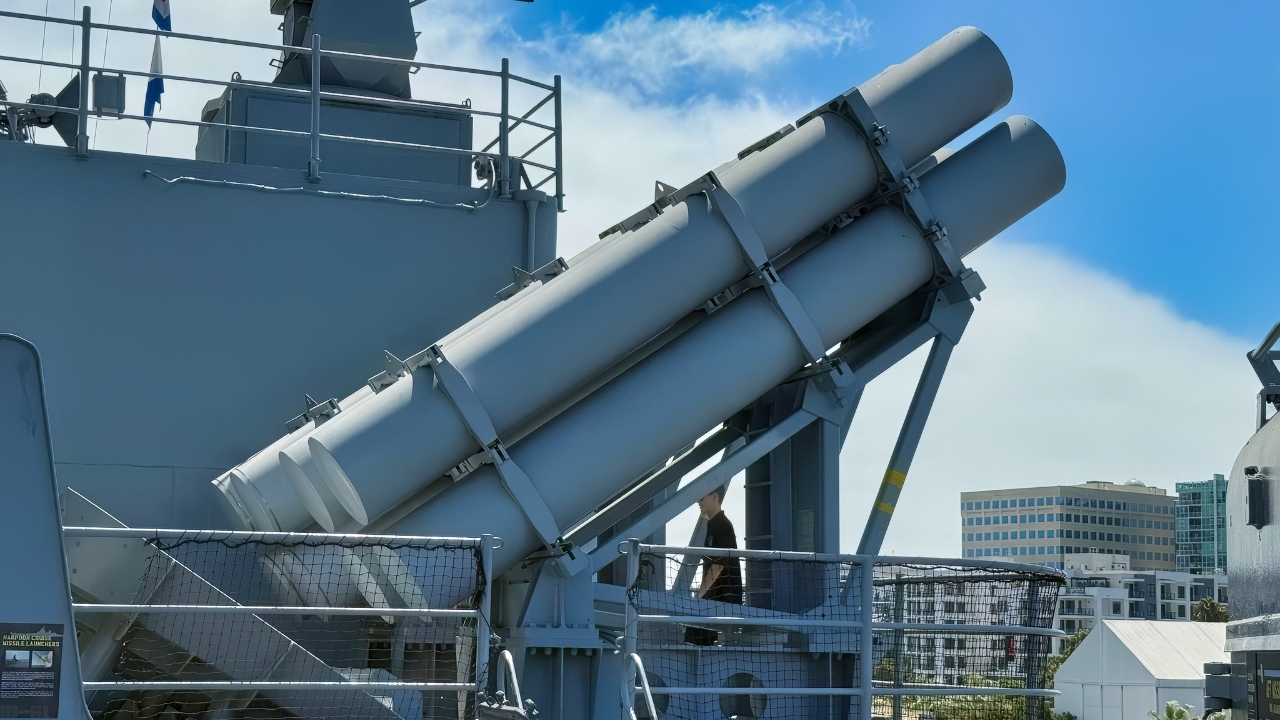
USS Iowa Harpoon Canister. Image Credit: Harry J. Kazianis/National Security Journal.

Missile Box on USS Iowa. Image Credit: National Security Journal.
Huge Amounts of Design Documents
The industry now uses computer-aided design and other modern methods to design a ship. But draftsmen did it the old-fashioned way during World War Two days, which meant many blueprints.
One battleship could create over 200 years of work for all the designers. For the Iowa-class, “The total completed plans reportedly weighed 175 tons, 30 inches in width and are 1,100 miles long when laid out,” according to the National Interest.
When it went into production mode – each battleship took nearly three years to build with 71,000 workers. Could you imagine that many employees toiling every day in this age?
Battleships Were Easier to Maintain and Could Be Taken Out of Retirement
Now I know what you are thinking. Due to the relative lack of high-tech features, the Iowa-class battleships were easier to maintain. Alternatively, it can take five to six years for a Nimitz-class aircraft carrier to refit and refuel its nuclear reactors.
Once an Iowa-class battleship was taken out of service, it could be returned to duty when war broke out. This happened during the Korean War and at the end of the Cold War during the Reagan-era when the Iowa-class dreadnoughts were pulled out of retirement.
It would be interesting to see what a battleship could do in 2024. Would it have space for helicopters? Could it fire anti-ship missiles or even hypersonic weapons? It would be fast enough to escort aircraft carriers, and it could definitely bombard enemy positions on shore.
I’m just not sure the U.S. shipbuilding industry could produce them promptly, though. There is no way you could find 71,000 skilled shipbuilders these days. The only country that can surge workers like that is China, which has the best shipbuilding industry in the world.
A Battleship Would Be Difficult If Not Impossible to Build
No, the only large vessels Americans can produce are the Ford-class carriers. The Gerald R. Ford has already succumbed to delays and cost overruns.
The era of an army of shipyard workers working three shifts a day, even on weekends, is over. We couldn’t build another battleship even if Congress passed a law to produce the huge vessels tomorrow.
But it is fun to speculate. We should give the old-school designers, engineers, and workers credit for being able to produce such large ships. We may never see such a concerted effort again.
Hopefully, readers of this article will realize just how much the United States needs to catch up in naval shipbuilding. It is time for a wake-up call to the defense industrial base to take it up a notch.
Otherwise, the United States will lose its warfighting edge and ability to project naval power. That is just what the country’s enemies are hoping for.
About the Author: Dr. Brent M. Eastwood
Brent M. Eastwood, PhD, is the author of Don’t Turn Your Back On the World: a Conservative Foreign Policy and Humans, Machines, and Data: Future Trends in Warfare, plus two other books. Brent was the founder and CEO of a tech firm that predicted world events using artificial intelligence. He served as a legislative fellow for U.S. Senator Tim Scott and advised the senator on defense and foreign policy issues. He has taught at American University, George Washington University, and George Mason University. Brent is a former U.S. Army Infantry officer. He can be followed on X @BMEastwood.


Weldor
February 16, 2026 at 9:53 pm
Wow talking about being a traitor and not knowing what the capabilities of a determined weldor or a weldors true work ethics. If it came down to it I guarantee weldors could push out a new warship in no time if had to working even 2 12 hour shifts. I know myself have worked 20 hours a day and turned around and back to work 4 hours later for months on end 7 days a week. Thanks for showing Americans just how much faith you have in us traitor.